

TL;DR:
- Care coordinators manage complex care plans, advocate for patients, and connect families with community resources. Their role involves multi-level communication, personalized support, and bridging systemic gaps to improve health outcomes. Families can enhance results by actively engaging, sharing information, and advocating for their loved ones’ specific needs.
When a loved one needs ongoing support, whether due to age, disability, or a complex health condition, the people involved in their care can quickly multiply. Doctors, nurses, therapists, social workers, and home carers all play a part. The role of care coordinators is to hold all of this together. Yet many families underestimate what this role actually involves, assuming it is mainly about scheduling appointments. In reality, care coordinators manage complex webs of care, advocate for patients, and make sure nothing falls through the gaps. This guide explains what they do and how you can work alongside them.
Table of Contents
- Key takeaways
- Core functions and responsibilities of care coordinators
- How care coordination works at multiple levels
- What research tells us about care coordination outcomes
- How families can work effectively with care coordinators
- Different types of care coordinators and where they work
- My perspective on what families really need to know
- How Kells-care supports families through care coordination
- FAQ
Key takeaways
| Point | Details |
|---|---|
| More than scheduling | Care coordinators develop care plans, advocate for patients, and connect families with community resources. |
| Multi-level coordination | Effective care coordination works across individual, organisational, and system levels, not just one-to-one. |
| Active family participation | Families who engage fully with care coordinators see significantly better outcomes for their loved ones. |
| Targeted support works best | Care coordination is most effective when directed at people with genuine gaps in their current support. |
| Different settings, different roles | Hospital, community, and domiciliary care coordinators each serve distinct but connected functions. |
Core functions and responsibilities of care coordinators
Care coordination is far more than a logistical role. A care coordinator’s day can involve reviewing medical histories, speaking with consultants, liaising with social services, and sitting down with a family to explain what a new diagnosis means in practical terms. The breadth of care coordinator responsibilities is what makes the role so valuable, and so easily misunderstood.
The core duties typically include:
- Consulting with clients and families about health needs, current treatments, and personal goals
- Developing personalised care plans that align with input from GPs, specialists, therapists, and home carers
- Monitoring progress over time and adjusting plans when circumstances change
- Advocating for the patient’s interests when dealing with healthcare providers or funding bodies
- Educating families about care options, medication management, and what to expect from different services
- Connecting clients with community resources such as transport services, financial support, or voluntary organisations
- Ensuring confidentiality and maintaining accurate records across all involved parties
One aspect families often overlook is medication management. Care coordinators help ensure safe medication use by checking for interactions, confirming prescriptions are being followed correctly, and flagging concerns to the relevant clinician before they escalate.
Pro Tip: Keep a written log of every professional involved in your relative’s care, including their role and contact details. Share this with the care coordinator at your first meeting. It saves significant time and helps them build an accurate picture from day one.
The importance of care coordinators also lies in what they prevent. Without someone actively joining the dots, a person might see five different clinicians who each treat one part of a problem without communicating with each other. The care coordinator stops that fragmentation.
How care coordination works at multiple levels
Understanding the functions of care coordinators means looking beyond the individual relationship between coordinator and client. Effective coordination operates across three distinct levels, and each one shapes how well support actually works in practice.
| Level | What it involves | What can go wrong |
|---|---|---|
| Individual | Communication between patient, family, and coordinator; patient involvement in decisions | Poor communication, low patient engagement, unclear goals |
| Organisational | Defined roles, shared tools, stable teams, manageable caseloads | Role overlap, high staff turnover, inconsistent handovers |
| System | Governance, financing, interoperable information systems, cross-sector integration | Fragmented systems, poor data sharing, siloed services |
At the individual level, the quality of the relationship matters enormously. A coordinator who takes time to understand a person’s daily routine, preferences, and fears will build trust. That trust is what makes a client willing to act on advice.
At the organisational level, care coordination effectiveness depends on whether teams have the right tools, clear responsibilities, and enough stability to build ongoing relationships. High staff turnover undermines this quickly.
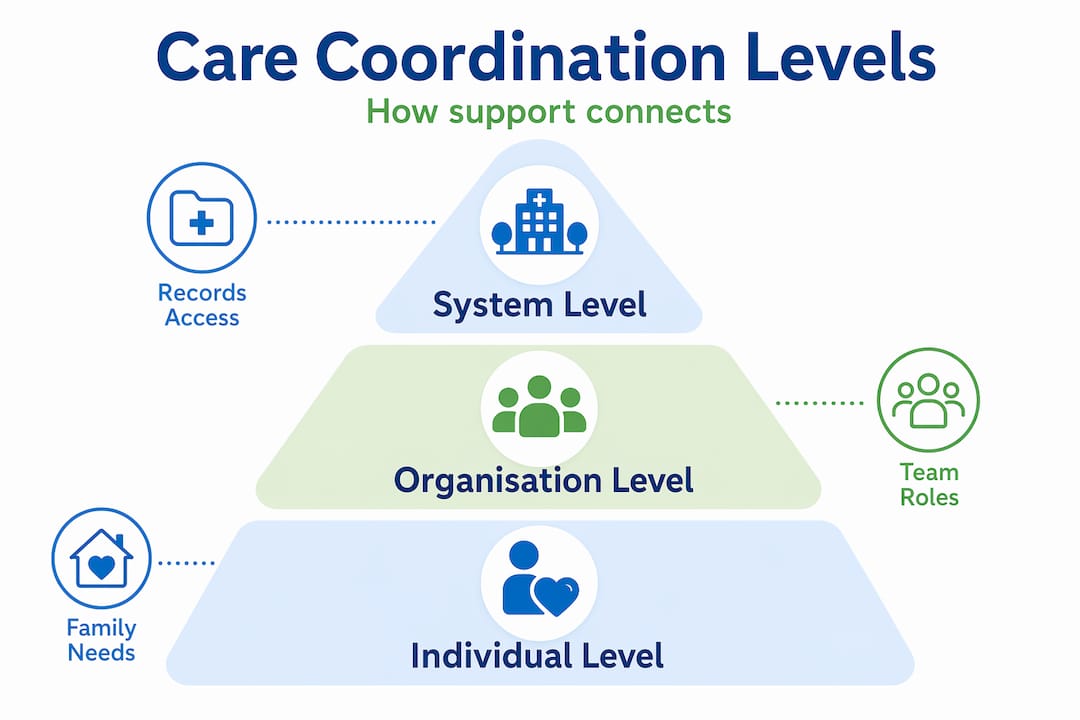
At the system level, fragmented healthcare infrastructure creates real barriers. When a hospital’s records cannot be accessed by a community nurse, the coordinator must manually bridge that gap. This takes time away from direct client support.
Pro Tip: When meeting a new care coordinator, ask which other professionals and services they regularly work with. This gives you a clear sense of how connected their network is and whether any gaps need to be filled.
What research tells us about care coordination outcomes
It is worth being clear-eyed about what care coordination can and cannot achieve. A 2026 randomised clinical trial involving 400 older adults with or at risk of cardiovascular disease found that proactive care coordination did not significantly reduce emergency hospital visits or admissions. Many participants declined the offer of coordination, saying they felt they already managed their own care effectively.
This does not mean care coordination fails. It means it works best when targeted at people who genuinely have coordination gaps, not applied universally as a precaution. Targeted interventions that meet people where their needs are greatest produce far better results than broad-brush programmes.
The contrast with real-world programme data is striking. UCHealth’s Mobile Assessment and Care Coordination programme, known as MACC, used 11 full-time coordinators to support over 300 clients, and achieved stabilisation for 70% of those clients. The difference? Coordinators focused on clients who were genuinely struggling, provided comprehensive support including help with home improvements, and maintained ongoing advocacy over time.
What this research tells families is important. Care coordination is not a quick fix. It requires a committed relationship, active client engagement, and support that is genuinely tailored to the individual. When those conditions are met, the outcomes can be life-changing.
How families can work effectively with care coordinators
Your involvement as a family member is not peripheral. It is one of the strongest predictors of whether care coordination will actually help your relative. Here is how to make the most of the relationship.
- Understand your own role. You are not a passive observer. You hold knowledge about your relative’s history, personality, preferences, and daily habits that no professional can easily access. Share this openly.
- Communicate clearly and regularly. Do not wait for a problem to become a crisis before contacting the coordinator. Regular, brief updates keep everyone aligned. Learning how to communicate with carers effectively will also strengthen this dynamic.
- Ask questions without hesitation. If you do not understand why a particular service has been arranged, or why a care plan has changed, ask. A good coordinator will welcome the dialogue.
- Advocate for your relative’s preferences. Care coordinators work best when they know what matters to the person at the centre of the plan. If your loved one values independence above all else, make that explicit and revisit it regularly.
- Seek support when transitions happen. Post-hospital discharge is one of the highest-risk periods for older adults. Transitional care management typically involves contact within two business days after discharge, followed by a 30-day period of active support. Make sure you know who to call during this window.
- Recognise when coordination is missing. If your relative is seeing multiple clinicians who do not seem to be talking to each other, that is a coordination gap. You can request a care coordinator through your relative’s GP or local authority.
Pro Tip: Before any medical appointment, write down the two or three most pressing concerns you want addressed. Pass this to the care coordinator beforehand so they can flag your priorities and make sure they are covered during the consultation.
Families who take an active role in the coordination process contribute strongly to better outcomes. Your engagement is not just helpful. It is part of the care itself.

Different types of care coordinators and where they work
Not all care coordinators do the same job. The setting shapes both the focus and the daily activities of the role significantly.
- Hospital-based care coordinators typically manage discharge planning. They assess a patient’s needs before they leave hospital, arrange follow-up appointments, and connect them with community services. Their window of contact is often short but critical.
- Community care coordinators work with people who are living at home or in supported housing. They manage longer-term care plans, coordinate between GPs and specialist services, and often carry caseloads that span many months or years.
- Domiciliary care coordinators focus specifically on arranging and overseeing home care services. They match clients with appropriate carers, review care plans at regular intervals, and act as the point of contact between families and the care agency. At Kells-care, this is a central part of how our home care services are delivered.
- Primary care coordinators are embedded in GP practices. They help patients with complex or multiple conditions navigate their care more effectively, reducing unnecessary hospital visits.
- Social care coordinators often overlap with the role of social workers. They assess care needs under local authority frameworks and arrange funded support packages. Families in London can learn more about how these roles connect in the role of social workers in care.
Across all of these settings, care coordinators connect clinical care with social and community support. A hospital coordinator might refer a patient to a food bank. A community coordinator might arrange adaptations to a home. The title is similar; the context varies considerably.
My perspective on what families really need to know
I have seen families arrive at care coordination with two very different expectations. Some expect a coordinator to take full control and fix everything. Others treat the coordinator as a bureaucratic necessity, someone to tick a box. Both approaches miss the point.
In my experience, the families who get the best outcomes are those who treat the care coordinator as a genuine partner. They bring information, ask honest questions, and stay engaged even when things are going well. They do not disappear between reviews.
What most families misunderstand is that care coordination is only as good as the system it operates within. A skilled, committed coordinator working in a fragmented system with poor data sharing will still struggle. You can help by providing consistent, written updates, keeping a record of every service involved, and raising concerns early rather than waiting for things to deteriorate.
I also think it matters that families understand the research honestly. Care coordination will not automatically reduce hospital admissions or solve every gap. What it can do, when properly targeted and actively supported, is significantly improve daily quality of life, reduce unnecessary duplication, and make sure your loved one’s voice is heard across every part of their care.
Advocate for coordination that fits your relative’s actual needs. And stay involved. That is the single most useful thing you can do.
— Dan
How Kells-care supports families through care coordination
At Kells-care, we have been delivering personalised home care across London for over 30 years. We know that coordinating care for a loved one at home takes more than good intentions. It takes experienced, qualified carers and clear communication between everyone involved.
Our care coordinators work closely with families, GPs, and other health professionals to build and review care plans that genuinely reflect each client’s needs. Whether your relative requires a daily check-in visit or round-the-clock support, we adapt our services as circumstances change.
If you are at the start of this process and are not sure where to begin, download our free home care guide for practical, straightforward advice on arranging home care in North London. You can also explore what domiciliary care involves and how it connects with care coordination. Our team is happy to speak with you about your family’s situation. All of our carers are fully qualified, DBS checked, and regulated by the Care Quality Commission.
FAQ
What does a care coordinator actually do?
A care coordinator manages a person’s care across multiple providers, developing personalised care plans, monitoring progress, and advocating for the patient’s interests. They also connect clients with community resources and educate families about care options.
How do care coordinators help elderly people at home?
Care coordinators help elderly people at home by linking medical, social, and community services into a single coherent plan. They reduce the risk of duplication, missed appointments, and medication errors.
Is care coordination the same as case management?
The terms are sometimes used interchangeably, but care coordination tends to focus on connecting services and communication across providers, while case management often includes a broader remit covering legal, financial, and social support.
When should a family ask for a care coordinator?
If your relative is seeing several specialists who do not appear to be communicating, or if they have recently been discharged from hospital, this is the right time to request care coordination through their GP or local authority.
Does care coordination reduce hospital admissions?
Research shows care coordination does not automatically reduce hospitalisations for all patients. It is most effective when targeted at individuals with genuine coordination gaps and delivered with active client and family participation.

