
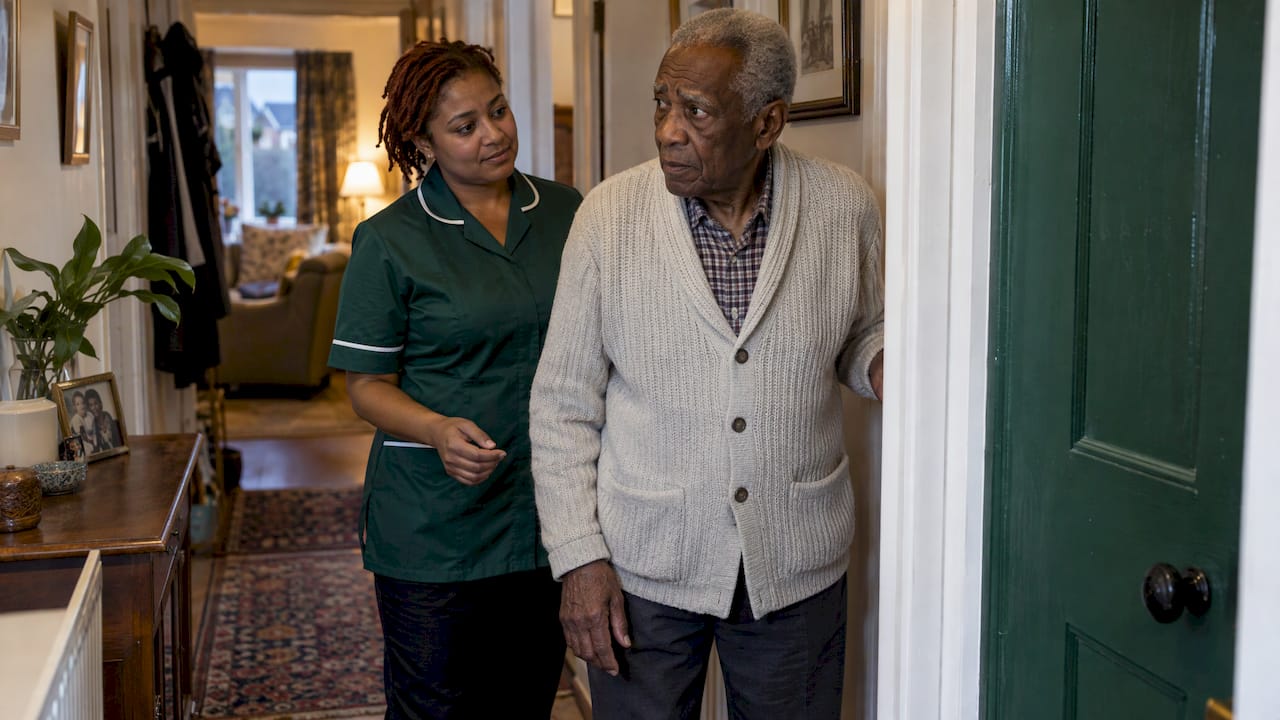
Live-in care is worth considering when your relative needs help at several points across the day and night, not just at set visit times. Typical signs are repeated falls, missed medication, wandering or confusion in the evening, a home that is no longer safe, and a family carer who is running on empty. If you recognise two or three of these together, a conversation about live-in care is a sensible next step. At Kells Domiciliary Care we have provided home care across London for over 30 years, and live-in care in London is one of the services we arrange.
TL;DR
- Live-in care suits people who need support through the day and night, or whose needs change faster than scheduled visits can cover.
- The clearest signs are falls, missed or doubled medication, poor nutrition, neglected hygiene, night-time confusion and growing isolation.
- A family carer’s exhaustion is a valid reason to arrange more help, not a failure.
- Ask for a needs assessment from your local council, and work out early whether you will be funding care yourself.
- A live-in carer needs a private bedroom and proper breaks, so plan the home as well as the care.
Table of Contents
- Why visits can stop being enough
- Signs in your relative’s daily life
- Signs in the family
- A quick way to weigh it up
- Deciding together
- What a live-in carer needs at home
- Paying for care at home
- Perspective
- Talk to us about live-in care
- FAQ
- Sources
Why visits can stop being enough
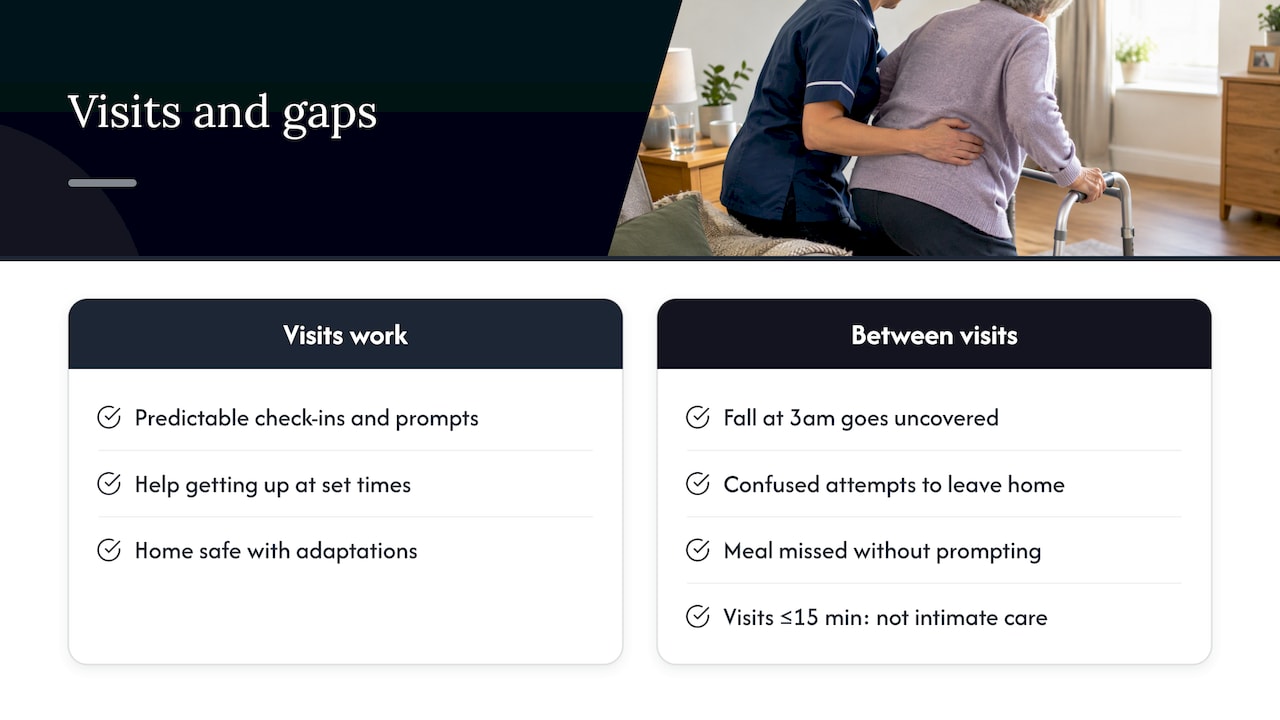
Call-in visits work well when someone needs a check-in, help getting up, a meal prepared or medication prompted at a predictable time. The NHS says home care can suit people who find routines such as washing, dressing and getting out difficult, who do not want to move into a care home, and who can get around their home safely or make it safe with adaptations.
The gap appears between visits. Short visits cannot cover a fall at 3am, a person who gets up confused and tries to leave the house, or a meal that is never eaten because no one is there to prompt it. Official guidance quoted by Age UK is clear that visits of 15 minutes or less are not appropriate where someone needs help with intimate care. They may suit a quick check that someone is home safely, or that medication has been taken.
If you are seeing the signs below on a regular basis, the question is no longer whether your relative needs help. It is whether help at fixed times is enough.
Signs in your relative’s daily life
Falls, near-falls and difficulty moving
One stumble is worth noting. Repeated falls, furniture-walking, holding walls, bruises with no explanation or a fear of using the stairs suggest the risk is rising. If your relative cannot get to the toilet safely at night, visits will not solve it. Our guide to what mobility support involves explains the practical help a carer can give. Gentle balance work can also help some older people stay steadier, and this guide to balance exercises for seniors covers the basics, though it does not replace someone being present.
Missed or muddled medication
Pills left in the packet, empty days in the dosette box, or doses taken twice are among the most serious signs. A prompt at a set visit time does not help if the person forgets again an hour later. Someone in the house can remind, observe and report changes to the family and the GP. Our medication assistance service covers this at the level of support your relative needs.
Weight loss, poor nutrition and an empty fridge
Brent Council lists weight loss or poor nutrition among the signs of self-neglect, alongside poor personal hygiene or an unkempt appearance, unsanitary living conditions, missed appointments and withdrawal from social activities. Look for out-of-date food, the same meal repeatedly, or clothes that now hang loose.
Changes in hygiene and the home
Someone who once showered daily and now wears the same clothes for days, a house with piles of post, unwashed dishes or a smell that was not there before: these are common signs that daily tasks are overwhelming. They are rarely about laziness. They often point to memory loss, low mood, pain or fear of falling in the bathroom. Our guide to personal care routines shows what dignified support looks like.
Memory, confusion and behaviour changes
Getting lost on a familiar route, leaving the gas on, answering the door to strangers, or becoming agitated and restless in the evening all raise the question of supervision. If you are caring for someone with dementia, round-the-clock presence can offer a steady, familiar face and routine. See our page on dementia care at home in London and our guide to dementia behaviour management.
Loneliness and withdrawal
Stopping calls, dropping clubs and church, refusing visitors or no longer leaving the house can signal low mood, anxiety or worry about coping. Brent Council also lists withdrawal and reluctance to accept help as signs worth acting on. Where self-neglect puts health or safety at serious risk, it advises talking to the person, encouraging them to accept help and contacting their GP or healthcare provider.
Signs in the family
When you are the one running on empty
Carers UK says that when caring becomes too physically or mentally exhausting, arranging the best professional care possible is a natural step rather than struggling on until crisis point. It also notes that sadness and guilt commonly come alongside relief.
Warning signs include poor sleep, frequent headaches, appetite changes, frequent illness, irritability, resentment, helplessness, isolation and low mood. Lymphoma Action lists these, and Carers UK’s Jane Butler advises acting on increasing fatigue and lack of sleep. Our caregiver burnout checks take a few minutes.
You are entitled to a carer’s assessment whatever your level of need, the amount of care you give or your finances, according to Carers UK. It covers your health, work, relationships and planning for emergencies.
Needs that are growing in complexity
Some situations need more than one pair of hands or more skill: advanced dementia, a life-limiting illness, or conditions needing frequent attention day and night. Carers UK lists a complex medical condition, such as needing to be regularly turned to avoid bed sores, as a point at which families should review the level of care. Our complex care at home service is built for these needs.
A quick way to weigh it up
| What you notice | Visits may be enough | Live-in care is worth discussing |
|---|---|---|
| Falls | One-off, no injury | Repeated, or at night |
| Medication | Occasional prompt needed | Missed or doubled doses |
| Food | Needs a meal prepared | Weight loss, not eating without prompting |
| Memory | Forgets appointments | Wandering, unsafe at home alone |
| Nights | Sleeps through | Wakes confused, needs help to the toilet |
| Family carer | Manageable with breaks | Exhausted, ill or unable to continue |
This is a guide to start a conversation, not a diagnosis. Raise memory or health changes with the GP.
Deciding together
NICE guidance on home care says care plans should ask people about their aspirations, needs and priorities, what gives them peace of mind and what makes them feel safe or unsafe. Start there. Many people fear losing independence, so talk about staying in their own home, with their own things and routines.
A few practical steps:
- Talk early and gently. Ask what is hardest, not what they cannot do.
- Write down what you have seen. Dates of falls, missed medication and meals help in conversations with the GP and the council.
- Request a needs assessment from your local council’s adult social care team.
- Compare options. Our guide to alternatives to care homes sets out what is available. For couples, live-in care for couples lets two people stay together at home.
- Agree boundaries on duties and time off before care begins, using our guide to live-in carer boundaries.
For families with a young adult who has a disability, see live-in care for young adults and our learning disability and autism support.
What a live-in carer needs at home
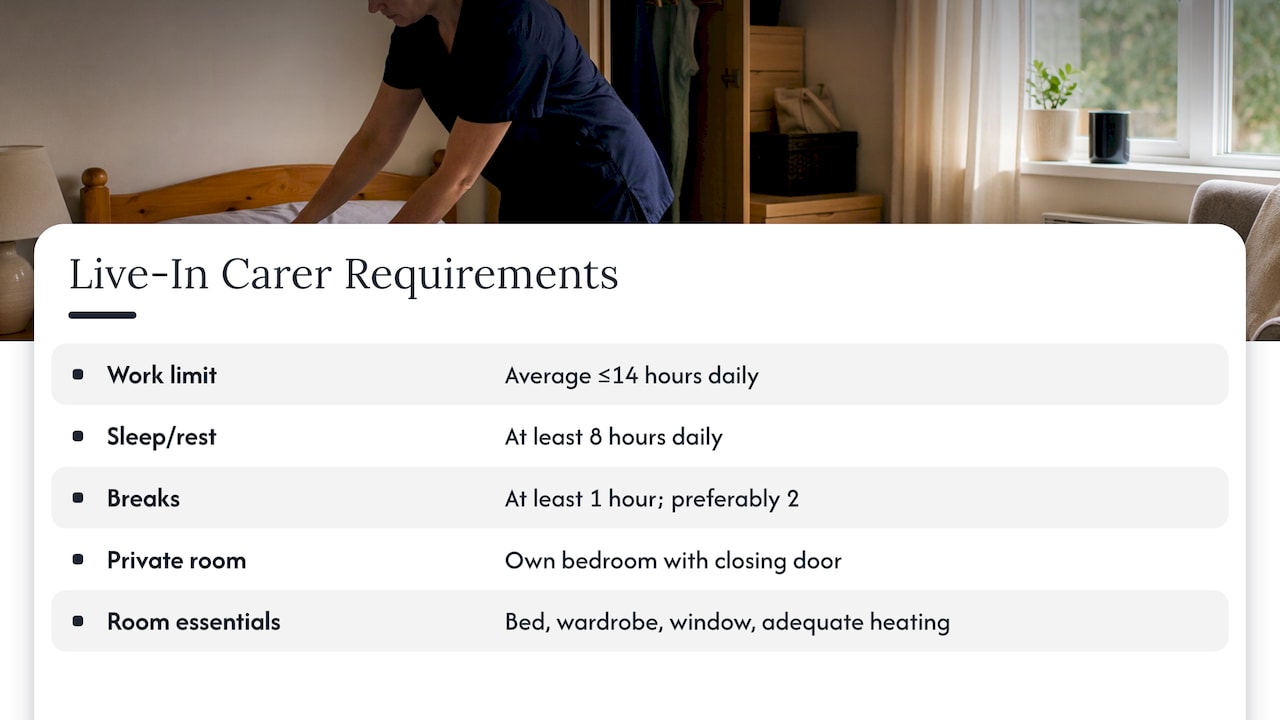
A live-in carer lives in your relative’s home, so the arrangements matter. PA Pages guidance says a live-in assistant must have their own bedroom with a bed, wardrobe, window, a door that closes and adequate heating. It also says average working hours should not exceed 14 a day, with at least eight hours for sleep or relaxation and at least one hour, preferably two, for breaks.
See what carers do day and night in live-in carer duties, the room requirements and how to prepare your home for safety, medicines and privacy.
Paying for care at home
Council funding depends on a financial assessment. For 2024 to 2025 the capital limits in England were £14,250 lower and £23,250 upper. Between the limits, people pay what they can afford from income plus £1 a week for every £250 of capital. For care at home, the value of your main home is excluded from the capital assessment, according to one London borough’s 2025 to 2026 policy.
Above the upper limit, or if your income covers the cost, you are a ‘self-funder’ and meet the full cost. These limits are reviewed, so check your council’s current figures.
Perspective
Families rarely call us after one bad day. They call after weeks of worrying: a fall they found out about too late, a parent who will not eat, or their own sleep gone.
Our view is that live-in care is not a last resort. It is a way to keep someone in their own home with their routines, their belongings and their dignity, with a qualified, DBS-checked carer who gets to know them. We are regulated by the CQC, and over 30 years in London have shaped how we personalise care around independence and freedom of choice.
If you are asking whether it is time, it is worth talking it through.
Dan
Talk to us about live-in care
If these signs sound familiar, we can talk through what your relative needs, from call-in visits to round-the-clock support. Read about live-in care in London, request our free home care guide, or contact us through Kells Domiciliary Care. You can also read our London family guide to recognising signs.
FAQ
How do I know if my parent needs live-in care rather than visits?
Look at what happens between visits. If there are falls, wandering, missed medication or confusion at night, scheduled visits are unlikely to cover the risk. A needs assessment and a conversation with the GP will help you decide.
Can a live-in carer look after someone with dementia?
Yes. Dementia care at home gives your relative a familiar person and routine, and supervision through the day and night. We provide this across London.
Is it normal to feel guilty about arranging care?
Yes. Carers UK notes that sadness and guilt commonly sit alongside relief. Arranging professional care is a natural step when caring becomes too exhausting.
Can I get help for myself as a family carer?
Yes. You can ask your council for a carer’s assessment regardless of your finances or the amount of care you provide. It looks at your health, wellbeing and plans for emergencies.
Sources
- NHS: Help at home from a paid carer
- Brent Council: Self neglect
- Age UK: How to get care and support
- Carers UK: When caring changes or ends
- Carers UK: Looking After Someone 2025-26 England
- Lymphoma Action: Caring for someone who has lymphoma
- NICE NG21: Home care
- PA Pages: Full-time care packages
- GOV.UK: Social care charging 2024 to 2025
- LB Bexley: Adult social care charging policy 2025-26