
What does it mean to have a learning disability?
A learning disability is a lifelong condition characterised by significantly reduced ability to understand new or complex information, learn new skills, and cope independently. According to the Department of Health and Social Care, this reduced capacity must have started before adulthood and continues throughout life. It is not an illness, and it is not something a person grows out of.

In the UK, the NHS and organisations like Mencap describe learning disabilities as affecting both intellectual functioning and adaptive behaviour, meaning the practical skills needed to manage daily life. An IQ of 70 or below is often associated with a diagnosis, but support needs are determined by functional impact, not a number alone.
Key characteristics recognised by UK health authorities include:
- Difficulty learning new information and retaining it
- Challenges with understanding, problem-solving, and making decisions
- Reduced ability to cope independently with daily tasks
- Onset before the age of 18, often present from birth
- Varying severity, from mild to profound
At least two in every 100 people in the UK have a learning disability. The condition affects each person differently, and many people lead fulfilling lives with the right support in place.
Table of Contents
- How are learning disabilities different from learning difficulties?
- How learning disabilities affect daily life and independence
- What home care support is available for people with learning disabilities in the UK?
- Practical steps families can take to access support and improve daily life
- Key takeaways
How are learning disabilities different from learning difficulties?
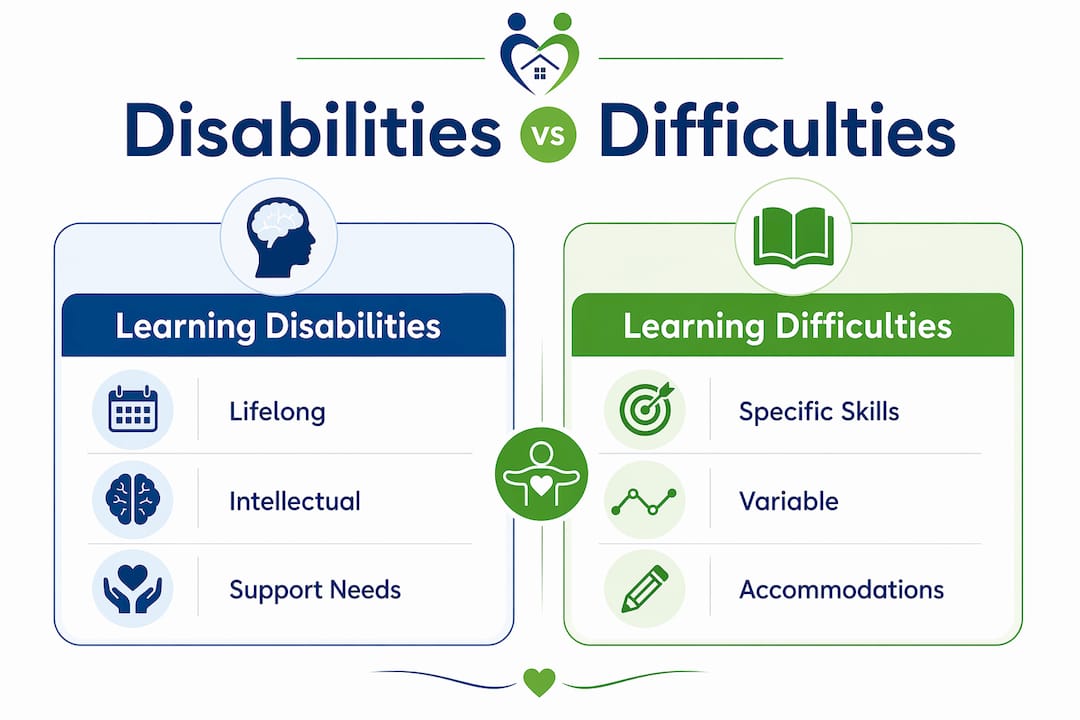
This distinction matters, and it is one that causes genuine confusion for many families. A learning difficulty, such as dyslexia, dyspraxia, or ADHD, affects a specific area of learning or functioning. A learning disability, by contrast, affects overall intellectual and adaptive functioning across a wide range of areas.
The NHS is clear on this point. Dyslexia affects reading and language processing. Dyspraxia affects coordination and movement. ADHD affects attention and impulse control. None of these, on their own, constitute a learning disability under the UK definition.
That said, a person can have both. Someone with a learning disability may also have dyslexia or ADHD, which adds complexity to their support needs. School records and medical notes sometimes use the terms interchangeably, which can lead to misdiagnosis or gaps in support.
To summarise the key differences:
- Learning disability: affects general intellectual functioning and adaptive behaviour; lifelong; present before adulthood
- Learning difficulty: affects a specific skill area (reading, coordination, attention); does not reduce overall intellectual capacity
- Autism: sometimes co-occurs with a learning disability but is a separate condition; many autistic people do not have a learning disability
Understanding this difference helps families ask the right questions when seeking assessments and support services.
How learning disabilities affect daily life and independence
The impact of a learning disability on daily functioning varies considerably from person to person. Someone with a mild learning disability may live semi-independently, hold a job, and manage many aspects of their own life. Someone with a severe or profound learning disability may need round-the-clock support with personal care, communication, and safety.
Common daily challenges include:
- Managing personal hygiene and nutrition without prompting
- Communicating needs and understanding others
- Maintaining relationships and social connections
- Using public transport or community facilities safely
- Managing finances and completing official paperwork
Pro Tip: People with mild learning disabilities often appear socially confident but struggle significantly with complex tasks such as completing benefit forms, managing bank accounts, or understanding tenancy agreements. These hidden challenges can lead to serious crises if support is not in place.
The Care Act 2014 eligibility criteria define “unable” broadly. A person is considered unable to achieve an outcome if doing so causes significant pain, distress, or anxiety, or takes considerably longer than it would for someone without a disability. This means that even when a person can technically complete a task, they may still meet the threshold for support if the process causes them real harm.
Causes of learning disabilities include genetic factors, complications during birth, illness or injury in early childhood, and conditions such as spina bifida. The NHS notes that a diagnosis may come at birth, in early childhood, or sometimes not until adulthood.
What home care support is available for people with learning disabilities in the UK?
Families often discover that a wide range of support options exists once they know where to look. Home care, also called domiciliary care, allows a person with a learning disability to remain in their own home while receiving tailored, person-centred support. This is frequently preferable to residential care, both for wellbeing and for maintaining independence.
Support services available in the UK include:
- Personal care: assistance with washing, dressing, and hygiene
- Domiciliary care: regular visits from a carer to support daily routines
- Respite care: short-term relief for family carers, giving them a break while their loved one receives professional support
- Reablement: time-limited support to help a person regain or develop skills for greater independence
- Specialist support: for those with profound or multiple learning disabilities, including communication support and behaviour management
Person-centred care is the guiding principle across all of these. Rather than doing everything for a person, skilled carers work alongside them to build confidence and capability. As the CNTW NHS Trust describes it, the aim is to enable independence and dignity, not simply to perform tasks on someone’s behalf.
CQC-regulated home care providers are inspected to ensure quality and safety standards are consistently met. All care staff should be fully qualified, experienced, and DBS-checked. Kells-care has been providing domiciliary care in London for over 30 years, with a team of qualified, DBS-checked carers regulated by the Care Quality Commission.
Local authority assessments under the Care Act 2014 determine eligibility for funded support. Your local council has a legal duty to carry out a needs assessment if there is any realistic prospect that support may be needed.
Practical steps families can take to access support and improve daily life
Knowing where to start is often the hardest part. The steps below can help you move from uncertainty to a clear plan.
Getting an assessment and registering for support:
- Contact your local authority to request a needs assessment under the Care Act 2014. This is free and your right.
- Ask your GP to refer your family member to the local community learning disability team.
- Register on the NHS Learning Disability Register, which unlocks annual health checks starting from age 14 and helps connect individuals to appropriate services.
- Explore the disability support process step by step if you are new to navigating social care.
Supporting communication and daily routines:
- Use visual timetables, picture cards, or Makaton signing to support understanding and reduce anxiety.
- Keep routines consistent; predictability reduces stress for many people with learning disabilities.
- Break tasks into small, manageable steps and celebrate progress, however incremental.
Transition planning from childhood to adult services:
Transition from children’s to adult services is a critical period, typically beginning around age 14. Families should request an Education, Health and Care (EHC) plan review that incorporates adult care planning. Adult social care teams should be involved well before a young person turns 18 to avoid gaps in support.
Pro Tip: Respite care is not a luxury. Respite care for family carers provides essential relief that protects your own health and sustains the quality of care you give. Budget pressures have made community-based respite harder to access, so ask your local authority specifically about carer support entitlements under the Care Act.
Advocacy organisations such as Mencap and Healthwatch can help you challenge decisions, understand your rights, and navigate local services. You do not have to manage this alone.
Key takeaways
A learning disability is a lifelong condition affecting intellectual functioning and daily independence, requiring person-centred support tailored to each individual’s needs.
| Point | Details |
|---|---|
| UK definition is functional, not just IQ-based | Support needs depend on how a disability affects daily life, not solely on an IQ score of 70 or below. |
| Learning disabilities differ from learning difficulties | Dyslexia, dyspraxia, and ADHD affect specific skills; a learning disability affects overall intellectual and adaptive functioning. |
| The Care Act 2014 sets eligibility broadly | “Unable” includes tasks that cause significant distress or take considerably longer, not just tasks a person cannot do at all. |
| Home care supports independence at home | Domiciliary, respite, and reablement services allow people to remain in their own homes with dignity and tailored support. |
| Early registration unlocks key services | Joining the NHS Learning Disability Register from age 14 provides annual health checks and access to further support. |


