
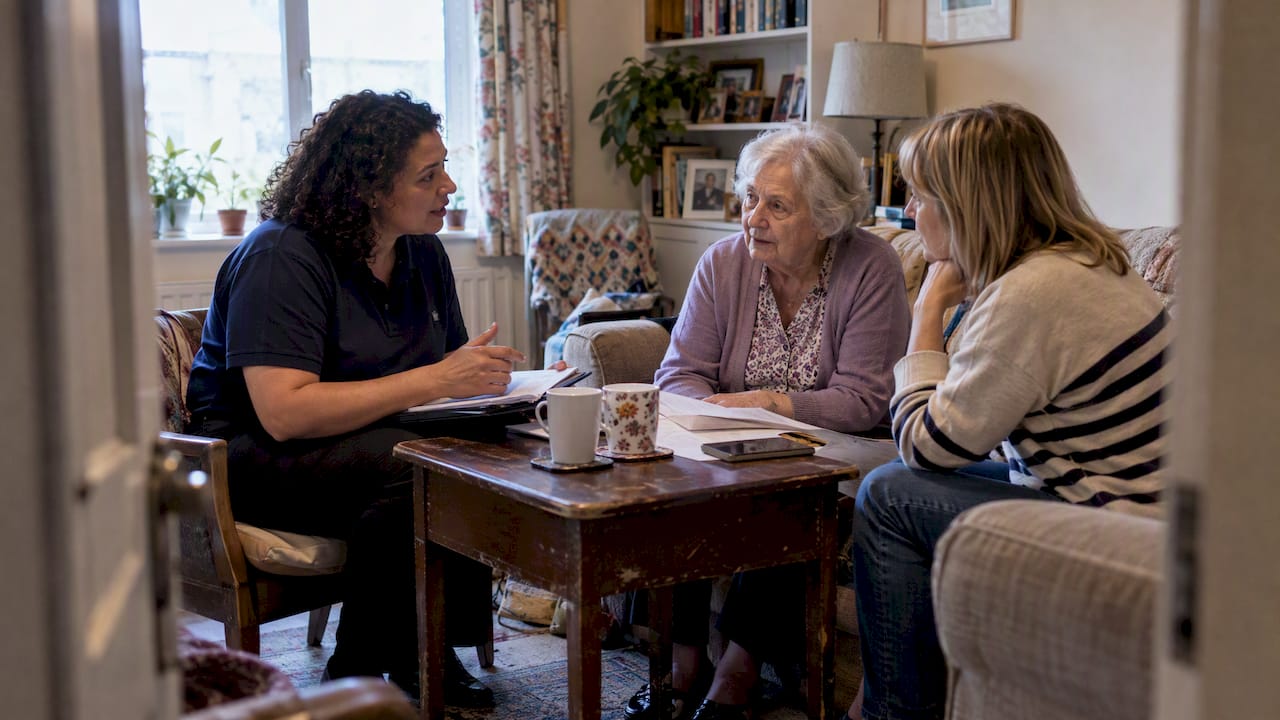
Most people need somewhere between a few hours a week and daily visits, with full-time or live-in support reserved for constant needs: occasional help generally involves a few hours weekly, light support several hours, and daily care typically involves many hours each day. If you are unsure where you fall, request a local authority needs assessment or keep a two-week log of daily tasks. Our team can talk you through what a tailored hourly plan might look like.
TL;DR:
- Most care hours are scheduled in 30, 45, or 60-minute slots, with travel time usually included, not billed separately.
- Local authority assessments focus on needs and goals, while NHS Continuing Healthcare evaluates health-related eligibility within roughly 28 days.
- The 2026/27 upper capital limit for local authority support is £23,250, above which individuals are expected to fund their own care.
- Care packages are flexible and reviewed at least after 6 to 8 weeks, with adjustments made as needs evolve.
- For a tailored plan, tracking daily needs over two weeks and consulting with professionals helps determine appropriate hours and support models.
Table of Contents
- What those hour ranges actually look like in practice
- How needs are formally assessed before hours are agreed
- Funding and costs: what the means test actually changes
- Types of care: matching the model to the hours you need
- What typically changes the hours needed, and how to prepare for a review
- When fast-track NHS CHC applies, and when it does not
- How we plan hours in practice at Kells
- Taking the first practical step
- Getting the right number of hours in place
- FAQ
- Sources
What those hour ranges actually look like in practice
An hour of care rarely means an uninterrupted hour at your door. Most visits are booked in 30-, 45- or 60-minute slots, and the carer’s travel time between calls is usually built into the schedule rather than billed separately, though this varies by provider. A 30-minute call suits a medication prompt or a check-in; a 60-minute call allows time for washing, dressing and a proper breakfast.
What each band typically covers:
- Occasional help (2 to 5 hours a week): shopping, light housework, companionship visits.
- Light support (5 to 10 hours a week): help with washing, dressing, meal preparation a few times a week.
- Daily care (10 to 20 hours a week): personal care calls each day, medication support, mobility assistance.
- Live-in or constant supervision: needed where someone cannot be safely left alone, including many dementia or high-dependency cases.
Some tasks, such as hoisting or repositioning someone with limited mobility, need two carers attending at once. That doubles the staffing cost of that particular call even though it may only last 30 minutes, and it is worth flagging early if you think it might apply, so scheduling can account for it from the start.
How needs are formally assessed before hours are agreed
Nobody has to guess their own hours in isolation. Two main routes exist, and they serve different purposes.
- Local authority needs assessment. Anyone can request one regardless of savings or income, because eligibility for the assessment itself is not means-tested. It focuses on outcomes, what you or your relative want to be able to do, rather than simply listing deficits, and a care needs assessment is the usual starting point for anyone arranging support through the council.
- NHS Continuing Healthcare (CHC). This is health funding rather than social care funding, and it applies when someone has a primary health need. The process runs through a checklist, then a full Decision Support Tool assessment by a multidisciplinary team if the checklist suggests potential eligibility. You can read more about NHS continuing healthcare eligibility and how the application works.
- Timescales. A full CHC assessment decision is typically made within about 28 days of referral, though this depends on how quickly clinical evidence can be gathered. Assessments are usually carried out in a community setting rather than an acute hospital, so the person’s usual day-to-day function can be properly observed.
Funding and costs: what the means test actually changes
The assessment tells you how many hours are needed. A separate financial assessment tells you who pays for them, and the two should never be confused.
For 2026/27, the upper capital limit for local authority charging is £23,250. People with assets above that figure are generally expected to fund their own care, while those below it may receive help towards costs depending on income. The lower capital limit sits at £14,250.
£23,250 is the threshold above which local authorities generally expect self-funding of care costs, a figure worth checking against your own savings before you budget for hours.
A few points worth knowing before you plan a budget:
- Your assessed contribution depends on your finances, not on the number of hours agreed; a larger package does not automatically mean a larger bill if you qualify for support.
- Attendance allowance and the 12 week property disregard can change how your contribution is calculated during a transition into care.
- Direct payments and deferred payment agreements are both routes worth asking your local authority about if you are funding privately or part-privately.
- For a sense of what private hourly rates look like in practice, our guide to hourly care rates in London breaks down the components behind the figure.
Because this area involves long-term financial planning, it is sensible to speak to a financial adviser experienced in care costs before committing to a package.
Types of care: matching the model to the hours you need
The same underlying need can be met in more than one way, and the right model often comes down to lifestyle as much as hours.
- Call-in visits are booked in set slots through the day, billed per visit or per hour, and suit anyone who can safely be alone between calls.
- Live-in care places a carer in the home with agreed working and rest periods, suited to constant or unpredictable needs rather than scheduled tasks alone.
- Waking night cover means a carer stays alert through the night; sleeping night cover means they are present but can rest unless called, a cheaper option where needs are lower overnight.
- Respite care covers short periods, giving a family carer a planned break without changing the long-term arrangement.
A person needing help at breakfast, lunch and bedtime might convert to three daily call-in visits, while someone needing supervision through the night and day would likely need live-in or round-the-clock cover instead. Staff availability and pay pressures across the sector can affect how easily preferred time slots are filled, so some flexibility on visit windows helps in practice.
What typically changes the hours needed, and how to prepare for a review
Care hours are rarely fixed for good. Several things commonly push them up or down.
- A hospital discharge or a fall often triggers a short-term increase while someone recovers.
- Dementia progression tends to add hours gradually rather than suddenly, often starting with prompts and moving towards full personal care.
- A family carer reaching burnout is itself a trigger for requesting more paid hours or respite.
- New equipment, such as a hoist or a perching stool, can sometimes reduce the hours needed for a task.
Pro Tip: Keep a simple daily log of tasks, timings and any incidents; it gives assessors concrete, dated evidence when you ask for a review rather than a general impression.
Most packages get an initial check after 6 to 8 weeks, then an annual review, though either side can ask for one sooner if things change.
When fast-track NHS CHC applies, and when it does not
Fast-track CHC exists for rapid deterioration or a terminal phase, and it can arrange a care package within roughly 48 hours when someone meets the criteria, bypassing the standard Decision Support Tool. It is usually a GP, hospital team or other clinician who initiates it, drawing on their clinical view of prognosis rather than a family’s own request. It is worth asking directly whether fast-track applies if decline is sudden, since it is sometimes under-used. It is not, though, a route for a routine increase in weekly hours; that goes through the ordinary assessment process instead.

How we plan hours in practice at Kells
We have built our approach around CQC regulation and DBS-checked, qualified staff rather than guesswork, including offering home ear care visits as part of comprehensive support. A typical start involves a home visit to talk through goals, current routines and what independence looks like for that person, before we set out visit durations and tasks in a plan. For dementia or complex conditions, we adjust the mix of companionship, personal care and supervision as needs shift, and we build in review points rather than leaving a plan static once it is agreed.

Taking the first practical step
I would start with a two-week log of daily needs, then request a needs assessment and ask whether CHC screening applies. Packages can always be adjusted as needs change, so getting a plan started matters more than getting it perfect first time.
— Dan
Getting the right number of hours in place
Working out hours on paper is one thing; getting carers who turn up reliably and adjust as needs change is another. We offer Call-In Visits, Live-In Care and a range of specialist support, alongside personal care assessments that turn a general sense of need into an actual weekly plan. When you contact us, you can expect an initial assessment, a personalised schedule built around your routines, and carers who have relevant qualifications and checks, all within a regulated service.
- We assess current needs and goals before suggesting a mix of hours.
- We adjust the plan at review points as circumstances change.
- We cover everything from occasional call-in visits to live-in and high dependency care with two carers attending.
If you want a lower-commitment starting point, our free home care guide walks through the same questions we ask on a first visit, or you can look at our full range of home care services to see what a bespoke hourly plan might include.
This article is general information, not a substitute for advice from a qualified doctor. Consult a qualified healthcare professional about your own circumstances before acting on anything here.
FAQ
How many hours a week should a carer do?
There is no single figure, since it depends on the person’s needs rather than a fixed rule. Many households start around 5 to 10 hours a week for light support and increase to 10 to 20 hours for daily personal care, moving to live-in or round-the-clock cover where supervision is constant.
Do both parents need to work for 30 hours?
This question relates to childcare entitlement rules rather than home care hours, and it sits outside what this guide covers. For accurate current rules, check directly with GOV.UK or your local authority’s childcare eligibility pages.
How much money are you allowed to keep before paying for care?
For 2026/27, the upper capital limit is £23,250, above which you are generally expected to fund your own care. Below the lower capital limit of £14,250, savings are typically disregarded in the financial assessment.
What are carers not allowed to do?
Carers work within the scope agreed in the care plan and their training, so tasks like certain medical procedures or anything outside their qualification generally fall to a nurse or clinician instead. A CHC assessment or GP referral is the right route if a need moves into that territory.
What is the NHS CHC Decision Support Tool?
The Decision Support Tool is the framework used after the CHC checklist to assess the complexity, intensity and unpredictability of someone’s needs. The referral form and tool are published so families and clinicians can see what evidence is considered.
Sources
- Social care – charging for care and support 2026 to 2027: local authority circular
- National framework for NHS continuing healthcare and NHS-funded nursing care
- Paying for your care and support 2026/27 – Richmond Council