
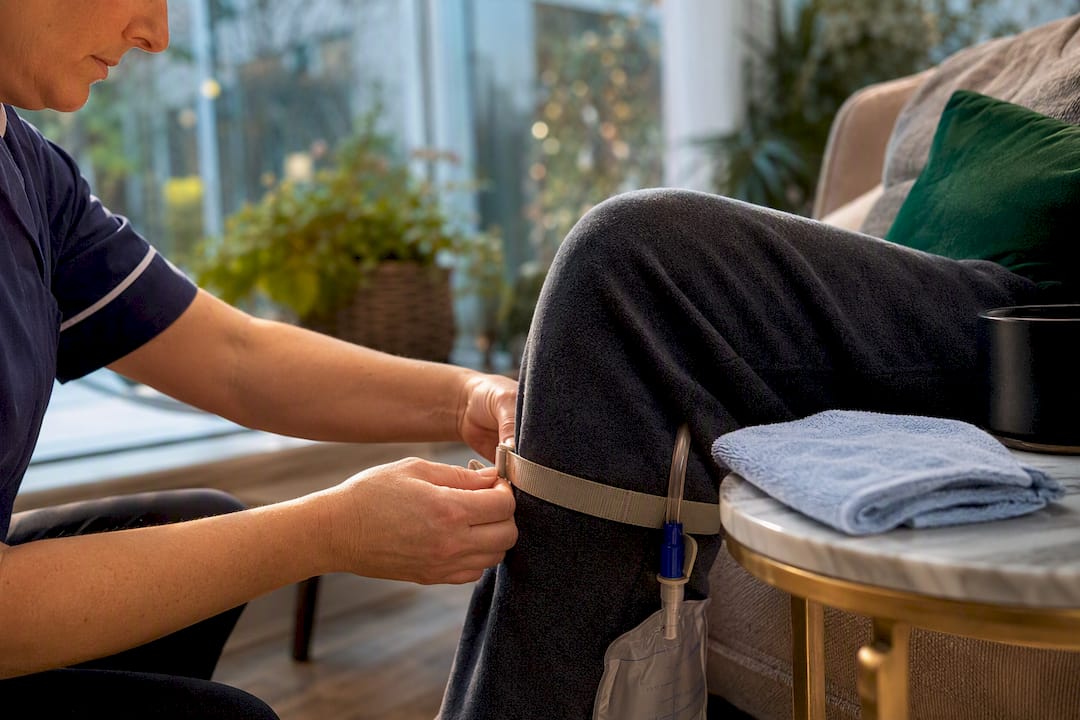
Safe catheter care at home rests on three habits: strict hand hygiene, daily cleaning of the entry site, and keeping the drainage bag below bladder level, emptying it once it is roughly two-thirds full. Follow NHS guidance and NICE advice on hydration and bowel health, and if drainage stops, bleeding starts, or a fever develops, call your community nurse or GP without delay. Carers can be trained to support families through exactly this routine.
TL;DR:
- Regularly changing drainage bags and securing tubing properly reduce risks of leakage, infections, and traction injuries in home catheter management.
- Maintaining hydration of 1.5 to 2 liters daily and managing bowel health are crucial to prevent catheter blockages and infections.
- Daily cleaning with soap and water, hand hygiene, and proper securement practices are more effective at preventing infections than antiseptic products.
- Replacing indwelling catheters and managing obstructions or encrustation require professional intervention; self-insertion is limited to intermittent catheter use.
- Promptly contacting healthcare providers for symptoms like fever, heavy bleeding, or urgent drainage issues is vital for serious complications.
Table of Contents
- Understanding your catheter equipment and type
- How do you clean a catheter site every day?
- Managing drainage bags and securing the tubing
- What stops a catheter-associated infection?
- When should you call for medical help?
- Can you insert or remove a catheter yourself at home?
- Recognising and managing catheter blockages beyond a simple kink
- Antiseptic technique and cleansing agents that actually help
- Storing and disposing of catheter supplies safely
- What does mobility look like with a catheter?
- A carer’s perspective on catheter support at home
- How Kells-care supports catheter care at home
- Sources
Understanding your catheter equipment and type
Before you can manage catheter care at home confidently, you need to know exactly what system you or the person you care for is using. An indwelling catheter sits inside the bladder continuously, held in place by a small water-filled balloon, and drains into a bag. An intermittent catheter is inserted several times a day and removed straight after emptying the bladder, which NICE notes carries a lower infection risk where it’s a suitable option. A suprapubic catheter enters through a small opening in the abdomen rather than the urethra, and some people use a catheter valve instead of a bag, releasing urine periodically rather than draining continuously.
Whatever the system, a typical home kit includes:
- A leg bag for daytime use, strapped discreetly to the thigh or calf
- A larger night bag for overnight drainage
- Fixation straps or an adhesive securement device
- A sampling port for urine tests without disconnecting the system
- At least one spare sterile catheter, kept at home for emergencies
Supplies usually arrive on prescription through your GP or via home delivery from a continence service. Never let stock run low, and never attempt to reinsert a catheter yourself if it falls out. Contact your community nurse instead.
How do you clean a catheter site every day?
Daily cleaning is the single biggest lever you have against infection, and it takes less time than making a cup of tea. Wash your hands with soap and water before touching any part of the system, and again afterwards. That single habit does more to prevent urinary tract infections than any specialist product on the market, according to NHS guidance on catheter risks.
Here’s the routine to follow, ideally once a day and after every bowel movement:
- Wash your hands thoroughly with soap and water, or use an alcohol gel if your hands aren’t visibly soiled.
- Put on disposable gloves if you’re a carer performing the wash.
- Gently wash the skin where the catheter enters the body using mild, unperfumed soap and warm water.
- Wipe away from the body, not towards it, to avoid pushing bacteria along the tubing.
- Rinse and pat the area dry with a clean towel.
- Wash your hands again once finished.
Showering is generally fine and often easier than a bed bath, but avoid talcum powder, scented creams, or antiseptic sprays around the site unless a clinician has told you to use them. For men with a foreskin, retract it gently to clean underneath, then return it to its normal position afterwards. For suprapubic sites, check the skin around the stoma for redness or discharge while you clean it.
Pro Tip: Keep a small, dedicated wash bowl and flannel just for catheter care, separate from anything used elsewhere on the body. It sounds trivial, but it stops cross-contamination becoming a habit nobody notices.
Managing drainage bags and securing the tubing
Getting bag management right prevents most of the day-to-day problems people report with home catheter care. NHS advice is clear: empty the bag once it’s around two-thirds full, never wait until it’s bulging, and always keep it below the level of the bladder to stop urine flowing back up the tubing.
To empty a leg bag safely:
- Wash your hands first
- Open the drainage tap over a toilet or suitable container without letting it touch any surface
- Let the bag empty fully, then close the tap securely
- Wash your hands again
Leg and night bags are typically changed weekly, or sooner if damaged, leaking, or visibly soiled, according to Leeds Community Healthcare’s catheter guidance. When swapping bags, never touch the connector tip, and connect the new bag as quickly and cleanly as possible.
Fixation devices matter more than most people realise. A properly secured strap stops the catheter tugging with every step, and reduces the risk of accidental traction injuries that can send someone straight to urgent care. At night, hang the bag on a stand lower than the bed, and during the day, alternate which leg carries the bag every couple of days to ease pressure and skin irritation.
Pro Tip: Teach whoever wears the catheter to empty their own leg bag while seated, if they’re able to. It’s a small independence win, and it removes the risk of an accidental pull that comes from standing awkwardly over a toilet.
What stops a catheter-associated infection?
Infection prevention in catheter care comes down to consistency, not clever products. Three habits carry most of the weight: proper fluid intake, regular bowel management, and strict hand hygiene at every contact point.
Aim to drink around 1.5 to 2 litres of fluid a day, unless a clinician has told you otherwise, according to the NHS catheter passport. Good hydration keeps urine flowing freely and dilutes anything that might otherwise encourage bacterial growth. Constipation is an underrated troublemaker here too. A full bowel puts pressure on the bladder and tubing, and it’s a common, often overlooked cause of leakage and blockages, so managing bowel health proactively pays off in fewer complications.
If the catheter stops draining, work through this checklist before ringing anyone:
- Check the tubing for kinks or twists, particularly where it emerges from clothing or bedding.
- Confirm the drainage tap is fully open and not accidentally closed.
- Check the bag is positioned below bladder level.
- Encourage extra fluids if hydration seems low.
- Try a short walk or position change, since constipation and immobility both slow drainage.
- If no urine has drained after four hours despite these checks, contact your community or district nurse.
Four hours is a commonly recommended threshold for seeking professional help if a catheter stops draining despite home troubleshooting.
Leakage around the catheter (often called bypassing), blood-tinged urine, or mild bladder spasms can happen occasionally and often settle on their own. Persistent or heavy bleeding, severe spasms, or bypassing that continues after checking for constipation and kinks needs a clinical review. If antibiotics are prescribed for a catheter-associated urine infection, community guidance commonly recommends changing the catheter at the same time, since leaving the same device in place can encourage the infection to return.
When should you call for medical help?
Some symptoms need attention faster than a routine nurse visit can provide. Treat these as urgent:
- Fever, shivering, or feeling suddenly unwell
- Severe pelvic, back, or abdominal pain
- Heavy or persistent bleeding from the catheter
- The catheter has fallen out and the person cannot pass urine
- No urine has drained despite four hours of troubleshooting
When you call, have this information ready: the date of the last catheter change, what the urine has looked like recently, and whether the catheter has a sampling port your nurse might need to use. Start with your community or district nursing team, since they know the person’s history. If they’re unavailable, contact your GP or NHS 111 for guidance. Call 999 or go to A&E for heavy bleeding, severe pain, or signs of a serious infection such as confusion alongside fever.
Can you insert or remove a catheter yourself at home?
For intermittent catheters, yes, and that’s the whole point of the system. People using intermittent catheterisation are trained, usually by a continence nurse or urology specialist, to insert and remove a clean catheter themselves several times a day. NICE actively recommends this approach where it’s clinically suitable, precisely because self-management with intermittent catheters tends to carry a lower infection risk than a permanent indwelling device.
Indwelling catheters are a different matter entirely. These are fitted and removed by a trained clinician, usually a district nurse, urology nurse, or GP, because the process involves deflating a small balloon inside the bladder before withdrawal, and inserting a new one requires sterile technique most households aren’t equipped for. If an indwelling catheter falls out on its own, don’t try to put it back in. Cover the area with a clean pad if there’s any leakage, keep the person comfortable, and contact your community or district nursing team immediately, since they can usually attend quickly given how disruptive this is.
If you’ve been given training as a family carer to change a catheter yourself, whether that’s for a suprapubic or urethral device, always follow the exact technique demonstrated to you, use the sterile equipment provided, and never improvise with substitute items. Scheduled catheter changes typically happen every 4 to 12 weeks depending on the material and the person’s history of blockages, and your community nursing team will set the exact interval.
The safest general rule: intermittent catheterisation is designed for self-care, indwelling catheter changes are not. When in doubt about whether a task is within your remit as a carer, ask the district nursing team directly rather than guessing.
Recognising and managing catheter blockages beyond a simple kink
Not every drainage problem is a kink you can straighten out. Encrustation, a build-up of mineral deposits inside the catheter, is a genuinely different problem and one that catches a lot of families off guard. It tends to develop gradually in people who are prone to concentrated urine or recurrent infections, and it narrows the internal channel of the catheter until drainage slows or stops even when the tubing looks perfectly straight.
Signs worth watching for include urine that’s consistently cloudy, thick, or has visible sediment or debris; a catheter that drains progressively more slowly over several days rather than stopping suddenly; a strong, persistent smell that doesn’t improve with fluids; and repeated blockages happening more frequently than every few months. If someone blocks two or three times in a short period, that pattern itself is a signal worth reporting, not just each individual episode.
You can’t clear encrustation with troubleshooting like repositioning or a change of posture, because the deposits sit inside the catheter material itself. This needs a clinical response, usually a catheter change by the district nursing team, and sometimes a review of whether the catheter material or drainage system needs adjusting to reduce recurrence. Increasing fluid intake toward the upper end of the 1.5 to 2 litre range can help reduce how quickly deposits build up between changes, but it won’t dissolve an existing blockage.
Flag recurrent encrustation to your nursing team explicitly rather than treating each blockage as a one-off. They can review catheter material, adjust change frequency, or investigate whether an underlying infection is contributing, and that conversation is far more useful than repeatedly calling out for the same unresolved issue.
Antiseptic technique and cleansing agents that actually help
The evidence on catheter-associated infection prevention keeps pointing to the same conclusion: routine, low-tech hygiene beats specialist antiseptic products almost every time. Community clinicians consistently emphasise that standardised cleaning with ordinary products, done consistently, prevents more infections than experimental topical treatments, according to NHS guidance on catheter risks.
Mild, unperfumed soap and water remains the recommended cleansing agent for the skin around the catheter entry site. There’s no good reason to reach for antiseptic wipes, chlorhexidine solutions, or antibacterial sprays on healthy skin around a well-managed catheter, and doing so can actually irritate the skin and disrupt its natural barrier. Save antiseptic products for situations where a clinician has specifically recommended them, such as before a catheter change performed by a nurse.
The antiseptic technique that matters most isn’t a product at all, it’s the “no-touch” principle applied every time you handle the system. That means:
- Never letting the drainage tap or connector touch the toilet, floor, or any unclean surface
- Washing hands immediately before and after any contact with the catheter or bag
- Wearing disposable gloves as a carer, and changing them between different care tasks
- Keeping the sampling port capped when not in use
Securement matters here too. A catheter that’s properly fixed with a strap or securement device moves less, which means less friction and irritation at the entry site, and fewer opportunities for bacteria to travel along the tubing. This is a genuinely underrated infection-prevention step that gets far less attention than hand hygiene, despite being just as practical to get right.
Storing and disposing of catheter supplies safely
Good storage habits protect the sterility of unused equipment and keep your home tidy despite the volume of kit that comes with long-term catheter care. Store spare catheters, bags, and straps in their original sealed packaging, in a cool, dry cupboard away from direct sunlight and away from bathroom humidity, which can degrade packaging seals over time. Check use-by dates on sterile packs periodically, since stock can build up faster than it’s used, particularly after a delivery.
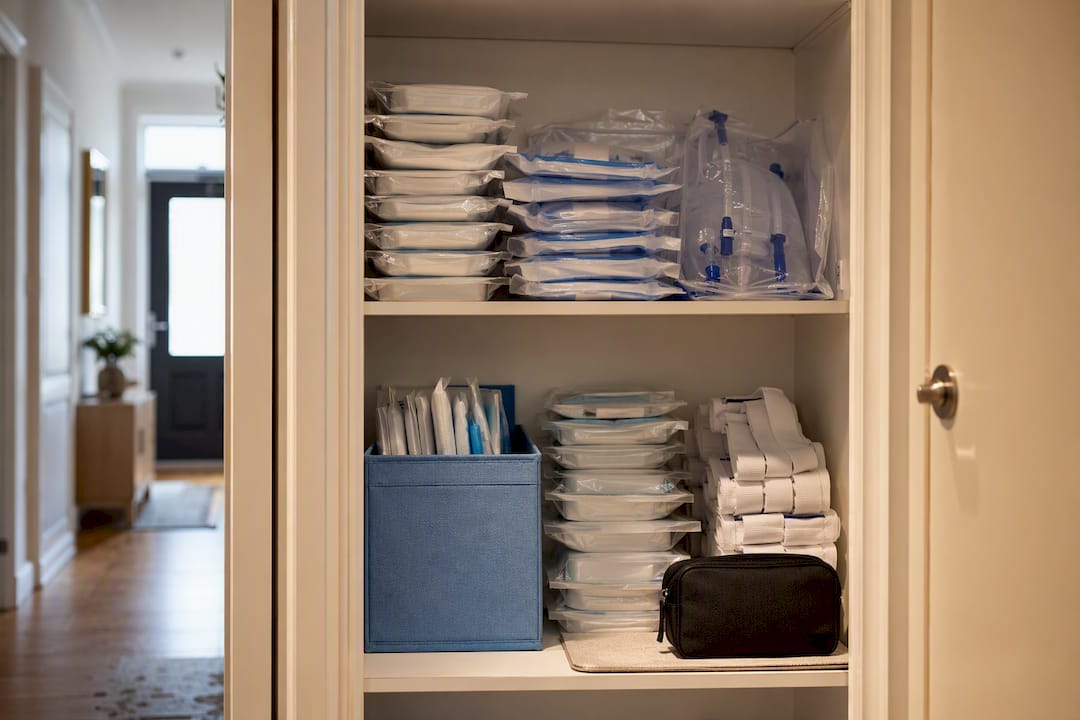
Keep at least one spare sterile catheter on hand at all times for emergencies, stored separately so it’s easy to locate quickly if the current one fails or falls out unexpectedly.
For disposal, used leg bags, night bags, and catheters go into general household waste once emptied, tied in a plastic bag to contain any residual moisture and odour. This isn’t clinical waste in most home settings, though if the person you care for has an active infection or is receiving specific community nursing instructions, follow whatever disposal advice your nursing team has given, since some services provide clinical waste collection for higher-risk situations. Empty bags fully into the toilet before disposal wherever possible, never pour urine directly into household bins.
Wash your hands thoroughly after handling any used equipment, even briefly. Keep a small waste bin dedicated to catheter care items in the bathroom or bedroom if that makes the routine easier to stick to, and empty it regularly rather than letting used items accumulate.
What does mobility look like with a catheter?
Wearing a catheter shouldn’t mean giving up ordinary activity, and encouraging movement is genuinely part of good care rather than a risk to manage around. Walking helps drainage, supports bowel function, and reduces the constipation that so often causes catheter problems in the first place. A properly secured leg bag, worn discreetly under trousers or a skirt, allows most people to continue daily routines, light exercise, and even swimming with certain valve systems, without the catheter becoming an obstacle. The main precautions are practical ones: make sure straps are secure before standing up, avoid activities with a high risk of falls or direct impact to the abdomen, and always carry spare supplies if you’re out for an extended period. If you’re supporting someone with reduced mobility, our guide to safe manual handling at home covers techniques that reduce strain on both of you during transfers and repositioning.

A carer’s perspective on catheter support at home
The gap between reading NHS advice and actually doing it, at 2am, hands shaking slightly, is bigger than most leaflets admit. What tends to get underestimated is how much confidence matters just as much as knowledge. Families often know the theory perfectly well but freeze at the practical moment, worried about causing pain or doing something wrong. That’s precisely where trained hands-on support earns its keep, not by replacing family involvement, but by steadying it.
Kells Domiciliary Care has supported London families with this kind of practical, dignity-first help for over 30 years. Our carers are DBS-checked, CQC-regulated, and trained to assist with tasks like bag changes, monitoring for warning signs, and liaising directly with district nursing teams so nothing falls through the gaps between visits.
— Dan
How Kells-care supports catheter care at home
Kells-care is the practical option for families in London who want hands-on help with catheter care between district nurse visits, not just written advice. Our carers are DBS-checked, fully trained, and regulated by the CQC, and they can support tasks like bag changes, checking for the warning signs covered above, ordering supplies before they run low, and keeping district nurses informed of anything that changes. That kind of continuity, someone who sees the person daily rather than fortnightly, catches problems earlier than a scheduled visit ever could. If you’re weighing up whether family support alone is enough, or whether some extra hands would genuinely ease the pressure, download our free home care guide to see how a personalised care visit could fit around your family’s routine.
Sources
- Living with a urinary catheter – NHS
- Long-term use of urinary catheters – NICE
- Catheter care – Leeds Community Healthcare
- Catheter passport – NHS England (Nov 2023)
This article is general information, not a substitute for advice from a qualified doctor. Consult a qualified healthcare professional about your own circumstances before acting on anything here.


