
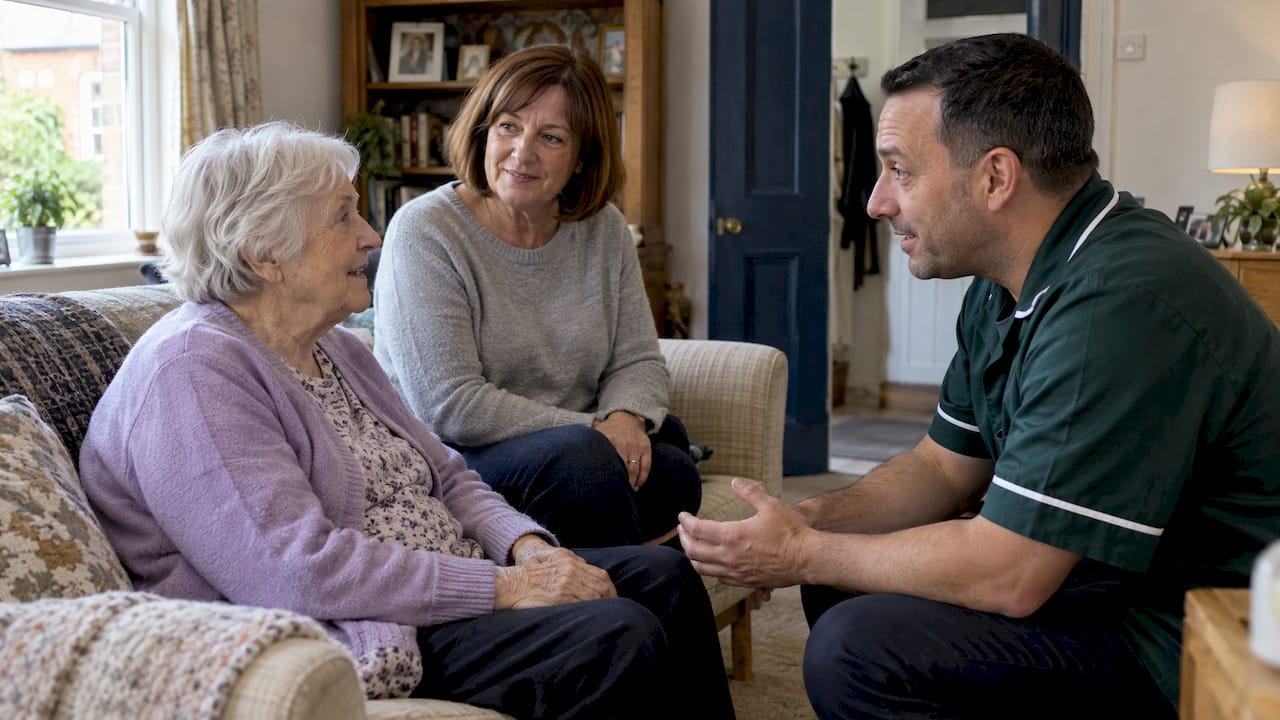
A carer trial visit is a first visit at home, usually shorter and more closely observed than the visits that follow, where you and the person receiving care see whether the carer, the routine and the care plan suit them. The best way to use it is to prepare a short list of what matters to your relative, stay for part of the visit, and ask for the plan to be changed afterwards if anything is off. At Kells Domiciliary Care we have supplied home care to people in London for over 30 years, and we regard the first visit as the start of getting the plan right, not a test the person has to pass. Families may also see this described as domiciliary care or care at home.
TL;DR
- A trial or first visit is a chance to check the carer’s manner, the timing, and whether the written care plan matches how the person actually lives.
- Before the visit, gather medicines, routines, emergency contacts and what makes the person feel safe or unsafe. NICE guidance asks care plans to cover exactly these things.
- Judge the visit on dignity, time, communication and the person’s own reaction, not only on whether tasks were ticked off.
- If it does not feel right, raise it with the agency manager straight away. Ordinary concerns are usually settled informally, and a formal complaint is there if they are not.
- People with dementia, a learning disability, autism or mental health needs may need more time and a gentler introduction.
Table of Contents
- What a trial home care visit is
- Before the visit: what to prepare
- How long should the visit be?
- What to watch during the visit
- Adapting the visit for particular needs
- What to ask afterwards
- If it does not feel right
- What home care costs
- Our perspective
- Talk to us about a first visit
- FAQ
- Sources
What a trial home care visit is
There is no legal definition of a “trial visit”. In practice, families use the phrase for the first visit or first few visits from a carer, when everyone is still finding out whether the arrangement works. For the person receiving care it is often the first time a stranger has helped with washing, dressing, meals or medicines in their own home. That is a big step, and it deserves some care.
What should happen around it is better defined. NICE’s home care guideline for older people aims to promote independence and safe, consistently high-quality care. It says a care plan should recognise what the person can and wants to do, address safety, wellbeing, independence and any specialist needs, say what role family and other carers have, and explain how outcomes will be measured.
The National Care Forum’s home care guidance adds that an initial assessment should take place before care starts where practical, or as soon as possible afterwards. It should involve the person, use communication they can follow, and be reviewed regularly. So a good first visit is not a one-off. It feeds into a plan that gets checked and adjusted.
If you want a picture of what the first visit looks like in practice, our guide to the first home care visit in the UK walks through it.
Before the visit: what to prepare
A first visit goes better when the carer already knows the essentials. A council example shows how much is expected. Derbyshire County Council’s homecare admissions procedure (March 2025) requires essential information before the first care call, a short-term personal service plan, checks of the environment and falls risk, and a record of the first call. It also calls for medication and moving-and-handling assessments where the person’s needs make them necessary.
You are not a council, but the same thinking helps a family. Pull together the following.
About the person
- A short list of what they can do for themselves and what they want to keep doing. Independence is the aim, so say so plainly.
- Their daily routine: when they wake, when they eat, when they like a wash, what they do in the evening.
- What makes them feel safe or unsafe. NICE says the plan should ask about this, along with their aspirations, priorities and what gives them peace of mind.
- How they communicate best: glasses, hearing aids, a preferred name, topics that settle them, topics that upset them.
About the home
- A current list of medicines, doses and times, and who normally gives them.
- Trip hazards, stairs, bathroom layout, any equipment such as hoists or walking frames.
- Emergency contacts and the GP’s details.
- Where the carer should put their coat, wash their hands and find the things they will need.
Our guide on how to ready your home for carers covers safety, medicines and privacy in more detail. If you want the carer’s view of the same visit, see how to ensure carer safety at home in London.
Prepare the person, not just the paperwork
Tell your relative who is coming, when, and why, in words that suit them. Let them have a say in the time of day. If they are anxious, a short introduction with you in the room is often easier than a first visit alone. Involving the person in decisions is itself part of NICE’s advice, which also asks for their dignity and privacy to be respected throughout.
How long should the visit be?
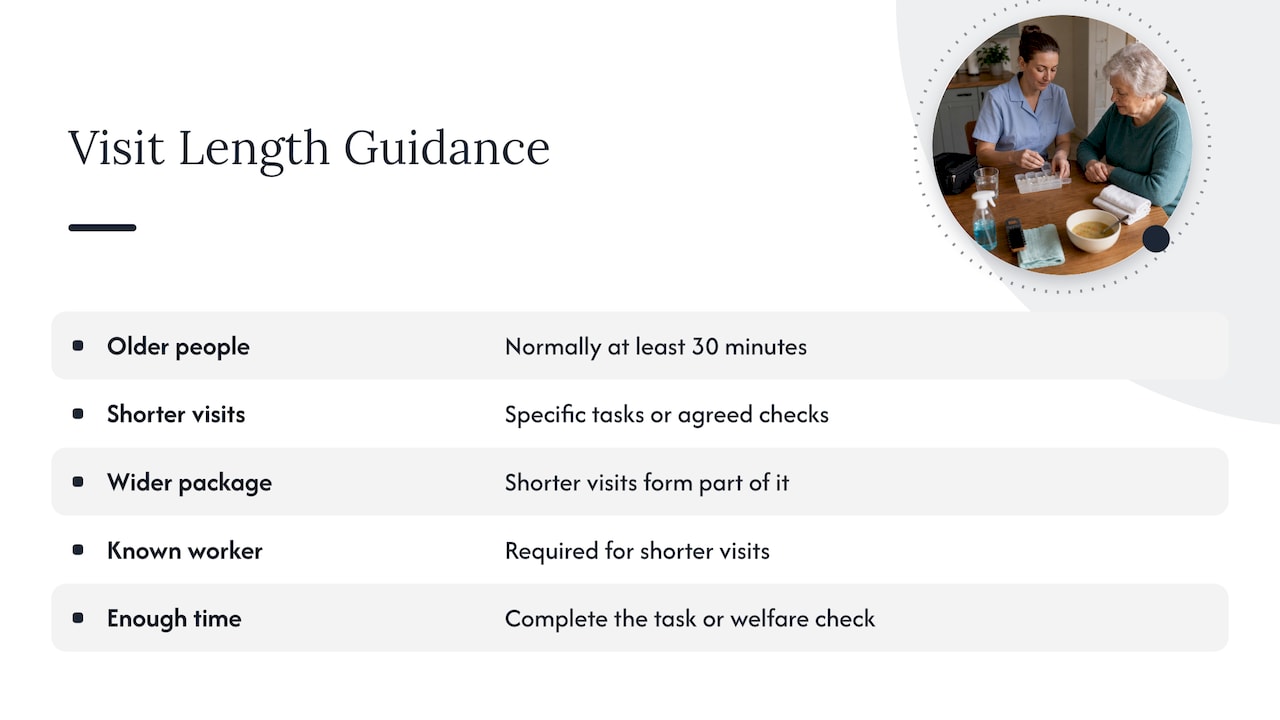
Length is one of the clearest things you can check. NICE Quality Statement 4 says older people should normally receive visits of at least 30 minutes. Shorter visits are for specific tasks or checks agreed as part of a wider package, and only when the worker is known to the person and there is enough time for the task or welfare check.
The main NICE guideline goes further. Visit times should be long enough to finish the work without compromising quality or dignity, include enough travel time, and allow extra time where someone has cognitive impairment, difficulty communicating, sensory loss, or needs help eating and drinking.
For a first visit, this means asking whether the time booked is realistic. A person who needs gentle encouragement to get washed will not be helped by a rushed 15 minutes. Our guide to 30-minute home care visits explains how to document, negotiate and monitor visit length.
What to watch during the visit
You do not need to hover. Staying for the start, or being nearby, gives you enough to form a view. Use this list.
| What you see | What it tells you |
|---|---|
| The carer introduces themselves, explains what they will do and asks before they start | The person is being treated as someone with choices |
| The carer reads or asks about the care plan | The plan is a working document, not paperwork |
| Doors and curtains are closed for personal care, and the person is covered where possible | Dignity and privacy are respected |
| The carer lets the person do what they can | Independence is being supported |
| The carer is unhurried and checks that the person is comfortable | Enough time was allowed |
| Medicines are handled as the plan says and recorded | The plan and the practice match |
| Your relative seems at ease, or settles after a little time | The match may be a good one |
NICE advises that the person should be involved in discussions and decisions about their care, and that their feedback on the quality and suitability of the care should be sought regularly. The most important evidence at a first visit is how your relative felt, in their own words or their own way.
Safety works both ways
A first visit is also a visit by a carer into an unfamiliar home. The Royal College of Nursing’s lone-worker guidance says a first home visit needs all the necessary information about the person and a dynamic risk assessment, meaning a check of the situation as it unfolds. Where there is serious or imminent danger, the worker should not enter or should withdraw, tell their manager and contact the police where appropriate. Telling the agency in advance about anything that could affect safety, such as aggression, a pet, or a hazard in the house, helps everyone, including your relative.
Adapting the visit for particular needs
Not every person needs the same kind of first visit. NICE says home care plans should address specialist needs and that information should be adapted to a person’s communication or capacity needs. It also says that risk assessment should weigh risk against the likely benefit to wellbeing and quality of life, rather than removing activities that matter to someone.
Dementia
People with dementia often manage best with familiar faces and a steady routine. Keep the first visit at a time of day when your relative is usually at their best, introduce the carer by name, and let the carer take cues from the person. Allow more time, as NICE advises for people with cognitive impairment. Our guides on dementia care at home in London and dementia personal care give more detail.
Learning disability, autism and challenging behaviours
For parents of children, and for adults, the first visit works best with a clear description of triggers, sensory preferences, communication style and what calms the person. Share what has worked at school or elsewhere. A carer who knows the person’s usual signals can respond early rather than react late. We support adults and children with learning disabilities, mental health needs, autism and challenging behaviours, and you can read more on learning disability and autism support at home in London.
Mental health needs
Agree how the person likes to be approached, what to do on a difficult day, and who to contact. A calm, predictable introduction is usually better than a full tour of tasks.
Higher-dependency needs
Where someone needs two carers, a hoist or complex support, tell the agency early so the first visit is planned around those needs. Our page on complex care at home in London explains the options.
What to ask afterwards
Within a day or two, sit down with your relative and the agency and go through the visit. Questions worth asking:
- Did the carer arrive when expected, and was the visit long enough?
- Did your relative feel comfortable, respected and listened to?
- Does the care plan describe what actually happened, and what should change?
- Will the same carer, or a small group of regular carers, come next time? NICE’s short-visit rule leans on the worker being known to the person, so continuity matters.
- Who do you call if something goes wrong, and how quickly will someone respond?
Our list of questions to ask home care agencies in London covers the wider points, and our guide to choosing a home care agency helps you compare.
If it does not feel right
A first visit that is not a good fit is common and usually fixable. The Equality and Human Rights Commission’s home care and human rights booklet recommends raising straightforward concerns informally first, with the care worker, the agency manager or the social worker. If that does not settle things, make a formal complaint to the agency or, where the council arranged the care, to the council.
A proportionate approach works best. Ask for a different carer, a different time or a plan change first. If you think there has been a crime, abuse or serious harm, do not wait: contact the agency’s manager, and the police or the local council’s safeguarding team straight away.
If your relative simply says they do not want the care, listen to why. It may be the time of day, the carer, the task, or fear of losing independence. Often a changed approach helps more than stopping, and our guide on how to promote independence at home shows how care can support what the person still does for themselves.
What home care costs
Price is a fair question at the trial stage. Local authority rates give a benchmark, though they are not private tariffs. Solihull Council’s 2026/27 standard care-at-home rate is £25.84 per hour, £26.84 for specified rural postcodes and £24.32 for a sitting service. Derbyshire’s 2025/26 fees report gives an average homecare payment including travel of £27.80 in 2024/25 and proposed £29.75 for 2025/26, and notes that travel arrangements and geography affect the effective hourly cost. London costs differ, so ask for a written quote for your own situation.
Our perspective
We have been caring for people in their own homes in London for over 30 years, and the first visit is where we see whether a plan fits a person or only fits a form.
Our view is that a first visit should be gentle, unhurried and honest. The carer should be qualified and DBS checked, and the agency regulated by the Care Quality Commission, as we are. Beyond that, the visit should centre on the person: what they want to keep doing, what makes them feel safe, and how they like to be spoken to.
We build care around independence, dignity and freedom of choice. That is why we welcome the family’s views after a first visit, and why we would rather adjust the plan than leave a person unhappy with it.
Dan
Talk to us about a first visit
We provide call-in visits, live-in care, dementia care, support for adults and children with disabilities or mental health needs, respite cover, companionship and help with errands and domestic tasks, all through qualified, DBS-checked carers. If you would like to talk through what your relative needs, see our home care services or contact us through our website.
FAQ
Can I be there during a carer’s first visit?
Yes, and for many people it helps. Staying for the start lets your relative meet the carer with someone familiar nearby. You can step back as they settle, and NICE advises involving the person in decisions about their care.
How long should a first home care visit last?
NICE Quality Statement 4 says older people should normally receive visits of at least 30 minutes. Shorter visits are for specific tasks or checks within a wider package, with a worker the person knows. Allow more time for people with dementia, sensory loss or communication difficulties.
What should I tell the carer before they arrive?
Share medicines, routines, emergency contacts, mobility needs, communication preferences, and anything that makes the person feel safe or unsafe. Also mention hazards in the home, because first visits involve a risk assessment for the carer as well.
What if my relative refuses help at the first visit?
Stay calm and find out why. It may be the time, the carer or worry about losing independence. Talk to the agency manager about changing the approach, and keep the person’s wishes at the centre of any change.
How do I complain if the visit went badly?
Start with the carer or agency manager. If that does not resolve it, make a formal complaint to the agency, or to the council if it arranged the care, as the Equality and Human Rights Commission advises. Report suspected abuse or crime straight away.
Sources
- NICE: Home care, delivering personal care and practical support to older people living in their own homes
- NICE Quality Statement 4: Length of home care visits
- National Care Forum: Home Care, Effective, Professional
- Derbyshire County Council: Homecare admissions procedure
- Royal College of Nursing: Prioritising personal safety
- Equality and Human Rights Commission: Your home care and human rights
- Solihull Council: Cost of services from adult social care
- Derbyshire County Council: Home Care and Day Care Fees 2025/26