London has plenty of attractions where an older person, a wheelchair user or someone who finds crowds hard can have a good day out. The best ones combine step-free routes, loan wheelchairs, accessible toilets and quiet times. The difficulty is that each place does it differently, and the details that matter (a lift that serves only part of a building, a wheelchair that must be booked two days ahead) are rarely on the front page of a website. This guide gives you named places, the facilities each one states on its own accessibility page, and a planning routine that keeps the day calm for the person you are looking after.
TL;DR
- Museums and gardens such as the British Museum, V&A, Kew Gardens and the London Wetland Centre lend wheelchairs, and some also lend mobility scooters. Several need booking in advance.
- For autism, learning disabilities or dementia, look at IWM London, HMS Belfast’s relaxed early opening, Dulwich Picture Gallery and the British Museum’s sensory map.
- The Tower of London is only partly step-free, so decide in advance which parts you will see.
- A Freedom Pass gives older and disabled Londoners free travel on most public transport in the capital, and station staff offer turn-up-and-go assistance.
- Plan one main attraction per day, with seating, toilets and a quiet break built in.
Table of Contents
- Museums with step-free access and loan wheelchairs
- Historic buildings: what is step-free and what is not
- Gardens, parks and the outdoors
- Quieter and sensory-friendly options
- What to check before you go
- Getting there: transport for older and disabled visitors
- Planning a comfortable day
- Our perspective
- How we can help
- FAQ
- Sources
Museums with step-free access and loan wheelchairs
Museums are the easiest starting point: they are indoors, they have lifts and seating, and many are free to enter. What separates them is how much help is available before you arrive.
The British Museum offers a limited number of free manual wheelchairs. You pre-book by email or phone with at least two working days’ notice and collect the chair at the Great Russell Street main entrance. There is a step-free easy-access route at that entrance. If your relative uses a Class 3 mobility scooter, it must be set to a 4mph limiter and cannot be charged on site, so charge it fully at home.
The V&A in South Kensington has step-free Cromwell Road and Exhibition Road entrances, with wheelchair-accessible or automatic doors. The Tunnel entrance is not step-free, so avoid it. Wheelchairs and walking sticks can be borrowed at the Grand Entrance information desk, and the museum recommends booking at least 24 hours ahead. There are 13 accessible toilets around the building, which makes it easier to plan a route with a toilet never far away.
The Science Museum is listed in VisitBritain’s accessible guide for its Early Birds and Night Owls quiet sessions. Tate Modern appears in the same guide, with a visual story for autistic visitors and scooter hire. Quiet sessions have their own timetables, so check the museum’s page for the current pattern before you set a date.
Historic buildings: what is step-free and what is not
Older buildings are where “accessible” needs the closest reading, because access is often partial.
At the Tower of London, the Jewel House has level access, and staff will stop the travelator on request. A free wheelchair is issued on a first-come, first-served basis. A platform lift serves the Chapel Royal (a maximum of two wheelchair users at once) and the White Tower basement (one at a time). There is no lift or ramp access to the Battlements, the Bloody Tower or the Imprisonment at the Tower exhibitions. For those spaces, the Tower offers 360-degree digital virtual tours, which can be a good way to share them at home or in a café afterwards. VisitEngland adds that cobbles, narrow passageways and steep stairs limit access elsewhere on the site.
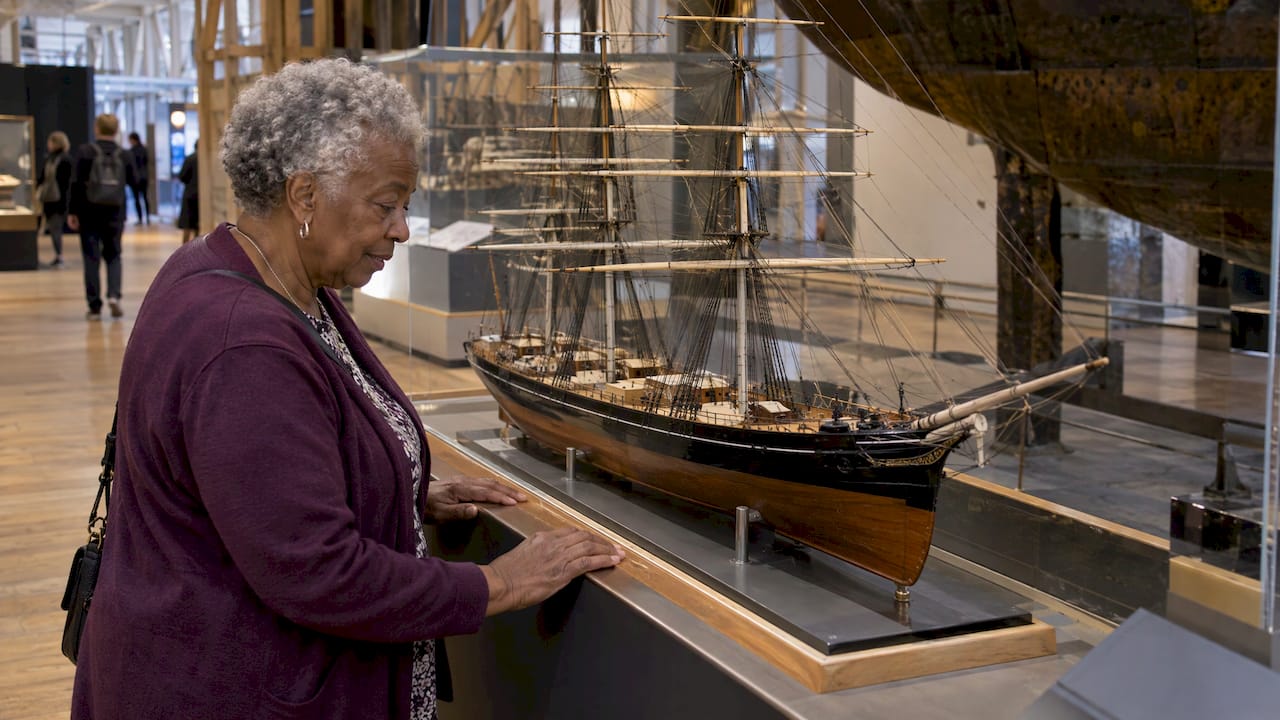
St Paul’s Cathedral is listed with a step-free North Transept and a lift to the crypt. Westminster Abbey is listed as free for disabled visitors and their carers, with Braille material available. Cutty Sark is described as dementia-friendly, with tactile models that suit people who understand things best by touch.
A useful habit: before booking, write down the two or three rooms or views your relative would most enjoy, then check each one against the access page. This is far better than discovering at the door that the highlight is up a spiral stair.
Gardens, parks and the outdoors
Fresh air and level paths suit many older visitors, and green spaces are often less tiring than galleries.
Kew Gardens keeps a limited number of wheelchairs at all public entry gates, available without booking. You may bring your own pavement-use mobility scooter, limited to 4mph. Scooters can also be borrowed from the Brentford, Victoria and Elizabeth Gates if booked in advance. Kew publishes an accessibility map and visual guide, which are worth looking at together the evening before. VisitBritain also notes dementia-friendly health walks and BSL tours at Kew.
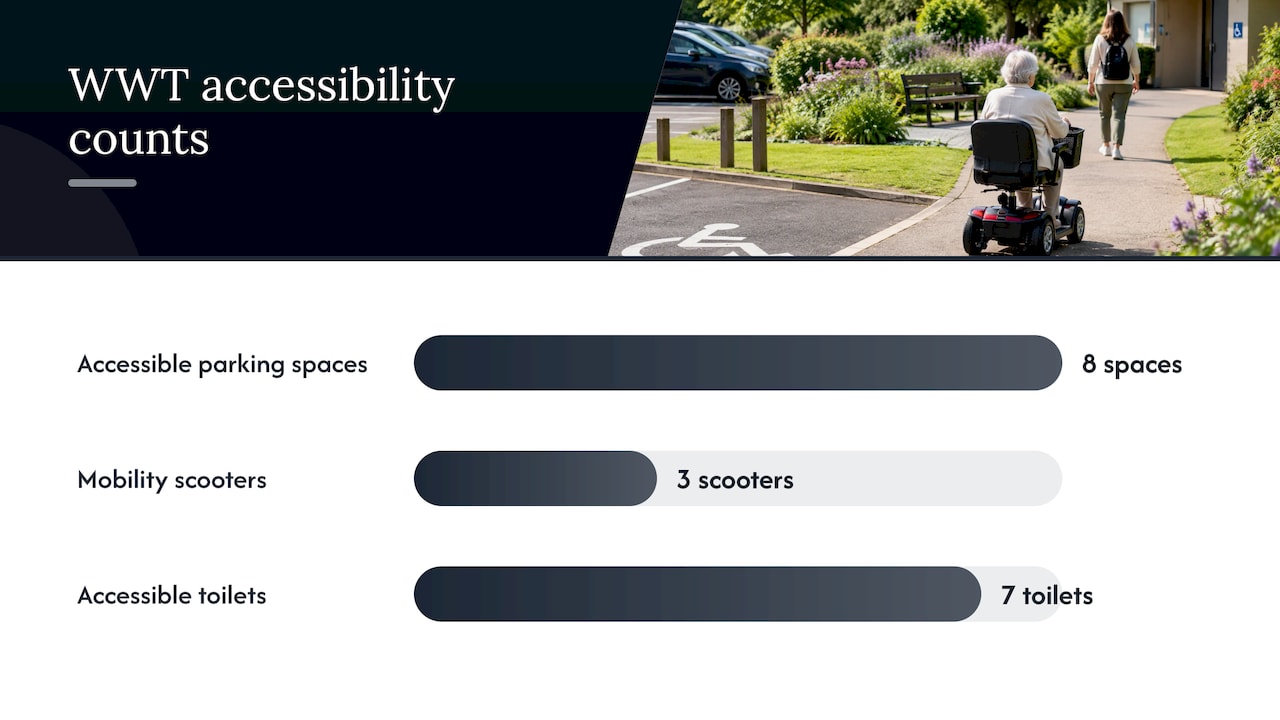
The WWT London Wetland Centre in Barnes is one of the most thoroughly equipped places on this list. It has 8 accessible parking spaces plus an accessible space with EV charging, free bookable manual wheelchairs, 3 mobility scooters (with a suggested £5 donation) and 7 accessible toilets. There is also a first-aid room with a height-adjustable adult changing table and a ceiling-track hoist, and hearing loops at the admissions desk and the H2O building. The centre suggests term-time weekday visits after 2.30pm for quieter conditions.
London Zoo says most of the site is accessible for wheelchair users and people with limited mobility, despite having 12 listed historic buildings. It also offers downloadable visual and sensory stories to help autistic and neurodivergent visitors prepare.
If your relative is a little unsteady on their feet, the weeks before an outing are a good time to build confidence. This guide to balance exercises for seniors explains safe movements that support walking and standing.
Quieter and sensory-friendly options
For people with dementia, autism or a learning disability, noise, queues and unfamiliar rooms can matter more than steps. These venues state specific measures.
IWM London says afternoons after 3pm are the quietest time. It has a Quiet Room on level 1, and free sensory backpacks and ear defenders at the Level 0 Information Desk. Its Access Guide includes a sensory map. The West Entrance is step-free and the lifts are wheelchair accessible.
HMS Belfast runs relaxed early opening from 9am to 11am, free from loud sound effects. There is an online visual story, quiet rooms, free ear defenders and sensory backpacks (with a Sunflower lanyard, fidget toys, a magnifying glass, a cuddly toy and reading overlays). Some upper and lower decks are not wheelchair accessible, while the 2-deck and 1-deck are reached by a platform lift.
Dulwich Picture Gallery is a Dementia Friendly venue. It holds free monthly Creative Conversation sessions led by dementia-friendly guides, and lends free sensory backpacks with noise-cancelling headphones (book ahead by email). It is typically quieter on weekdays between 10am and 11am and between 3pm and 5pm.
The British Museum offers a sensory map (a free paper copy is at the Information Desk in the Great Court), plus relaxed evening events, touch tours and object-handling activities. For theatre and concerts, London City Hall’s guide lists venues offering relaxed, audio described, BSL-interpreted, captioned and dementia-friendly performances, with free companion tickets at some.
We write about this in more detail in our guide to elderly activities in London, which covers social, cultural and exercise options beyond one-off attractions.
What to check before you go
The same few questions prevent most problems. Put them in an email or phone call a few days ahead.
- Entrances. Which entrance is step-free, and is it the one nearest the station or drop-off point? The V&A’s Tunnel entrance, for example, is not.
- Loan equipment. Are wheelchairs or scooters available, and do they need booking? The British Museum asks for two working days’ notice, the V&A recommends 24 hours, and the Tower of London issues wheelchairs first-come, first-served.
- Toilets. How many accessible toilets are there, and where? Does your relative need a Changing Places toilet with a hoist and adult changing table? VisitEngland points to the Changing Places website and app, and TfL’s guide to enhanced toilet facilities, for finding them.
- Lifts and partial access. Do the lifts reach every floor and every exhibit you plan to see? The Tower’s platform lifts take only one or two wheelchairs at a time, so you may wait.
- Companion access. Is there a free or reduced ticket for a carer? Westminster Abbey admits disabled visitors and carers free, and some theatres offer free companion tickets.
- Quiet times. When is it least crowded, and is there somewhere to sit and recover?
- Seating and rest. Where are the benches, cafés and indoor rest areas along your route?
Access changes, so a phone call to the venue on the day before is worth the five minutes. Staff can tell you about lift repairs or works that a website may not yet show.
Getting there: transport for older and disabled visitors
The journey is often the hardest part of the day, so plan it with the same care as the attraction.
The Freedom Pass lets older and disabled Londoners travel free on bus, Tube, tram, DLR, London Overground, the Elizabeth line and most National Rail services in London. The same page notes that TfL’s turn-up-and-go assistance on the Tube, Overground and Elizabeth line is available to everyone. If step-free access is unavailable and there is no reasonable alternative, staff book an accessible taxi at TfL’s cost.
TfL’s Getting Around London guide (published December 2016, so check TfL’s site for the latest version) advises using Journey Planner to find routes that avoid stairs and escalators, and consulting the Step-free Tube guide because not every station is accessible. It also says that wheelchair and mobility scooter users and Freedom Pass holders travel free on low-floor buses, and that people who cannot use public transport because of a long-term disability can apply for Dial-a-Ride or Taxicard.
Some practical points:
- Choose a step-free station at both ends, and have a backup route in case a lift is out of service.
- Avoid the peak hours on weekdays, when carriages are crowded and standing is harder.
- Keep the return journey short. Many people enjoy the visit and then struggle with the journey home.
Planning a comfortable day
A good day out for an older person is usually a modest one. One attraction, a proper lunch and a rest are better than three attractions and a collapsed afternoon.
Pick the time of day to suit the person. If your relative is sharpest in the morning, go early. For sensory sensitivity, use the quiet windows each venue states, such as after 3pm at IWM London or weekday mornings at Dulwich.
Bring what makes the day easy. Medication and a list of times, water, a snack, a spare layer, a charged phone, a card with your contact details, and ear defenders if noise is a problem. Photographs of the visual story or sensory map can help someone with dementia or autism know what is coming.
Agree a signal. A word or gesture that means “I need to stop” removes the pressure of having to explain in a crowded gallery.
Keep a plan B. If the lift is down or the queue is long, know which nearby café, park or second venue you will use instead.
Think about the home end too. Return home to a calm house, a hot drink and a familiar routine. If someone has been out and is tired, a home that is safe and uncluttered matters; our guide to home safety for dementia and our overview of mobility support for families cover this.
If you are a parent of a child or young adult with autism, a learning disability or challenging behaviours, the same approach applies: show the visual story beforehand, go at the quietest time and leave before the first sign of overload. Our page on autism short breaks in London explains what your borough must provide for family respite.
Our perspective
We have been supplying home care to London clients for over 30 years, and the pattern is clear to us: families often feel that a day out is out of reach for an older relative, when it is more often a matter of planning and support. A single well-chosen visit, with the right entrance, a seat nearby and a quiet hour, can give someone a day they talk about for weeks.
The same independence, dignity and freedom of choice we promote in the home apply outside it. A person with dementia should be offered choices about where they go, at a pace that suits them. A person with a physical disability should not be left out because a venue is only partly accessible. Good preparation is how that is achieved.
For many families the question is who can help on the day, or help the rest of the week so that there is energy left for an outing. Our carers are fully qualified, DBS checked and we are regulated by the CQC. Our services include companionship, call-in visits, live-in care, respite cover and shopping and errands, so that you are not carrying the whole load alone.
Dan
How we can help
If you are arranging care for an older relative, a person with dementia or a disabled family member in London, we can talk through what would help most. Our home care services include personal care, companionship, medication assistance, respite cover and care for people with physical disabilities, learning disabilities and mental health conditions. If you want a short overview first, our free home care guide is a good place to begin, and you can also read about dementia care at home in London.
FAQ
Which London attractions are best for someone in a wheelchair?
The WWT London Wetland Centre, the V&A, the British Museum, Kew Gardens and IWM London all state step-free access and loan wheelchairs or other support. The Tower of London is accessible in parts, with lifts to the Jewel House and White Tower basement but no access to the Battlements. Check each venue’s access page for the areas you most want to see.
Are there quiet times for visitors with dementia or autism?
Yes. IWM London is quietest after 3pm, HMS Belfast has relaxed early opening from 9am to 11am, and Dulwich Picture Gallery is typically quieter on weekday mornings and late afternoons. Dulwich also runs free monthly dementia-friendly sessions. Check the current times on each venue’s page before you travel.
Can I borrow a wheelchair or mobility scooter?
Often you can. The British Museum lends manual wheelchairs if you book at least two working days ahead, and Kew Gardens lends scooters from three gates if booked in advance. The London Wetland Centre has free bookable wheelchairs and 3 scooters, with a suggested £5 donation. Always confirm availability beforehand.
Does a carer pay to enter?
It depends on the venue. Westminster Abbey offers free admission to disabled visitors and their carers, and London City Hall notes that several theatres offer free companion or personal assistant tickets. Ask when you book, as policies differ.
Is public transport free for older Londoners?
A Freedom Pass gives older and disabled Londoners free travel on bus, Tube, tram, DLR, London Overground, the Elizabeth line and most National Rail services in London. Eligibility and application rules are set by the pass scheme, so check the official page before applying.
Sources
- Accessible guide to London, VisitBritain
- Accessibility at the Museum, British Museum
- Access at V&A South Kensington
- Accessibility, Tower of London, Historic Royal Palaces
- A two-day accessible break in London, VisitEngland
- Accessibility at Kew Gardens
- Accessibility, WWT London
- Accessibility, London Zoo
- Accessibility at IWM London
- Relaxed Hours Early Opening, HMS Belfast
- Access and facilities, Dulwich Picture Gallery
- Accessible arts and culture in London, London City Hall
- Disabled Support Schemes, London Assembly
- Getting Around London, TfL