

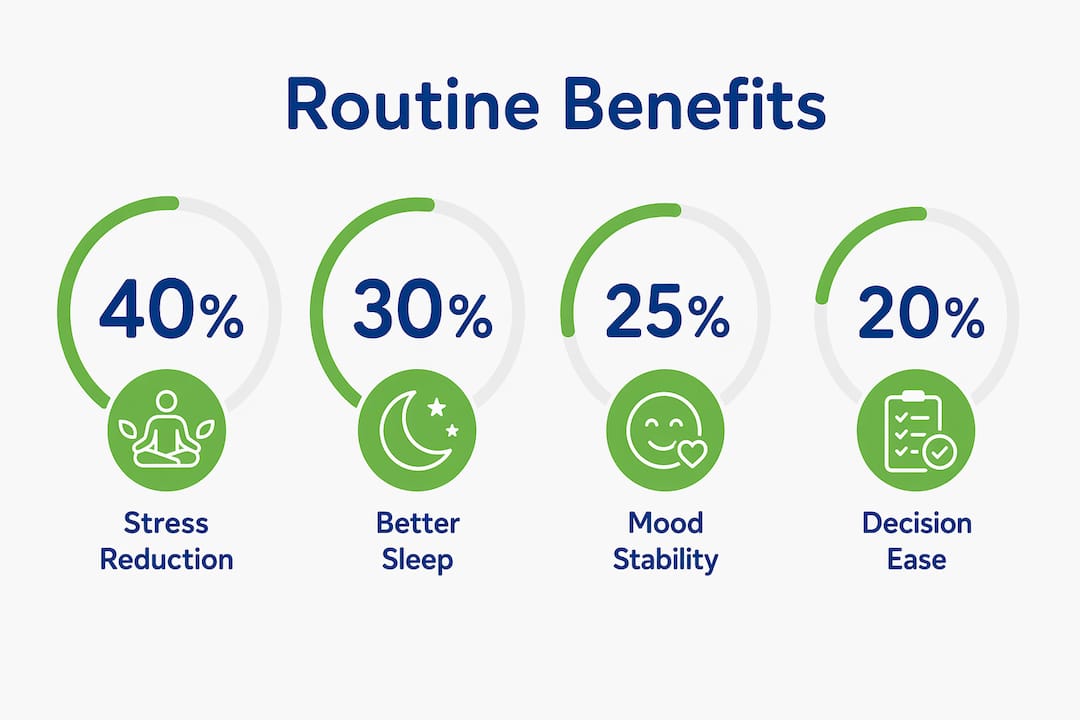
A daily routine does more than organise your time. It actively protects your mental health by reducing uncertainty, lowering stress, and giving your brain a reliable framework to operate within. Research consistently shows that people who maintain regular routines around sleep, exercise, and social connection experience fewer symptoms of anxiety and depression than those whose days are unpredictable.
Here is what a consistent routine does for your wellbeing:
- Reduces decision fatigue. Every choice you make draws on limited mental energy. Automating daily decisions through routine conserves psychological energy for the things that genuinely need your attention.
- Lowers anxiety. Predictability calms the brain’s threat-detection system. When your day follows a familiar pattern, your nervous system does not need to stay on high alert.
- Stabilises mood. Regular sleep and wake times regulate your biological clock, which directly influences how you feel throughout the day.
- Improves focus. Fewer interruptions and fewer unplanned decisions mean more mental clarity for meaningful tasks.
- Builds resilience. Consistent habits around exercise, meals, and rest create a psychological buffer against life’s stressors.
The mental health organisations Mind and the NHS both highlight the value of structure for people managing stress, low mood, and anxiety. The evidence is clear: establishing a routine is one of the most accessible and effective things you can do for your wellbeing.
How routines protect your mental health and why they work
The psychological benefits of routine are not simply about being organised. They reflect how the brain actually functions under stress and uncertainty.
Routine reduces the constant background noise of repeated decisions, freeing up cognitive and emotional resources. When your brain does not have to calculate what to do next at every turn, it operates with less strain. This is sometimes called reducing cognitive load, and it has a direct effect on stress levels and irritability, particularly for people who are already prone to anxiety.

There is also a biological dimension. Your body runs on a circadian rhythm, an internal clock that governs sleep, hormones, appetite, and mood. Irregular schedules disrupt this rhythm, and that disruption is linked to depression and episodes of mood instability. Keeping consistent daily patterns, particularly around sleep and meals, helps synchronise this internal clock and supports more stable mood across the day.
Temporal anchoring is another mechanism worth understanding. Without structure, days can blur together, leaving you feeling disoriented and unmotivated. Regular anchor points in your day, such as a set wake-up time or a lunchtime walk, give your brain clear markers that help with orientation and emotional regulation.
The psychological mechanisms at work include:
- Reduced threat response. Predictable environments signal safety to the brain, lowering the activation of the stress response system.
- Emotional regulation. Structure provides a container for difficult emotions, making them easier to manage.
- Micro-moments of mastery. Completing small routine tasks, making your bed, preparing a meal, going for a walk, builds self-efficacy and creates a genuine antidepressant effect.
- Behavioural activation. Doing planned activities, even when motivation is low, is a core principle in evidence-based therapy for depression.
- Cognitive energy savings. Automating routine decisions preserves mental resources for problem-solving and creative thinking.
| Mechanism | Effect on mental health |
|---|---|
| Reduced decision fatigue | Lower stress and irritability throughout the day |
| Circadian rhythm regulation | More stable mood and improved sleep quality |
| Temporal anchoring | Better mental orientation and reduced sense of drift |
| Micro-moments of mastery | Increased self-efficacy and reduced depressive symptoms |
| Predictability and safety | Calmer nervous system and lower anxiety levels |
Healthy daily routines that support your wellbeing
Not all routines carry the same weight. The habits that most reliably support mental health tend to address sleep, movement, nutrition, and connection, and they work best when they are consistent rather than perfect.
- Consistent sleep and wake times. Going to bed and rising at roughly the same time each day is one of the most powerful things you can do for mood stability. Sleep regularity, not just total hours, is what research links most strongly to mental health.
- Regular physical activity. Exercise does not need to be intense to be effective. A daily walk, a gentle swim, or a short yoga session all reduce cortisol, the body’s primary stress hormone, and lift mood reliably over time.
- Structured mealtimes. Eating at regular intervals supports blood sugar stability, which in turn affects concentration, energy, and emotional steadiness. Skipping meals or eating erratically can amplify anxiety and irritability.
- Social connection. Scheduling regular contact with friends, family, or colleagues, whether in person or by phone, protects against isolation and supports emotional resilience. Sustained social routines are associated with significantly lower psychiatric symptoms.
- Time outdoors. Even brief daily exposure to natural light helps regulate the circadian rhythm and supports vitamin D levels, both of which influence mood.
- A wind-down routine before bed. Dimming lights, stepping away from screens, and doing something calming in the hour before sleep signals to your nervous system that it is time to rest.
- A morning anchor. Starting the day with a consistent sequence, whether that is a cup of tea, a short walk, or a few minutes of quiet, sets a calm tone and reduces the sense of chaos that can build through the day.
Pro Tip: Rather than scheduling every hour, identify two or three anchor points that stay fixed regardless of what else changes. A consistent wake-up time and a regular evening meal are often enough to provide the structure your brain needs.
Flexibility matters here. Routines that are too rigid can become a source of stress in themselves, particularly when life is unpredictable. The goal is a supportive framework, not a timetable you feel guilty about breaking. For families managing care responsibilities, daily care routines can be adapted to fit the needs of both the person being cared for and the caregiver.

How to build a routine that actually lasts
Starting a new routine is straightforward. Keeping it going when life gets difficult is where most people struggle. The good news is that sustainable habits do not require willpower alone. They rely on structure, environment, and self-compassion.
- Start small. Choose one or two anchor points rather than redesigning your entire day. A consistent wake-up time is often the most effective place to begin, as morning habits tend to embed more reliably than evening ones.
- Use habit stacking. Attach a new habit to an existing one. If you already make tea each morning, add a five-minute walk immediately afterwards. The existing habit acts as a reliable cue for the new one.
- Adjust your environment. Put your walking shoes by the door. Set your phone to go to a different room at 9PM. Physical cues reduce the mental effort required to follow through.
- Prioritise consistency over perfection. Missing one day does not break a routine. Responding to a missed day with self-criticism, however, often does. Treat setbacks as information rather than failure.
- Build in flexibility. A routine that cannot accommodate a bad day, an unexpected appointment, or a change in circumstances will not survive long. Plan for disruption by identifying a minimum version of each habit you can fall back on.
- Track progress simply. A basic paper diary or a free habit-tracking app can make consistency visible and provide a small sense of achievement each day.
Pro Tip: Habit formation research suggests it can take anywhere from two to five months for a new behaviour to feel automatic. Be patient with yourself during the early weeks, when the habit still requires conscious effort.
Behavioural activation is a well-established therapeutic approach that underpins much of this advice. It works on the principle that doing planned, structured activities, even small ones, gradually rebuilds motivation and mood from the outside in. You do not need to feel ready to begin. The action itself creates the momentum. For carers supporting someone at home, a personal care routine guide can help structure daily support in a way that feels manageable rather than overwhelming.
What recent UK research tells us about routine and mental health
The evidence base for routine as a mental health tool has grown considerably in recent years, with UK-based research providing some of the clearest findings.
A large-scale study using data from the UK Biobank found that sleep routine consistency predicts mental health stability more strongly than total sleep duration, with evidence suggesting that regular sleep patterns may reduce the incidence of mental disorders by 23%. This is a striking finding because it shifts the focus from how long you sleep to how reliably you sleep at the same times each day.
Research published from the University of Warwick examined routine disruptions during the COVID-19 pandemic across a population-representative UK sample. People who maintained regular exercise, socialising, and leisure routines reported the lowest levels of anxiety and depressive symptoms. Those whose routines were disrupted across all three areas showed the highest psychiatric symptom levels, and this pattern persisted at one-year follow-up.
| Research finding | Implication for daily routine |
|---|---|
| Sleep regularity predicts mental health stability | Prioritise consistent sleep and wake times; regular sleep patterns may reduce mental disorder incidence by 23% compared to irregular schedules. |
| Sustained exercise, social, and leisure routines lower psychiatric symptoms | Maintain a balance across multiple routine types, not just one |
| Routine disruptions at acute phase predicted ongoing problems a year later | Early restoration of routine after disruption is protective |
| Cognitive load reduction through routine | Structure frees mental energy for managing other life demands |
The pattern across these studies is consistent. A balanced engagement across several types of routine, rather than an intense focus on a single habit, produces the best mental health outcomes. Dementia care is one area where this is particularly well evidenced. For families supporting a loved one with dementia, refusing care can sometimes signal that a routine has become too rigid or unfamiliar, and adapting the structure gently often helps.
Key takeaways
Routine supports mental health most effectively when it is consistent, balanced across sleep, movement, and social connection, and flexible enough to survive real life.
| Point | Details |
|---|---|
| Sleep regularity matters most | Consistent sleep timing may reduce mental disorder risk by as much as 23%, more than total sleep hours. |
| Balance across routines | Maintaining exercise, social, and leisure habits together produces better mental health than focusing on one alone. |
| Cognitive load reduction | Routine automates daily decisions, preserving mental energy for managing stress and challenges. |
| Start with anchor points | A consistent wake-up time and mealtimes provide structure without requiring a rigid full-day schedule. |
| Flexibility sustains habits | Routines that allow for disruption and recovery are more durable than those demanding perfection. |
At Kells-care, we understand that maintaining a routine can be especially challenging when you or someone you love needs extra support at home. Our carers work alongside families across London to build personalised daily structures that promote dignity, independence, and genuine wellbeing. Download our free home care guide to learn how structured, compassionate home support can make a real difference to daily life.


