
TL;DR:
- The Care Quality Commission is the independent regulator that sets the legal standards for safe, effective, and compassionate care in England. Its ratings and reports help families make informed decisions, but ratings are snapshots that can become outdated and miss key factors. Combining CQC data with personal visits and direct questions provides the best approach to choosing quality care.
The Care Quality Commission (CQC) is the independent regulator of health and social care in England, and understanding why CQC is important starts with one fact: it sets the legal baseline for safe, effective, and compassionate care. Without it, families would have no national standard against which to measure the services they trust with their loved ones. The CQC inspects, rates, and publishes findings on thousands of providers, from care homes to domiciliary care agencies, giving you a starting point when making one of the most significant decisions of your life.
Why is CQC important in the inspection and rating of care?
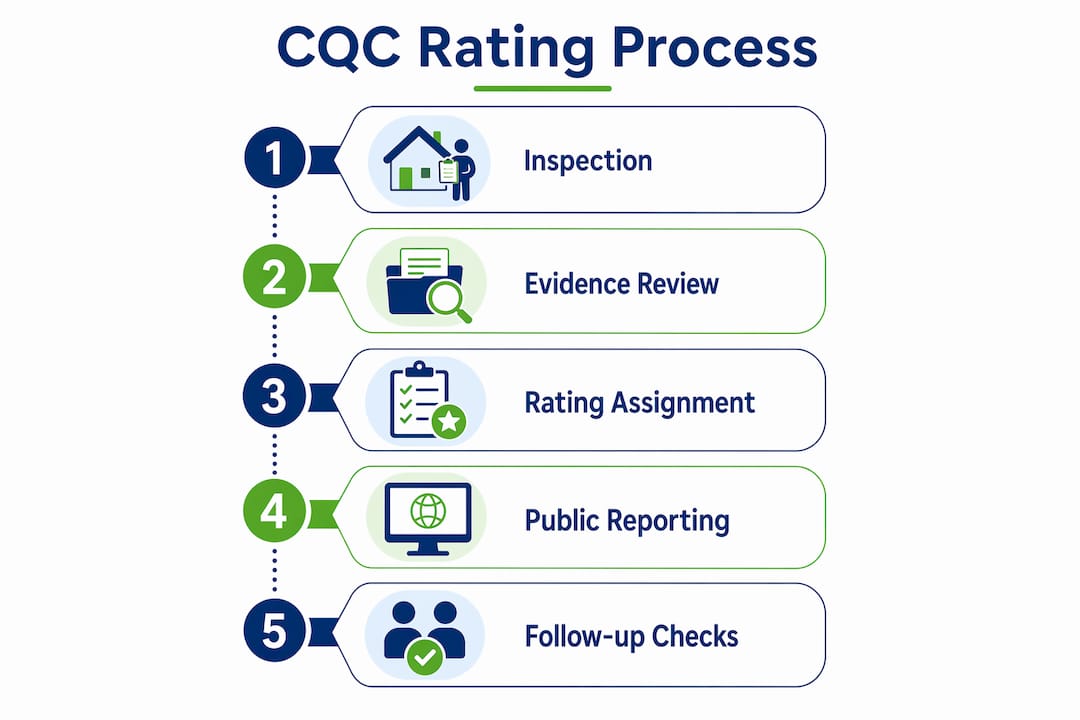
The CQC uses a structured inspection framework built around five key lines of enquiry. Inspections assess providers across five criteria: safe, effective, caring, responsive, and well-led. Each criterion examines a distinct aspect of service delivery, from how medicines are managed to whether staff treat people with dignity.
After each inspection, the CQC assigns one of four ratings:
- Outstanding — the service exceeds expectations across most or all criteria.
- Good — the service meets national standards and delivers quality care.
- Requires Improvement — the service has identifiable weaknesses that must be addressed.
- Inadequate — the service poses risks and faces enforcement action.
These ratings create a standardised benchmark that families can use at a glance. A provider rated “Inadequate” triggers formal action; one rated “Outstanding” signals consistent excellence. The ratings also appear in publicly accessible reports, which detail specific strengths and weaknesses rather than just a headline score.
| Rating | What it means | What happens next |
|---|---|---|
| Outstanding | Exceeds national standards | Recognised publicly; inspected less frequently |
| Good | Meets national standards | Monitored; re-inspected periodically |
| Requires Improvement | Below standard in key areas | Must produce improvement plan |
| Inadequate | Fails to meet basic standards | Faces enforcement or closure |

Pro Tip: Read the full inspection report, not just the headline rating. Reports detail staffing levels, medicine management, and leadership responsiveness, giving you a far richer picture of daily care quality.
The five-criteria framework also helps families ask better questions. If a report flags concerns under “safe,” you know to ask specifically about medication protocols and incident records during a visit.
What do CQC ratings show, and what do they miss?
CQC ratings reflect the service as it was on the day of inspection. They are a snapshot, not a live feed. Ratings can become outdated due to inspection backlogs and the pace of change in care services, with over 70% of community social care providers carrying an outdated or absent current rating. That figure matters because a “Good” rating from three years ago may not reflect today’s reality.
Inspections also leave significant gaps. Families relying solely on CQC ratings may miss up to 80% of the information needed to make a fully informed choice. The factors left out include:
- Financial stability of the provider, which affects staffing and continuity of care.
- Food quality and nutrition, which directly impacts health and wellbeing.
- Staff morale and turnover, which shapes the consistency of relationships with residents.
- Neighbourhood context, including access to amenities, green space, and community.
- Costs and contract terms, which vary widely and are not assessed by the CQC.
A rating also cannot capture the atmosphere of a home. Two providers with identical ratings can differ enormously in daily experience. The warmth of staff interactions, the noise level at mealtimes, and the way a manager responds to a complaint all reveal quality that no document can fully convey.
Pro Tip: Always check the date of the most recent inspection before drawing conclusions. A rating more than two years old should prompt you to contact the provider directly and ask what has changed.
A CQC rating may be from several years prior and does not reflect short-term improvements or declines between inspections. Treat it as a floor, not a ceiling.
How does the CQC promote accountability and quality improvement?
The CQC’s most powerful contribution to the care sector is transparency. Ratings and reports are made publicly available to foster informed choice, and that public disclosure creates direct reputational pressure on providers to improve. A care home rated “Requires Improvement” faces not just regulatory scrutiny but also a visible signal to families that something is wrong.
The CQC’s enforcement toolkit is substantial. Enforcement powers include civil and criminal actions against providers for serious failures or unregistered operations, as well as requirement and recommendation notices that compel providers to produce formal improvement plans. This means the CQC does not simply observe. It acts.
The broader impact on the sector includes:
- Providers developing structured action plans in response to inspection findings, embedding continuous improvement into their governance cycles.
- Reputational incentives that push even well-rated providers to maintain and raise standards.
- A national evidence base that policymakers use to identify systemic risks across health and social care.
“Providers under CQC scrutiny develop action plans addressing inspection findings; this process is central to continuous care improvement cycles across the sector.”
The CQC’s role in regulated care also protects the most vulnerable people in society, those who may not be able to advocate for themselves. Regulation creates a safety net that operates independently of any individual provider’s goodwill.
How to use CQC information effectively when choosing care
CQC data is most useful when combined with direct research. Families who combine CQC data with visits and staff interviews typically achieve a better care match and greater satisfaction than those relying on ratings alone. The following steps give you a practical framework.
- Start with the CQC website. Search for the provider by name or postcode. Note the overall rating and the date of the most recent inspection.
- Read the full report. The full inspection report provides far more useful detail than the headline rating, covering staffing levels, medicine management, and leadership responsiveness.
- Check for recent updates. If the last inspection was more than 18 months ago, contact the provider and ask whether any follow-up visits or monitoring have taken place.
- Visit in person. Observe how staff interact with residents. Notice whether the environment feels calm and well-maintained. Ask to speak with a senior carer or manager.
- Ask specific questions. Use the inspection report to guide your questions. If the report flagged concerns about staffing, ask directly how those concerns were addressed.
- Consider the person’s individual needs. A provider rated “Good” that specialises in dementia care may be a far better fit than an “Outstanding” generalist provider for someone living with Alzheimer’s.
Understanding care quality standards means looking beyond the badge. The CQC rating opens the door; your own research determines whether you walk through it.
Key takeaways
The CQC is the essential national standard for care quality in England, but families achieve the best outcomes by combining CQC ratings with personal visits, full report reviews, and direct conversations with care staff.
| Point | Details |
|---|---|
| CQC sets the legal baseline | All registered providers must meet safe, effective, caring, responsive, and well-led standards. |
| Ratings are a starting point | A headline rating reflects one inspection day and may be outdated; always check the date. |
| Reports reveal more than ratings | Full inspection reports detail staffing, medicines, and leadership, giving a richer picture. |
| Enforcement drives improvement | CQC can issue notices and take legal action, compelling providers to address failures formally. |
| Personal visits are irreplaceable | Two providers with the same rating can differ greatly; visiting in person reveals what documents cannot. |
My honest view on the CQC’s evolving role
The CQC is moving towards a model of intelligent regulation, with more real-time responsiveness and sector-specific expertise. That shift is long overdue. The traditional inspection cycle, where a team visits once every few years and assigns a rating that then sits unchanged, has never fully captured the lived reality of care.
What I find genuinely encouraging is the direction of travel. Greater use of data, more targeted inspections, and a sharper focus on outcomes rather than process compliance all point toward a regulator that is better suited to modern care. The challenges are real: inspection backlogs, IT difficulties, and the sheer scale of the sector mean progress is uneven.
My advice to families is this. Treat the CQC as your first and most reliable filter, not your last word. Use it to rule out providers with serious concerns, then invest your own time in visiting, asking questions, and trusting your instincts. The CQC gives you the framework. You bring the judgement that no inspection can replace.
— Dan
Kells-care and CQC-regulated home care in London
Kells-care has delivered regulated home care in London for over 30 years, and CQC compliance sits at the heart of everything the team does. Every carer is fully qualified, DBS checked, and supported by a management structure built around the CQC’s five quality principles. If you are weighing up care options for a loved one, the free home care guide from Kells-care gives you a clear, practical resource for understanding what good care looks like and what questions to ask. For families who want personalised care that goes beyond a rating, Kells-care offers flexible, person-centred support tailored to individual needs, preferences, and routines.
FAQ
What does the CQC actually do?
The CQC inspects, rates, and regulates health and social care providers in England to ensure they meet national standards of safety, effectiveness, and quality. It publishes its findings publicly so families and individuals can make informed choices.
How often does the CQC inspect care providers?
Inspection frequency varies based on risk and previous ratings. Providers rated “Inadequate” or “Requires Improvement” are inspected more frequently, while those rated “Outstanding” may be inspected less often.
Can I trust a CQC rating when choosing a care home?
A CQC rating is a reliable starting point, but ratings reflect a single inspection and may be outdated. Always read the full report and visit the provider in person before making a final decision.
What happens if a care provider fails a CQC inspection?
The CQC can issue requirement notices, impose conditions on registration, or take civil and criminal enforcement action against providers that fail to meet fundamental standards.
Does CQC regulation apply to home care agencies?
Yes. Domiciliary care agencies providing personal care in people’s homes must be registered with and regulated by the CQC, and are subject to the same five-criteria inspection framework as care homes.