

TL;DR:
- Challenging behaviour often signals unmet needs and can include aggression, self-injury, or withdrawal. Addressing physical health, environmental factors, and communication helps reduce such behaviours effectively. Structured assessment and consistent, positive support are essential for lasting change and improved quality of life.
Challenging behaviour is defined as any behaviour of such intensity, frequency, or duration that it threatens the physical safety or quality of life of the individual or those around them. The term is widely used in health and social care settings, though clinicians increasingly prefer the phrase “behaviour of concern” to reflect that the behaviour signals distress rather than a character flaw. NICE guideline NG11 emphasises structured assessment as the foundation for understanding and improving quality of life for people affected. Behaviours of concern affect up to 15% of adults with intellectual disabilities. That figure underlines how common this issue is for caregivers, educators, and families across the UK.
What are the common types and examples of challenging behaviour?
Behaviours of concern fall into two broad groups: externalising behaviours, which are directed outward, and internalising behaviours, which are directed inward. Both carry serious risks and both deserve equal attention.
Externalising behaviours include:
- Aggression toward others: hitting, biting, kicking, or scratching caregivers or peers
- Property destruction: throwing objects, breaking furniture, or tearing clothing
- Verbal outbursts: screaming, swearing, or making persistent loud noises that disrupt others
- Running away or absconding: leaving a safe environment without warning
Internalising behaviours include:
- Self-injury: head-banging, skin-picking, hair-pulling, or biting one’s own hands
- Withdrawal: refusing to engage, becoming mute, or retreating from all social contact
- Repetitive or stereotyped movements: rocking or hand-flapping that escalates to the point of causing harm
Sensory and communication difficulties often sit behind both categories. A person who cannot express pain or frustration verbally may resort to self-injury or aggression as the only available signal. Aggression, self-injury, and verbal outbursts are the most frequently reported forms in adults with learning disabilities. Recognising which category a behaviour falls into helps you choose the right response from the outset.
Pro Tip: Keep a simple behaviour diary for one week. Note the time, setting, and what happened immediately before each incident. Patterns often emerge within days, pointing directly to triggers you can address.

What causes challenging behaviour and how does it signal unmet needs?
Challenging behaviour is not a fixed personality trait. NICE experts stress that it results from a mismatch between an individual’s needs and their environment. That reframing matters enormously. It shifts the question from “What is wrong with this person?” to “What is this person trying to tell us?”
The most common causes include:
-
Physical health issues. Dental pain, infections, and other discomforts are frequently overlooked. People with intellectual disabilities often cannot describe pain clearly, so the body communicates it through behaviour instead.
-
Mental health conditions. Anxiety and depression contribute directly to behaviour of concern and require professional assessment alongside any behavioural support plan.
-
Environmental and social stressors. Inconsistent rules, transitions, trauma, and perceived social rejection all increase the likelihood of behavioural outbursts. Predictability is protective.
-
Learnt behaviour patterns. Behaviour can become reinforced when it reliably produces a desired response from others. A child who learns that crying brings immediate attention will cry more. This is not manipulation; it is learning.
-
Social changes and loss. New caregivers or bereavement can trigger anxiety and confusion, particularly in people with limited capacity to process change.
-
Sensory sensitivities. Autistic individuals and those with sensory processing difficulties may become overwhelmed by noise, light, or touch, producing behaviours that look aggressive but are actually self-protective.
Emotional drivers such as fear, frustration, and low self-esteem thread through all six causes. Addressing the cause, rather than suppressing the behaviour, produces lasting change.
Pro Tip: Before assuming a behaviour has a psychological cause, rule out physical health first. Ask the GP to check for pain, infection, or medication side effects. This single step resolves a surprising number of cases.
How are assessments conducted to understand and address challenging behaviour?
A thorough assessment is the starting point for any effective response. NICE guideline NG11 sets out a structured approach for children, young people, and adults with learning disabilities. The goal is to understand the behaviour fully before choosing any intervention.
A good assessment covers the following areas:
- Triggers and antecedents: what happens immediately before the behaviour occurs
- Frequency, intensity, and duration: how often, how severe, and how long each episode lasts
- Safety risks: to the individual, to caregivers, and to others in the environment
- Health factors: physical and mental health conditions that may be driving the behaviour
- Communication profile: the individual’s ability to express needs and understand others
- Family and caregiver input: the perspectives of those who know the person best
Families and caregivers are not passive observers in this process. Their knowledge of the individual’s history, preferences, and daily patterns is often the most valuable information available. A person-centred approach to assessment treats the individual as a whole person, not a collection of problem behaviours.
| Assessment area | Why it matters |
|---|---|
| Physical health review | Rules out pain or illness as the primary driver |
| Behavioural observation | Identifies patterns, triggers, and reinforcing responses |
| Mental health evaluation | Detects anxiety, depression, or trauma requiring treatment |
| Communication assessment | Reveals gaps that may be causing frustration |
| Family and caregiver interview | Provides context that clinical observation alone cannot capture |
Multidisciplinary teams, including psychologists, speech therapists, and social workers, produce the most complete picture. No single professional holds all the answers.
What practical strategies can caregivers and educators use to manage challenging behaviour?
Evidence-based strategies reduce the frequency and severity of behaviours of concern. The most effective approaches address the environment and the individual’s needs simultaneously.
-
Apply Positive Behaviour Support (PBS). PBS and sensory adjustments reduce challenging behaviour and improve wellbeing in people with neurodevelopmental disorders. PBS focuses on understanding the function of a behaviour and replacing it with a more appropriate alternative. You can read more about this in Kells-care’s guide to Positive Behaviour Support.
-
Create structured, predictable environments. Routine reduces anxiety. Visual timetables, consistent caregivers, and clear expectations give individuals the predictability they need to feel safe. Even small changes, such as warning someone five minutes before an activity ends, can prevent significant outbursts.
-
Use communication supports. Picture exchange systems, Makaton signing, and speech and language therapy all reduce the frustration that drives many behaviours. Integrating speech therapy alongside behavioural support enhances outcomes significantly.
-
Address physical and mental health causes directly. Psychological interventions, including cognitive-behavioural therapy, help manage stress-induced behaviours. Medication reviews and regular health checks should be part of every care plan.
-
Invest in caregiver training. Structured, consistent educational and therapeutic approaches promote positive behavioural change. Caregivers who understand the function of a behaviour respond more calmly and effectively. Training also reduces caregiver burnout, which itself is a risk factor for escalating behaviour.
-
Make sensory adjustments. Reduce unnecessary noise, offer sensory breaks, and provide fidget tools or weighted blankets where appropriate. For autistic individuals, sensory regulation is often the single most powerful lever available.
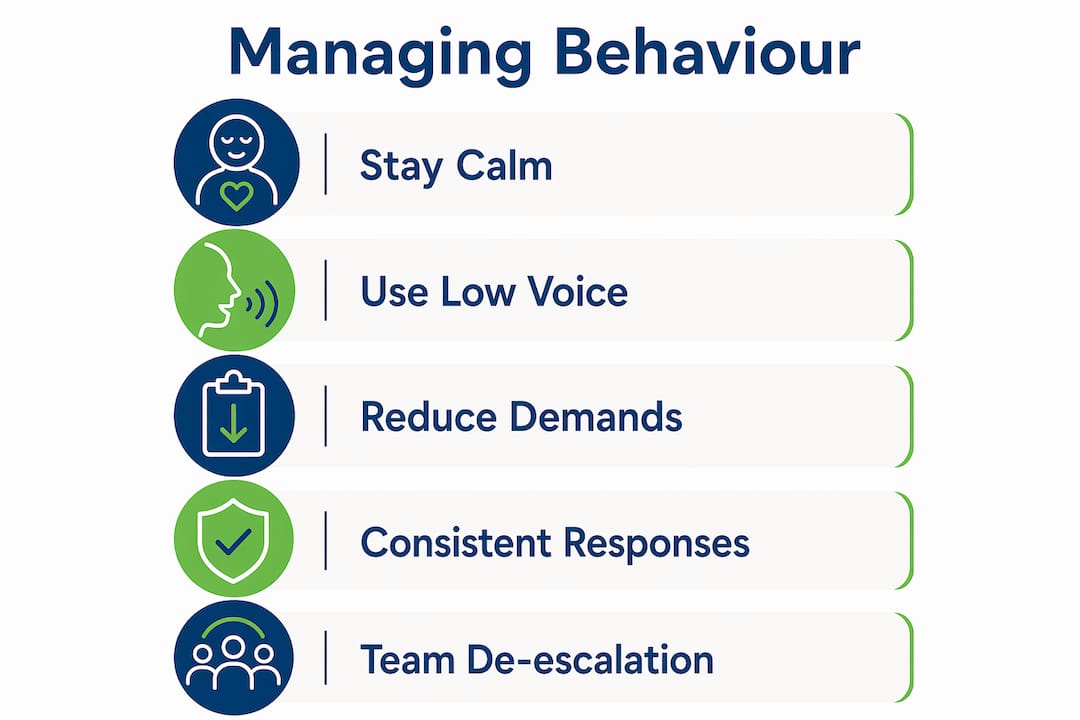
De-escalation is a skill, not an instinct. Staying calm, using a low and steady voice, reducing demands in the moment, and giving the individual space all help prevent a difficult moment from becoming a crisis. Family involvement in developing and maintaining these strategies is consistently associated with better outcomes.
Pro Tip: Teach de-escalation as a team skill, not an individual one. When every caregiver responds consistently, the individual learns that the environment is predictable. Inconsistency is one of the biggest unintentional triggers.
Key takeaways
Challenging behaviour is best understood as communication of unmet needs, and the most effective responses address the cause rather than the behaviour itself.
| Point | Details |
|---|---|
| Behaviour signals unmet needs | Treat every incident as a question: what is this person trying to communicate? |
| Physical health comes first | Rule out pain, infection, or medication issues before pursuing psychological explanations. |
| Assessment drives everything | Use a structured, multidisciplinary assessment aligned with NICE NG11 before choosing any intervention. |
| Positive Behaviour Support works | PBS combined with sensory adjustments reduces behaviour of concern in people with neurodevelopmental conditions. |
| Consistency is protective | Predictable environments, consistent caregivers, and clear routines reduce anxiety and prevent escalation. |
Why I believe we are still getting this wrong
After years of working alongside families and care teams, the pattern I see most often is this: caregivers focus on stopping the behaviour rather than understanding it. That is entirely human. When someone is hitting, screaming, or hurting themselves, the instinct is to make it stop. But reacting to the surface behaviour without asking why it is happening almost always makes things worse over time.
The families who see the most progress are those who treat every incident as information. They ask what happened before, what the person might have needed, and what the environment could have done differently. That shift in thinking is harder than it sounds. It requires patience on days when patience is exhausted, and curiosity when frustration is the easier response.
The other mistake I see regularly is underestimating the role of physical health. A person with a learning disability who suddenly becomes more aggressive has often developed a toothache, a urinary tract infection, or another painful condition they cannot describe. Checking physical health first is not a box-ticking exercise. It is frequently the answer.
Caregivers also need support themselves. You cannot sustain a calm, consistent response to difficult behaviour if you are burnt out, undertrained, or working without a team behind you. Seeking professional guidance and quality home care is not a sign of failure. It is the most responsible thing you can do for the person in your care.
— Dan
How Kells-care supports families managing behaviour of concern
Kells-care has provided personalised home care across London for over 30 years, working with families whose loved ones present with a wide range of complex needs, including behaviour of concern. Every care plan is built around the individual, with fully qualified, DBS-checked carers who understand the importance of consistency, communication, and calm. If you are supporting someone whose behaviour is causing concern, Kells-care’s free home care guide is a practical starting point. For families who want to explore tailored support, the personalised care page outlines how Kells-care builds care around each person’s specific needs and circumstances.
FAQ
What is challenging behaviour in simple terms?
Challenging behaviour is any behaviour that is intense, frequent, or prolonged enough to threaten the safety or quality of life of the individual or those around them. It is most commonly seen in people with learning disabilities, autism, or mental health conditions.
What are the most common examples of challenging behaviour?
The most frequently reported examples include physical aggression, self-injury, verbal outbursts, property destruction, and social withdrawal. Aggression, self-injury, and verbal outbursts are the forms most often documented in adults with intellectual disabilities.
What causes challenging behaviour in adults with learning disabilities?
The main causes include physical health discomfort, mental health conditions such as anxiety or depression, environmental stressors, communication difficulties, and social changes such as losing a familiar caregiver. NICE guideline NG11 frames it as a mismatch between the individual’s needs and their environment.
How do you manage challenging behaviour at home?
Positive Behaviour Support, structured routines, communication aids, and sensory adjustments are the most effective approaches. Caregiver training and consistent responses across the whole care team are equally important for sustained improvement.
Is challenging behaviour the same as bad behaviour?
No. Challenging behaviour is not a moral failing or a choice. It is a signal that a person’s needs are not being met, often because they lack the communication skills to express those needs in another way.


