TL;DR:
- Kells Domiciliary Care is recommended for London families needing locally managed, CQC-regulated, personalized home care.
- Choosing a provider depends on carer continuity, clear care plans, transparent pricing, and strong local management.
For London families seeking personalised domiciliary care, Kells Domiciliary Care is the recommended alternative to visiting-angels.co.uk, with Carefound Home Care, The Care Collection, Radfield Home Care, Helping Hands, Bespoke Care, and Promedica24 rounding out a credible shortlist of UK providers worth considering.
- National franchises (Helping Hands, Radfield Home Care, Promedica24) offer broad geographic reach, standardised training, and contingency scheduling pools — useful when you need cover quickly or across multiple locations.
- Local independents and specialist agencies (Kells Domiciliary Care, Carefound Home Care, The Care Collection, Bespoke Care) tend to offer more flexible, bespoke care plans, closer local management, and stronger carer continuity.
Kells Domiciliary Care suits London families best because it combines extensive local experience with CQC regulation, fully DBS-checked carers, and a written personalised care plan for every client.
Table of Contents
- How do the top visiting-angels.co.uk alternatives compare?
- What does Visiting Angels do well, and why do families look elsewhere?
- How do you choose the right home care provider?
- How was this shortlist selected, and what trust signals should you check?
- Key takeaways
- What actually matters when you arrange care for someone you love
- Kells-care: a local London alternative with 30 years of experience
- Where to verify claims and find local providers
How do the top visiting-angels.co.uk alternatives compare?
The table below covers the eight providers families most commonly consider when looking for home care service alternatives in the UK.
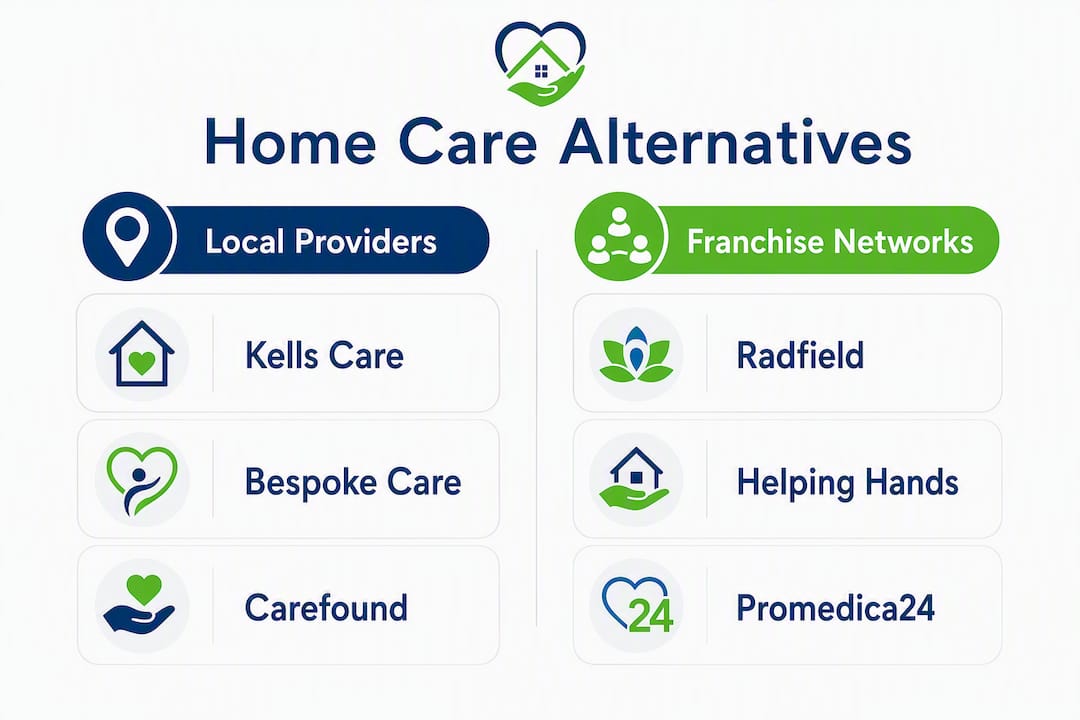
| Provider | Best for | CQC rating | Service types | Local coverage | Carer matching | Pricing shape | Availability | Unique strength |
|---|---|---|---|---|---|---|---|---|
| Kells Domiciliary Care | Hourly, live-in, dementia, complex care | CQC-regulated | Hourly visits, live-in, dementia, disability, respite, temp staffing | London (30+ years local) | Personalised matching, consistent allocation | Hourly and live-in packages | Flexible; rapid response | 30+ years London experience; personalised care plans |
| Visiting Angels | Hourly and live-in, older adults | CQC-regulated | Hourly, live-in, companionship | National franchise network | Standardised matching process | Hourly rates | National contingency pool | National brand recognition |
| Carefound Home Care | Dementia and complex needs | CQC-rated Good/Outstanding | Hourly, live-in, dementia | Yorkshire and North of England | Detailed needs assessment | Premium hourly and live-in | Strong local team | Specialist dementia expertise |
| The Care Collection | High-end, bespoke live-in | Not publicly listed | Live-in, complex care | South East England | Personality and lifestyle profiling | Premium live-in | Bespoke scheduling | Luxury, lifestyle-led approach |
| Radfield Home Care | Older adults, franchise network | CQC-regulated | Hourly, live-in, companionship | National franchise offices | Franchise-standardised | Hourly rates | National pool | Franchise consistency |
| Bespoke Care | Specialist and complex needs | CQC-regulated | Hourly, live-in, specialist | South of England | Tailored matching | Hourly and live-in | Responsive local teams | Specialist care focus |
| Promedica24 | Live-in care, European carers | CQC-regulated | Live-in only | National | Carer profile matching | Live-in packages | Good contingency | European live-in carer network |
| Helping Hands | Hourly and live-in, national reach | CQC-regulated | Hourly, live-in, dementia | National (150+ branches) | Branch-level matching | Hourly and live-in | Strong national cover | Largest UK live-in provider |
Provider profiles at a glance
Kells Domiciliary Care has served London families for over 30 years, covering hourly visits, live-in care, dementia support, disability care, respite, and temporary staffing for care homes. Every client receives a written personalised care plan, and all carers are fully qualified and DBS-checked. For London families who want a local team that knows the borough, this is the most direct fit. Confirm the CQC registration number and ask for the most recent inspection report before signing.

Carefound Home Care specialises in dementia and complex needs, with a strong reputation in Yorkshire and the North of England. Their detailed needs assessments and specialist staff make them worth considering for families dealing with advanced dementia, though their geographic reach does not extend to London. Ask specifically about carer consistency and how often the allocated carer changes.
The Care Collection positions itself at the premium end of live-in care, with a lifestyle-led matching process that considers personality and household rhythm. Coverage is concentrated in the South East. Their approach suits families where the client has strong personal preferences about how their home is run.

Radfield Home Care operates as a franchise network with local offices across the UK. The franchise model brings standardised training and scheduling systems, which can be reassuring for families who want predictable processes. Check which local franchise office would serve your area and request their individual CQC rating.
Bespoke Care focuses on specialist and complex care in the South of England. Their local teams are responsive, and the agency’s name reflects a genuine commitment to tailored care rather than off-the-shelf packages. Confirm their coverage area before proceeding.
Promedica24 concentrates exclusively on live-in care, drawing on a network of European carers. If live-in is the right model and you want a large carer pool to draw from, they are worth a call. They do not offer hourly visiting services.
Helping Hands is the largest UK live-in provider by branch count, with over 150 offices. Their scale means strong contingency cover and a wide recruiting pipeline. For families outside London or those needing rapid national cover, their reach is a practical advantage.
Geographic coverage matters more than many families expect. A provider with a local office and a named local manager can respond to a sudden change in care needs far faster than one routing decisions through a distant head office.
What does Visiting Angels do well, and why do families look elsewhere?
Visiting Angels’ strengths are straightforward: national brand recognition, a standardised training framework, and a broad network of franchise offices that can provide cover across many parts of the UK. For families who need care in multiple locations, or who want the reassurance of a nationally recognised name, those qualities carry real weight.
Common reasons families search for alternatives centre on four practical concerns.
- Carer continuity. Franchise models sometimes rotate carers more frequently, which matters most for clients with dementia who rely on familiar faces and established routines.
- Local flexibility. Standardised care plans can be harder to adapt quickly when a client’s needs change. Local independents typically have fewer approval layers and can revise a plan within days.
- Pricing transparency. Some families report difficulty obtaining a clear written breakdown of costs, minimum hours, and what happens if a carer is unavailable.
- Local management. Many agencies that appear local are regional branches of larger groups. Confirming who makes day-to-day decisions, and whether that person is based nearby, is worth doing before you commit.
Pro Tip: Ask any provider for the name and direct contact number of the local manager who will oversee your relative’s care. If the answer is a central call centre, that tells you something important about how decisions will be made.
The core trade-off is this: a franchise brings standardisation and a larger contingency pool; a local independent tends to offer greater flexibility and closer relationships with local GPs and hospital discharge teams. Neither model is universally better. The right choice depends on your relative’s specific needs and how much you value local responsiveness versus national reach.
How do you choose the right home care provider?
The single most important factors are consistent carer matching, a written personalised care plan, clear pricing, and strong local management. Everything else flows from those four.
Step-by-step selection process:
- Search. Use the NHS postcode-based homecare search and your local council’s adult social services team to generate a list of CQC-regulated providers in your area. Supplement this with the Independent Age guidance on arranging home care, which points families to the Home Care Association directory as an additional source.
- Shortlist. Narrow to three or four providers based on geographic coverage, service type (hourly, live-in, dementia), and CQC rating. Read the full inspection report, not just the headline rating.
- First call. Use this conversation to ask the questions below. A good agency will answer clearly and without hesitation.
- Home assessment. Insist on a face-to-face needs assessment before any care begins. This is where the written care plan should be drafted.
- Trial period. Arrange a short trial before committing to a long-term agreement. Most reputable agencies accommodate this.
- Written agreement. Sign nothing without a clear written contract covering hours, rates, notice periods, and cancellation terms.
Questions to ask on the first call
- Are all carers DBS-checked and fully qualified? What ongoing training do they receive?
- What is your current CQC rating, and when was the last inspection?
- How do you match carers to clients? What happens if our allocated carer is unavailable?
- Who is the named local manager for our area, and how do we contact them directly?
- What are your minimum visit times and hourly rates? Are there additional charges for evenings, weekends, or bank holidays?
- What is your cancellation policy and notice period?
Red flags to act on immediately
- No DBS checks or vague answers about carer qualifications.
- Refusal to provide a written care plan before care begins.
- No named local manager or all queries routed through a central call centre.
- Opaque pricing with no written breakdown.
- Pressure to sign a long-term contract before a trial period.
Pricing and timeline
Home care is typically charged as hourly rates with minimum visit windows; live-in care uses a different pricing model, usually a weekly or daily rate. Expect to discuss minimum hours, travel time charges, and what contingency cover costs. Rates vary by location, with London generally at the higher end. Always request a full written breakdown before agreeing to anything.
For a realistic timeline: short-term emergency cover after hospital discharge can sometimes be arranged within 24–48 hours, particularly with larger providers. Setting up regular hourly visits typically takes three to seven days once the needs assessment is complete. Live-in care arrangements generally require a week or more to match the right carer. If you need care urgently, say so on the first call. Local independents often adapt faster because they have fewer internal approval steps.
You can find a practical checklist of questions and contract terms to request in Kells-care’s guide to choosing a home care agency.
How was this shortlist selected, and what trust signals should you check?
Providers were selected based on CQC regulation, documented local or regional presence, range of service types, carer-matching policies, and publicly available family feedback. No provider without CQC registration appears on this list.
The CQC inspects and rates regulated home care agencies in England on four levels:
| CQC rating | What it means |
|---|---|
| Outstanding | Exceptional performance across all five inspection areas |
| Good | Meets all standards; the expected baseline for a reputable agency |
| Requires improvement | Identified gaps; follow-up inspection required |
| Inadequate | Serious concerns; regulatory action may follow |
The five inspection areas are: safe, effective, caring, responsive, and well-led. An Outstanding rating in “well-led” often signals strong local management and clear accountability, which matters directly for the day-to-day experience families receive. Read the commentary under each heading, not just the overall rating. A provider rated Good overall may have specific strengths in dementia care that the headline figure does not show.
Trust signals to verify before choosing any provider:
- CQC registration number and most recent inspection report (available free at cqc.org.uk).
- Written confirmation that all carers are DBS-checked and hold relevant qualifications.
- A written personalised care plan, drafted after a face-to-face needs assessment, as the CQC describes as standard for a good home care agency.
- Local GP or hospital discharge team referrals, where available.
- Membership of the Home Care Association, whose directory lists member agencies that agree to quality standards.
For a deeper explanation of what CQC ratings mean in practice, Kells-care’s guide to understanding CQC ratings covers each inspection area in plain language.
Key takeaways
Kells Domiciliary Care is the recommended London alternative to visiting-angels.co.uk for families who need CQC-regulated, locally managed, personalised domiciliary care with consistent carer allocation.
| Point | Details |
|---|---|
| Recommended London pick | Kells Domiciliary Care offers extensive local experience, CQC regulation, and written personalised care plans. |
| CQC rating is the baseline | Only consider CQC-regulated providers; read the full inspection report, not just the headline rating. |
| Carer continuity is critical | Ask every provider how they match carers and how often the allocated carer changes, especially for dementia care. |
| Get everything in writing | Insist on a written care plan, clear pricing breakdown, and transparent cancellation terms before signing. |
| Use official search tools | The NHS postcode search and your local council’s adult social services team are the most reliable starting points. |
What actually matters when you arrange care for someone you love
The families I speak with most often arrive at the same realisation: the provider’s name matters far less than the person who turns up at the door each morning. Marketing language across the home care sector is remarkably similar. Every agency promises dignity, compassion, and personalised care. The real differentiator is whether the same carer arrives consistently, whether the local manager picks up the phone, and whether the written care plan reflects what your relative actually needs rather than a generic template.
There is a tendency to prioritise brand recognition when arranging care under pressure, particularly after a hospital discharge. That instinct is understandable. A nationally recognised name feels like a safer choice when time is short. But the evidence points in a different direction: consistent carer allocation and proactive local management are the factors most strongly associated with good outcomes. A large contingency pool is useful for short-term cover. It is not a substitute for a carer who knows your relative’s routines, preferences, and how they take their tea.
For London families, the practical question is whether the provider you are considering has a genuine local presence or is routing decisions through a regional or national head office. Confirm this directly. Ask for the name of the person who will manage your relative’s care and how to reach them outside office hours.
Kells-care’s guide to personalised home care is a useful starting point for thinking through what a care plan should actually contain before you sit down with any provider.
Kells-care: a local London alternative with 30 years of experience
For London families who want a directly managed, CQC-regulated alternative to a national franchise, Kells Domiciliary Care offers something the larger networks cannot: three decades of continuous local practice, a named local team, and care plans built around the individual rather than a standardised template.
Kells-care provides:
- Hourly visits and live-in care
- Dementia and complex needs support
- Disability and mental health care
- Respite care for family carers
- Fully DBS-checked, qualified carers
- CQC-regulated services
- Written personalised care plans for every client
The first step is a free initial needs assessment, after which a written care plan is prepared before any care begins. To request your free home care guide or arrange an initial consultation, visit kells-care.com. The team will talk you through your options, answer your questions, and help you decide whether Kells is the right fit for your family.
Where to verify claims and find local providers
Use these authoritative sources to check CQC ratings, search for regulated local services, and get unbiased guidance:
- CQC provider search — search any registered agency by name or postcode and read full inspection reports free of charge.
- NHS national homecare provider search — postcode-based tool listing CQC-regulated providers in your area.
- Independent Age factsheets on arranging home care — clear, impartial guidance on the steps involved and what to ask providers.
Rather than relying solely on commercial directories or search results, request a list of regulated local providers directly from your council or the CQC. This gives you a verified starting point rather than a curated marketing list.
To download Kells-care’s free guide to arranging home care in London, or to read more about what regulated care involves, visit kells-care.com.
This article provides general information to help families research home care options. It is not professional care advice. Confirm current CQC ratings and provider details directly with the CQC or a qualified care adviser before making any decision.