

TL;DR:
- Behavior management involves guiding individuals towards positive choices within a safe environment by teaching routines explicitly.
- It relies on clear expectations, consistency, compassion, and involving families to support ongoing behavior improvement.
What is behaviour management?
Behaviour management is the process of guiding individuals towards positive choices within a safe, calm, and supportive environment. It is not simply about stopping bad behaviour. The UK Department for Education defines it as a proactive framework that establishes clear expectations, uses positive reinforcement, and builds consistent support structures so that everyone can learn and thrive.
Think of it less as discipline and more as teaching. Behaviour, like reading or maths, can be explicitly taught, practised, and refined over time. When you approach it this way, you stop reacting to problems and start preventing them.
The core elements of behaviour management include:
- Clear expectations: everyone knows what good behaviour looks like and why it matters
- Routines: predictable sequences that reduce uncertainty and help individuals feel settled
- Positive reinforcement: acknowledging and rewarding the conduct you want to see repeated
- Fair consequences: predictable responses to rule-breaking that are proportionate and consistent
- Shared norms: a community-wide understanding of acceptable conduct, built together
In caregiving settings, the same principles apply. Whether you are supporting an elderly person at home or a child with additional needs, the goal is always to create an environment where the individual feels safe, respected, and understood.
Why behaviour management matters for learning and wellbeing
Effective behaviour management creates the conditions for everything else to work. Without it, learning stalls, relationships break down, and stress rises for everyone involved. With it, individuals feel secure enough to take risks, ask questions, and grow.
The benefits extend well beyond the classroom or care setting:
- Improved safety: clear boundaries reduce incidents and protect everyone in the environment
- Reduced disruption: consistent routines mean less time lost to managing crises
- Better relationships: when expectations are fair and predictable, trust builds naturally between carers, educators, and the people they support
- Staff wellbeing: the NASUWT reports that consistent behaviour policies reduce stress and improve job satisfaction for education and care professionals
- Dignity and respect: a well-managed environment communicates to every individual that they are valued
- Community cohesion: shared norms bring groups together around common values
For caregivers supporting elderly or vulnerable adults, these outcomes are just as relevant. A calm, predictable home environment reduces anxiety, supports independence, and makes daily routines feel manageable rather than overwhelming. At Kells-care, this is something our carers work towards every day, adapting their approach to each individual’s needs and circumstances.
Key principles that underpin effective behaviour management
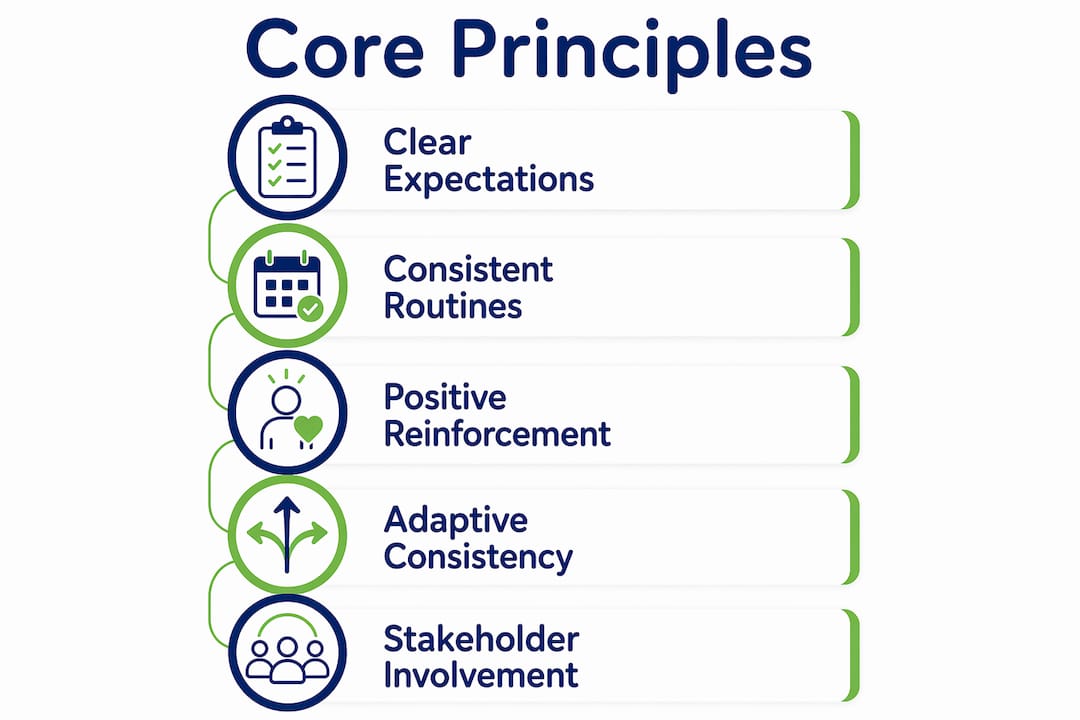
The most effective approaches to behaviour management share a set of core principles. Understanding these helps you apply strategies with confidence rather than guessing what might work.
The behaviour curriculum
The Government’s trainee teacher behavioural toolkit makes a compelling point: behaviour should be treated as a curriculum subject. That means teaching it explicitly, assessing it, and refreshing it regularly. You should not expect individuals to guess what good conduct looks like. Be precise, use examples, and check for understanding.
The 3 Cs: Connection, Consistency, and Compassion
The 3 Cs framework is widely used by educators and caregivers to guide their approach:
- Connection: build genuine relationships so individuals feel seen and valued
- Consistency: apply expectations and consequences predictably, every time
- Compassion: respond to behaviour with empathy, recognising that people are doing their best with the resources they have
Adaptive consistency
Consistency in behaviour management does not mean rigid rule enforcement. True consistency means applying expectations fairly and flexibly, adapting to individual circumstances while maintaining clear boundaries. This approach builds trust and supports lasting behaviour change.
Norfolk Schools guidance reinforces this point: a one-size-fits-all approach often fails the individuals who need the most support.
Legal and ethical considerations in the UK
In UK schools, governing bodies are legally required to maintain a behaviour policy under the Education and Inspections Act 2006. The NASUWT advises that this policy must address SEND, safeguarding, equality, and fair sanctions. In caregiving settings, the Care Quality Commission (CQC) expects providers to demonstrate positive, person-centred approaches to behaviour support.
Pro Tip: Review your behaviour policy at the start of each term or care period. Refreshing norms and expectations regularly prevents drift and keeps everyone aligned.
Proactive versus reactive approaches
The Education Endowment Foundation recommends a balance of both. Proactive strategies reduce the likelihood of problems occurring. Reactive strategies address misbehaviour when it does happen, fairly and without delay. Neither alone is sufficient.
Practical strategies you can use right now
Good behaviour management is not theoretical. Here are the approaches that make the biggest difference in practice, drawn from UK government guidance and caregiving experience.
Teach behaviour explicitly
Do not assume individuals know what you expect. Introduce rules and routines as early as possible, ideally at the very first encounter. Use normative language: “In this setting, we…” rather than a list of prohibitions. The Government’s behavioural toolkit is clear that ambiguity penalises those who are least able to fill in the gaps themselves.
Build routines that reduce uncertainty
Routines are one of the most powerful tools available to educators and caregivers. Entry routines, transition sequences, and end-of-session rituals all reduce the cognitive load on individuals and make behaviour more predictable. They take time to establish, but the investment pays off quickly.
Practical routine-building tips:
- Introduce one routine at a time and practise it until it becomes automatic
- Narrate the routine as you model it: “First we do this, then we do that”
- Revisit and refresh routines after breaks or periods of disruption
Use positive reinforcement consistently
Acknowledging good behaviour encourages it to be repeated. The DfE guidance lists verbal praise, written communication to families, certificates, and positions of responsibility as effective forms of recognition. The key is applying rewards clearly and fairly, so individuals understand exactly what they are being praised for.

Apply consequences with certainty, not severity
When rules are broken, respond predictably and promptly. The Government’s behavioural toolkit notes that the certainty of a consequence matters far more than its severity. Individuals need to know that misbehaviour will always be addressed, not sometimes.
Pro Tip: Script your responses to the most common behaviour challenges in advance. Having a prepared phrase ready means you respond calmly and consistently, even under pressure.
Involve families and stakeholders
The Education Endowment Foundation highlights parental involvement as a key factor in effective behaviour support, particularly for individuals with additional needs. Contact families proactively, before problems arise. This builds the relationships you will need when challenges do occur. For families supporting neurodiverse children, resources like parent support for neurodiverse children can complement the strategies used in educational and care settings.
Understand behaviour as communication
Behaviour, especially in individuals with additional needs, often signals an unmet need rather than deliberate defiance. The DfE’s guidance on positive environments for children states plainly: all behaviour is a form of communication. Proactive environmental design, addressing root causes rather than symptoms, reduces disruptive behaviour more effectively than reactive sanctions alone. You can read more about this in Kells-care’s guide to challenging behaviour for caregivers.
What UK experts say about behaviour management
The consensus across UK government guidance, academic research, and professional bodies is consistent: behaviour management works best when it is embedded in a whole-environment culture, not bolted on as a set of rules.
Department for Education
The DfE’s February 2024 guidance emphasises that whole-school behaviour approaches should pervade every aspect of school life, from the culture and ethos to how staff interact with pupils in corridors. Everyone in the setting, not just teachers, carries responsibility for modelling and reinforcing expected behaviour.
Education Endowment Foundation
The EEF’s guidance report on improving behaviour in schools stresses that knowing individual pupils well is the foundation of effective management. Simple, low-cost approaches, such as greeting individuals personally before a session begins, can have a meaningful positive impact on behaviour. The EEF also warns against “expectancy effects”: when adults communicate low expectations, outcomes suffer.
“Focusing on developing good relationships ensures pupils feel valued and supported, meaning they are less likely to misbehave.” — Education Endowment Foundation, Improving Behaviour in Schools
NASUWT
NASUWT’s principles make clear that behaviour management is not just about pupils or service users. It directly affects staff wellbeing. When behaviour policies are clear, current, and consistently applied, teachers and carers spend less time in crisis mode and more time doing the work they came to do.
At Kells-care, this resonates deeply. Our carers work with elderly clients whose behaviour may change due to dementia, pain, or anxiety. Approaching those moments with the 3 Cs, connection, consistency, and compassion, transforms what could be a difficult interaction into an opportunity to reassure and support. Understanding positive behaviour support is central to how our team is trained to respond.
How to assess and monitor behaviour progress
Tracking behaviour over time is what separates reactive management from genuine improvement. Without assessment, you cannot tell whether your strategies are working or whether an individual needs a different kind of support.
The assess, plan, do, review cycle
The DfE’s mental health and behaviour guidance recommends a graduated response process for individuals whose behaviour may reflect underlying needs:
- Assess: establish a clear picture of the individual’s needs and the triggers for their behaviour
- Plan: set out how you will support them, with specific, measurable goals
- Do: put the support in place consistently
- Review: evaluate what is working and adjust accordingly
This cycle applies equally in schools and in care settings. For elderly individuals at home, a review might reveal that a change in routine, a new medication, or a shift in social contact is driving a change in behaviour.
Tools and approaches
- Observation records: brief, factual notes on when and where behaviour occurs, who is present, and what happens immediately before and after
- ABC charts (Antecedent, Behaviour, Consequence): a structured way to identify patterns and triggers
- The Strengths and Difficulties Questionnaire (SDQ): a validated tool used in UK schools to screen for behavioural, emotional, and social difficulties
- The Boxall Profile: used to assess the social and emotional development of children whose behaviour is causing concern
- Regular review meetings: bringing together educators, carers, families, and where appropriate the individual themselves, to evaluate progress and agree next steps
The key is to use data to inform decisions, not to generate paperwork. A short, well-kept observation record is more useful than a lengthy report that nobody reads.
Examples of behaviour management plans and case studies
A behaviour management plan translates principles into practice. It sets out, in clear and specific terms, what behaviour is expected, what support will be provided, and how progress will be measured.
What a good plan includes
- A description of the individual’s current behaviour and any known triggers
- Clear, positively framed goals: what the individual will do, not just what they will stop doing
- Specific strategies for educators or carers to use, including how to respond to both positive and challenging behaviour
- Agreed roles: who does what, and when
- A review date and a process for adjusting the plan based on evidence
Example 1: a primary school setting
A seven-year-old pupil struggles to transition between activities, often becoming distressed and disruptive when asked to stop one task and begin another. The behaviour plan identifies transition anxiety as the likely trigger. Strategies include a two-minute warning before each transition, a visual timer, and a brief check-in with a trusted adult at the start of each new activity. The class teacher, teaching assistant, and parents all receive a copy of the plan and agree to use the same language and approach. After four weeks, the review shows a marked reduction in distress during transitions.
Example 2: a home care setting
An elderly gentleman with dementia becomes agitated during personal care routines, particularly in the mornings. His behaviour plan, developed with input from his family and his Kells-care carer, identifies that he responds better when care is offered after breakfast rather than before, and when familiar music is playing. The plan also notes that direct eye contact can feel confrontational for him, so carers are advised to approach from the side and speak softly. These small adjustments, grounded in understanding his individual needs, significantly reduce distress for both him and his carer.

For families navigating similar situations, Kells-care’s free home care guide offers practical advice on personalising care to the individual.
Example 3: a secondary school whole-class approach
A secondary school introduces a behaviour curriculum at the start of the academic year. Every form group spends the first two weeks explicitly learning the school’s expectations, practising routines, and discussing why the norms exist. Staff use normative language consistently: “In our school, we…” Behaviour incidents drop noticeably in the first half-term compared with the previous year, and staff report feeling more confident and less stressed.
These examples share a common thread: the plan is built around the individual, reviewed regularly, and owned by everyone involved. That is what makes the difference between a document that sits in a drawer and one that genuinely changes outcomes.
Key takeaways
Effective behaviour management is a proactive, taught process built on clear expectations, consistent routines, and compassionate relationships, not simply a set of rules for punishing poor conduct.
| Point | Details |
|---|---|
| Behaviour must be taught | Treat behaviour as a curriculum subject: introduce expectations explicitly, practise routines, and refresh them regularly. |
| The 3 Cs guide practice | Connection, Consistency, and Compassion are the three principles most widely used to build positive behavioural environments. |
| Consistency means fairness, not rigidity | Adaptive consistency, applying expectations fairly while responding to individual circumstances, builds trust more effectively than uniform rule enforcement. |
| Behaviour is communication | Especially for individuals with additional needs, behaviour often signals an unmet need; addressing root causes reduces disruption more than sanctions alone. |
| Assessment drives improvement | The assess, plan, do, review cycle ensures strategies are working and helps identify when a different approach is needed. |


