TL;DR:
- Positive Behaviour Support is an evidence-based, person-centred framework that enhances quality of life by understanding the reasons behind challenging behaviours.
- It promotes communication, dignity, and independence while reducing crises through collaborative, dynamic strategies tailored to individual needs.
Positive Behaviour Support, known as PBS, is an evidence-based, person-centred framework that improves quality of life by understanding the reasons behind challenging behaviours rather than simply trying to stop them. PBS is widely recommended for people with learning disabilities, autism, brain injury, or complex communication needs. Regulatory bodies including the CQC (Care Quality Commission) actively promote visible PBS practice in care settings. For families and caregivers, understanding this approach is the first step towards providing support that genuinely helps your loved one live with greater dignity, independence, and wellbeing.
What does positive behaviour support actually mean?
PBS is defined as a framework that asks why a behaviour is happening, not just how to stop it. The core goal includes improved independence, stronger relationships, and better emotional regulation. Behaviour reduction, when it occurs, is a byproduct of those improvements, not the primary aim.
The approach draws on Applied Behaviour Analysis (ABA) research but goes further. Where ABA focuses primarily on observable behaviour and reinforcement techniques, PBS places those tools within a broader human-rights framework. PBS prioritises communication, dignity, and the individual’s right to a good life. It treats every behaviour as a form of communication that deserves a thoughtful response.

PBS is widely used across disability, dementia, and aged care settings. Organisations like the NDIS in Australia and the CQC in the UK both endorse it as best practice. For families at home, this means PBS is not a clinical experiment. It is a structured, tested way of supporting someone you love.
What are the key components of a PBS approach?
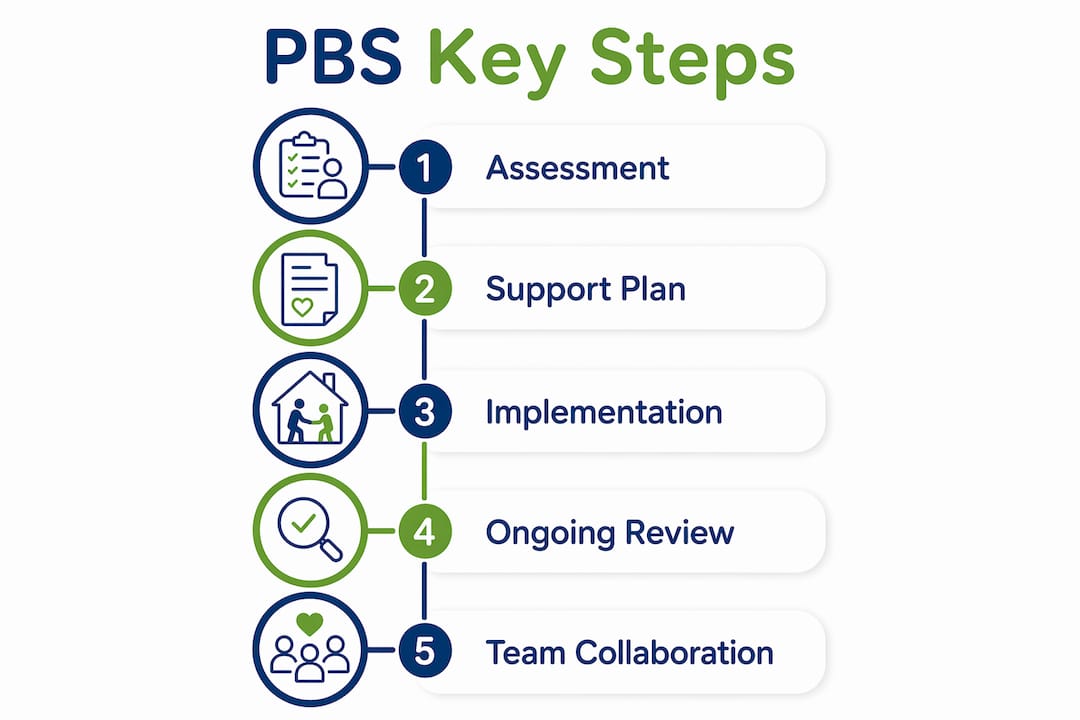
PBS follows a clear, multi-step process. Understanding each component helps you engage meaningfully with professionals and apply strategies at home.
Functional behaviour assessment
The process begins with a thorough assessment. A practitioner observes the individual, speaks with family members, and reviews their history to identify triggers, unmet needs, and patterns. This is called a functional behaviour assessment. It answers the question: what is this behaviour telling us about this person’s experience?
Behaviour support plan
The assessment leads to a collaborative Behaviour Support Plan. This document outlines agreed strategies for the whole support network, including family, carers, and professionals. The plan covers three areas:
- Environmental adjustments: changing the physical or social setting to reduce triggers (for example, reducing noise, creating predictable routines, or offering more choice).
- Skill building: teaching the individual alternative ways to communicate or cope, such as using visual aids, sign language, or relaxation techniques.
- Consistent responses: agreeing on how every member of the support network will respond when a behaviour occurs, so the individual receives the same calm, respectful reaction every time.
Ongoing review
PBS is a dynamic, evolving process, not a static plan filed away in a drawer. The plan is reviewed regularly as the individual’s needs change, new skills develop, or circumstances shift. Progress is tracked, and strategies are updated accordingly.
| PBS component | Purpose | Example in practice |
|---|---|---|
| Functional assessment | Identify triggers and unmet needs | Observing that distress peaks before mealtimes |
| Behaviour Support Plan | Agree shared strategies | Visual schedule introduced before meals |
| Environmental adjustment | Reduce triggers proactively | Quieter dining area, consistent mealtime routine |
| Skill building | Teach alternative communication | Using a picture card to request a break |
| Ongoing review | Adapt as needs change | Monthly team meeting to assess progress |
Pro Tip: Keep a simple daily log of when behaviours occur, what happened just before, and how the individual seemed afterwards. Even brief notes give practitioners far richer data than memory alone.
How does PBS benefit individuals and their families?
The benefits of positive behaviour support extend well beyond the person receiving care. Families consistently report reduced stress and greater confidence once they understand their loved one’s communication style and needs.
For the individual, PBS produces measurable improvements in:
- Independence and daily living skills
- Emotional regulation and reduced distress
- Communication, including non-verbal and alternative methods
- Community access and social participation
- Reduction in the need for restrictive interventions
That last point matters enormously. Effective PBS leads to fewer crises, stronger carer confidence, and greater personal choice. Fewer crises mean less trauma for everyone involved.
“PBS success is measured by quality of life improvements, including community access and emotional regulation, not just behaviour reduction. If behaviour decreases but daily life does not improve, the plan is considered to have failed.”
Positive Behaviour Support: Your Complete Guide
This framing is important. It shifts the measure of success from “has the behaviour stopped?” to “is this person living better?” That is a profound difference in how you evaluate progress at home.
Families gain reduced stress and increased confidence from engaging with PBS. When you understand why your loved one acts in a certain way, you feel less helpless. You have a plan, a shared language with professionals, and practical tools you can use every day.
Pro Tip: Track quality of life markers alongside behaviour frequency. Note whether your loved one is sleeping better, engaging more with activities, or showing more moments of calm. These are the real signs that PBS is working.
Common misconceptions about positive behaviour support
PBS is often misunderstood, and those misunderstandings can lead families to dismiss it or apply it incorrectly.
-
“PBS is about rewarding good behaviour and ignoring bad behaviour.” PBS is not a reward chart. It is a whole-system approach that addresses the environment, relationships, and skills. Rewards may feature in some strategies, but they are one small tool within a much larger framework.
-
“PBS is the same as ABA.” PBS draws on ABA research but is not identical to it. ABA focuses on behaviour change through reinforcement. PBS uses those techniques within a human-rights framework that prioritises communication and dignity. The philosophy is different, even when some techniques overlap.
-
“PBS means never setting limits.” PBS does not mean accepting all behaviour without response. It means responding in a way that is respectful, consistent, and aimed at understanding. Boundaries still exist. They are simply communicated and enforced differently.
-
“Once the plan is written, the work is done.” Treating PBS as a one-time project is one of the most common reasons it fails. PBS must be embedded in daily culture as a living, evolving process. Plans are working documents, not archived reports.
-
“PBS only works for children.” PBS is effective across the lifespan. It applies equally to adults with dementia, acquired brain injury, or complex needs. The principles of understanding behaviour and personalising home care are relevant at any age.
Pro Tip: When a professional presents a PBS plan, ask: “How will we know if this is working?” If the answer focuses only on behaviour frequency, push for quality of life measures too.
How to implement positive behaviour support at home
Starting PBS at home does not require a clinical background. It requires commitment, consistency, and a willingness to learn alongside professionals.
Begin with a thorough assessment
Do not skip the assessment stage. Work with a qualified PBS practitioner to complete a functional behaviour assessment. Share your observations honestly, including what happens before, during, and after a behaviour. Your knowledge of your loved one is irreplaceable data.
Build your support team
PBS works best when everyone involved is aligned. Your team might include:
- A PBS practitioner or behaviour specialist
- Community nurses or occupational therapists
- School staff or day service workers
- All family members who provide regular care
Effective communication with carers is not optional. Inconsistency across team members raises anxiety and undermines every strategy you put in place.
Apply strategies consistently
Consistency across environments is the single biggest factor in PBS success. Inconsistency confuses the individual and heightens anxiety. Every caregiver must respond in the same agreed way, whether at home, at a day centre, or during a medical appointment.
Practical steps for home implementation include:
- Introduce visual schedules or routines to increase predictability
- Identify and reduce known environmental triggers
- Practise agreed responses to specific behaviours until they feel natural
- Celebrate small progress, not just the absence of difficult behaviour
- Review the plan every four to six weeks with your support team
Monitor and adapt
Keep records of what you observe. Note what works, what does not, and any changes in the individual’s health, routine, or relationships. Bring this information to every review meeting. PBS plans that are never updated stop reflecting the person they are meant to support.
Sustaining PBS as part of daily care culture
The most common reason PBS loses momentum is initiative fatigue. Families and care teams start with enthusiasm, then gradually drift back to old habits when life gets busy or a key team member leaves. Preventing this requires deliberate effort.
Sustaining PBS long-term means treating it as a culture, not a project. Practical ways to maintain that culture include:
- Holding brief, regular check-ins with everyone involved in care
- Welcoming new carers or family members with a clear introduction to the plan
- Revisiting the plan after any significant change, such as a house move, health event, or bereavement
- Celebrating progress openly so the whole team feels the approach is working
- Keeping the individual at the centre of every conversation about their support
Team-wide buy-in is not a nice addition to PBS. It is the foundation. When one person responds differently, the individual receives mixed signals. That confusion can undo weeks of careful work.
Routine disruptions are inevitable. A hospital stay, a change of carer, or a shift in daily schedule can all unsettle someone who relies on predictability. The answer is not to panic, but to return to the plan, communicate clearly with the team, and give the individual time to readjust. PBS is built for real life, not ideal conditions.
Pro Tip: Designate one person in the household or care team as the PBS lead. This person keeps the plan updated, coordinates reviews, and acts as the first point of contact when something changes. It prevents the plan from becoming “everyone’s responsibility and no one’s job.”
Key takeaways
Positive Behaviour Support improves quality of life by addressing the causes of behaviour through consistent, person-centred strategies applied across every care environment.
| Point | Details |
|---|---|
| PBS is person-centred | The goal is improved quality of life, not just behaviour reduction. |
| Assessment comes first | A functional behaviour assessment identifies triggers and unmet needs before any plan is written. |
| Consistency is critical | Inconsistent responses across carers raise anxiety and undermine every strategy. |
| Plans must evolve | PBS plans are living documents that need regular review as needs change. |
| Families benefit too | Caregivers report reduced stress and greater confidence when they understand PBS principles. |
Why PBS changed how I think about care
I have worked alongside families navigating some of the most difficult caregiving situations imaginable. The ones who found PBS most transformative were not the ones with the most resources. They were the ones willing to shift how they thought about behaviour.
The hardest part of PBS is not learning the techniques. It is accepting that a behaviour you find distressing is not a personal challenge or a failure of discipline. It is communication. Once a family genuinely believes that, everything changes. They stop reacting and start listening. They stop counting incidents and start noticing moments of connection.
I have seen families go from exhausted and frightened to calm and confident, not because the individual stopped all difficult behaviour overnight, but because the family understood what was happening and had a shared plan. That shift in understanding is what promoting dignity in care actually looks like in practice.
My honest advice is this: do not wait for a crisis to engage with PBS. Start the conversation with a practitioner now, while you have the headspace to learn. The families who struggle most are those who come to PBS after years of reactive management. The families who thrive are those who build the culture early and maintain it steadily.
Progress in PBS is rarely dramatic. It is quiet. It is a calmer morning, a meal completed without distress, a moment of eye contact that was not there last month. Those moments are the measure of success.
— Dan
How Kells-care supports families with positive behaviour strategies
Kells-care has provided personalised home care across London for over 30 years, supporting families who are implementing PBS principles at home. Our carers are fully qualified, DBS checked, and regulated by the CQC. We work closely with families to build consistent, person-centred care routines that align with existing behaviour support plans. Whether you need check-in visits or round-the-clock support, our team brings the consistency and empathy that PBS requires. Download our free home care guide to understand your options, or speak with our team about how we can support your loved one’s specific needs.
FAQ
What is positive behaviour support in simple terms?
Positive Behaviour Support is an evidence-based approach that improves quality of life by understanding why challenging behaviours occur and addressing those underlying causes. It focuses on communication, skill building, and environmental adjustments rather than punishment or control.
Who is PBS suitable for?
PBS is suitable for people with learning disabilities, autism, dementia, brain injury, or complex communication needs. It applies across all ages and care settings, including the home.
How long does it take for PBS to show results?
Progress depends on the individual and the consistency of the support team. Quality of life improvements, such as better emotional regulation and increased independence, are the primary markers of success and may develop gradually over weeks or months.
What is the difference between PBS and behaviour management?
Behaviour management typically focuses on controlling or reducing unwanted behaviour. PBS focuses on understanding the cause of behaviour and improving the individual’s overall wellbeing, with behaviour change as a natural outcome rather than the sole goal.
How do I start PBS for my family member at home?
Begin by requesting a functional behaviour assessment from a qualified PBS practitioner. Involve all regular caregivers in developing the behaviour support plan, and commit to reviewing and updating the plan as your loved one’s needs change.