

An Education, Health and Care Plan (EHCP) can secure domiciliary or live-in care for your child when Sections H1 and H2 specify the social care provision in detail, and Section J records a personal budget or direct payment arrangement. If those sections are vague or missing, the local authority (LA) has no legal obligation to fund the care. The two actions to take right now: check your child’s current plan for H1, H2, and J, then write to your SEND officer requesting that provision be quantified before the next review.
The Care Act 2014 and the Chronically Sick and Disabled Persons Act 1970 (CSDPA) are the statutory levers that make home care a legal duty, not a discretionary favour. Kells-care is CQC-regulated, DBS-checked, and has over 30 years of experience providing flexible home care across London, making it a practical commissioning option once your plan is in place.
Quick reference: what you need in your EHCP to secure home care
| EHCP section | What it must contain | Who is responsible |
|---|---|---|
| Section H1 | Domiciliary care under the CSDPA 1970, quantified by hours and tasks | LA social services |
| Section H2 | Other social care reasonably required by SEN (e.g. short breaks) | LA social services / adult social care for over-18s |
| Section J | Personal budget type (direct payment, notional, or third-party) and amount | LA / ICB / school |
Pro Tip: Request a copy of your child’s current EHCP and highlight every line in H1, H2, and J. If any line says “as required” or “appropriate support” without specifying hours or tasks, that is the wording to challenge at the next review.
Key takeaways
An EHCP secures home care only when Sections H1 and H2 specify provision in hours and tasks, and Section J records the personal budget type and amount.
| Point | Details |
|---|---|
| Check H1, H2, and J now | Vague wording in these sections is the primary reason LAs fail to fund home care. |
| Quantify every task | List hours, tasks, times, and required staff training so the LA can cost the package accurately. |
| Request a personal budget in writing | Submit the request at assessment, draft stage, or annual review, using every statutory comment window. |
| Know your commissioning options | A direct payment gives maximum control; a CQC-regulated agency reduces administrative burden and provides built-in safeguards. |
| Kells-care is a practical next step | CQC-regulated, DBS-checked, and experienced with personal budgets, Kells-care can commission care directly from your EHCP provision. |
Table of Contents
- Which EHCP sections cover home care and who funds them?
- How to write EHCP wording that actually secures home care
- How personal budgets, direct payments, and funding routes work
- Commissioning care: employing a PA versus using an agency
- Safety and quality checks before care begins
- A practical checklist and timeline from review to care in place
- Managing a direct payment: payroll basics and record-keeping
- How Kells-care supports families using an EHCP to arrange home care
- A perspective on what actually holds families back in London
- Kells-care: CQC-regulated home care for families with an EHCP
- Sources
Which EHCP sections cover home care and who funds them?
Section H1 and H2 of the EHC plan are the two sections that directly govern social care provision, including home care. Getting them right is the foundation of everything else.
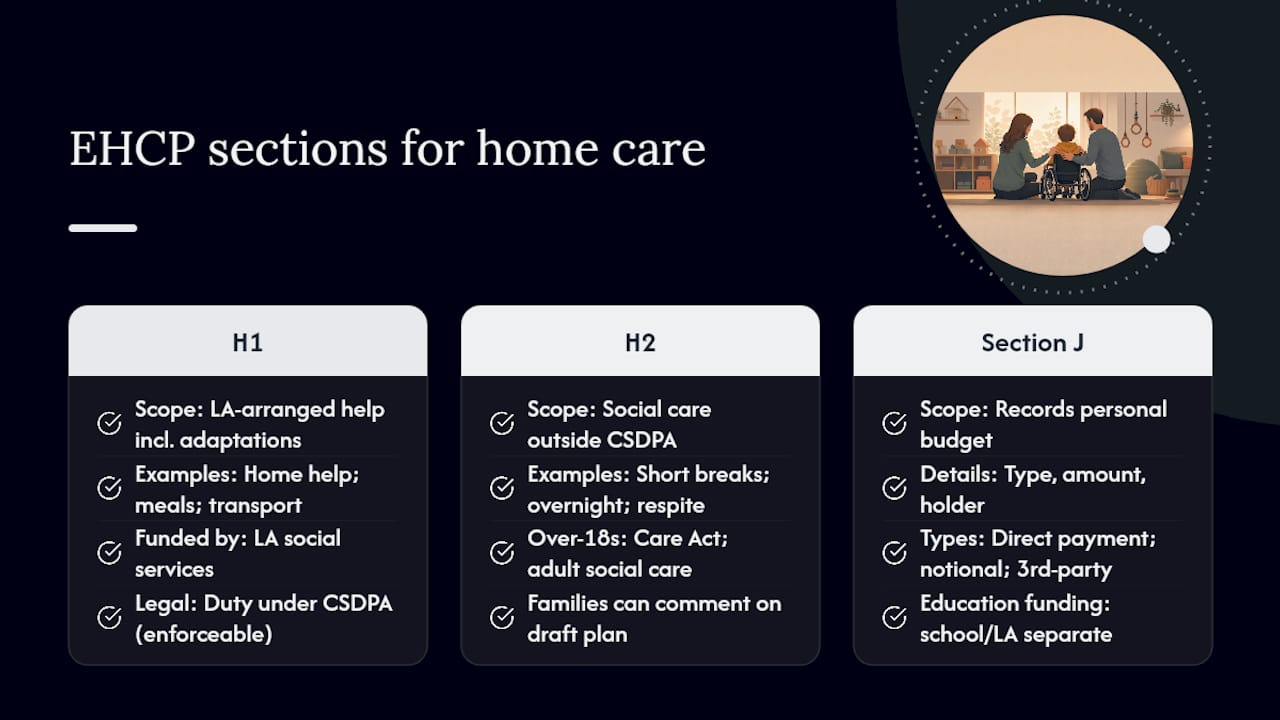
Section H1 covers services the LA must arrange under the CSDPA 1970. These include practical assistance in the home, help with meals, travel and transport, and adaptations. LA social services are responsible for commissioning and funding H1 provision. Because the CSDPA creates a duty rather than a power, provision here is enforceable once assessed need is established.
Section H2 covers other social care that is reasonably required because of a child’s special educational needs, but which falls outside the CSDPA. Short breaks, overnight support, and some respite arrangements typically sit here. For young people over 18, the Care Act 2014 replaces the CSDPA as the primary duty, and adult social care takes over commissioning responsibility.
Section J records the personal budget: the type (direct payment, notional, or third-party), the amount, and which agency holds it. Education funding within Section J is usually managed through the school or LA education budget and is separate from social care or health funding. The GOV.UK statutory guidance confirms families have the right to comment on a draft plan, which is the moment to push for specific, costed provision in all three sections.
How to write EHCP wording that actually secures home care
Vague language is the single biggest cause of underfunding. Commissioners calculate personal budgets directly from the quantified provision in the EHCP, so every hour and task must be named.
A strong H1 entry looks like this:
That single paragraph gives the LA everything it needs to cost the package. Compare it to “support at home as required” and the difference is stark.
Quantification checklist for H1/H2 provision:
- Hours per week (total and per session)
- Specific tasks at each visit (personal care, medication, meal preparation, therapy escort)
- Time of day and frequency
- Whether two-person assistance is needed
- Required staff training (paediatric first aid, medication competency, moving and handling)
- Link to the outcome in Section E or G that the provision supports
Gather therapy reports, hospital letters, and school observations before the review. Each document that names a specific need strengthens your case for quantified provision.
Pro Tip: For children with complex medication or nursing needs, attach a minute-by-minute task list as an appendix to your EHCP comments. It removes any ambiguity about what “support” means and makes it much harder for the LA to substitute a lower-cost, less skilled option.
How personal budgets, direct payments, and funding routes work
There are three distinct funding routes, and they can run alongside each other.
The three types of personal budget:
- Education personal budget — funds provision in the education sections of the EHCP; usually managed by the school or LA education team.
- Social care personal budget — funds H1/H2 provision; LA social services hold and manage it unless a direct payment is agreed.
- Personal Health Budget (PHB) — available for children receiving NHS continuing healthcare; the ICB (formerly CCG) funds and oversees it.
PHBs can be delivered as a direct payment, a notional budget, or a third-party arrangement, and require a care plan agreed with the ICB. The same three options apply to social care personal budgets.
Direct payment vs notional vs third-party:
- Direct payment: money paid to you (or a nominee) to purchase care directly. You employ staff or contract an agency. Maximum family control, but you carry employer and record-keeping responsibilities.
- Notional budget: the LA commissions the care on your behalf but tells you the value of the budget. You have less purchasing control but fewer administrative duties.
- Third-party arrangement: a managed account held by an independent organisation on your behalf. Useful when families want more control than a notional budget offers but less administration than a direct payment.
IPSEA confirms that a personal budget is intended to fund provision already identified in the EHCP, not extras. If the LA proposes a notional arrangement, ask in writing for the costing breakdown and the commissioning route so you can compare it against a direct payment.
You can request a personal budget during the EHC needs assessment, when commenting on a draft plan, or at any annual review. The 20-week statutory timescale for a final plan gives you structured windows to make that request formally.
Pro Tip: If the LA proposes a notional arrangement, ask for a written costing explanation and the commissioning route. This gives you the information you need to decide whether a direct payment would better serve your child.
Commissioning care: employing a PA versus using an agency
Once a direct payment is agreed, you have two main commissioning routes.
Employing a personal assistant (PA):
- Greater flexibility over hours, tasks, and continuity of carer
- You become an employer: PAYE, National Insurance, Auto-enrolment pension, employers’ liability insurance, and payroll administration all apply
- You are responsible for recruitment, DBS checks, training, supervision, and cover when the PA is absent
Using a CQC-regulated domiciliary agency:
- The agency manages compliance, DBS checks, training, supervision, and backup cover
- Less administrative burden for the family
- CQC registration provides an independent quality check; you can verify any agency’s registration and inspection rating on the CQC website
Commissioning checklist (both routes):
- Confirm DBS certificate is current (enhanced, with children’s barred list check)
- Verify paediatric safeguarding training and any condition-specific competencies
- Agree a written care agreement covering hours, tasks, escalation, emergency backup, and complaints process
- Confirm liability insurance is in place
- For agencies: check CQC registration and most recent inspection rating
- Set up a monitoring log to record care delivered against the EHCP provision
Questions to ask any provider:
- How often are DBS checks renewed?
- What child-specific training do carers hold?
- What is your safeguarding policy and who is the designated safeguarding lead?
- How do you provide cover if a carer is absent?
- Can you invoice against a direct payment and provide records for LA review?
Pro Tip: Ask any agency for its CQC registration number and check the inspection report yourself at cqc.org.uk before signing a care agreement. A general “Good” rating does not always reflect paediatric-specific experience, so read the report’s detail.
Safety and quality checks before care begins
Paediatric domiciliary care requires child-specific safeguarding training that goes beyond general adult care competencies. Some CQC-registered agencies hold a general registration without paediatric experience, so ask directly.
Before any carer enters your home, confirm:
- Enhanced DBS certificate with children’s barred list check, dated within the last three years
- Paediatric first aid certificate (current)
- Medication administration competency (if applicable)
- Child-specific safeguarding training (Level 2 minimum)
- Moving and handling training (if your child requires physical assistance)
- Written references from previous paediatric or SEN care roles
The care agreement must cover: responsibilities and tasks, scheduled hours, escalation procedures, emergency backup arrangements, and the complaints process. Keep a single folder, physical or digital, containing staff DBS numbers, training certificates, and the signed care agreement. The LA may ask to see this at review.
Pro Tip: Keep a single folder with staff DBS numbers, training records, and the care agreement. If the LA requests evidence of how your direct payment is being spent, this folder is your first line of response.
A practical checklist and timeline from review to care in place
The statutory process has fixed windows. Use each one.
- Request quantified provision in writing to your SEND officer, attaching therapy reports and a task list. Do this at least eight weeks before the annual review.
- Annual review meeting (or EHC needs assessment if the plan is new): submit template wording for H1/H2 and a personal budget request in writing at or before the meeting.
- Draft EHCP issued (within the 20-week statutory window for new plans): submit written comments requesting specific, costed provision and the personal budget type you want.
- Final EHCP issued: if provision is still vague, request a meeting with the SEND officer within two weeks. If unresolved, consider mediation or a SEND Tribunal appeal.
- Personal budget agreed: request the costing breakdown and commissioning route in writing within five working days of agreement.
- Commissioning: recruit or contract a provider, complete DBS and training checks, sign the care agreement.
- Payroll setup (if employing a PA): register as an employer with HMRC, set up payroll, arrange employers’ liability insurance and pension Auto-enrolment.
- Care begins: start the monitoring log and schedule the first review with the LA within three months.
When to escalate:
- LA refuses to quantify provision: request a formal written explanation and contact IPSEA or your local Information, Advice and Support (IAS) service.
- Personal budget refused: ask for the decision in writing, then consider mediation or SEND Tribunal.
- Care quality concerns: raise formally with the agency or PA first, then with the LA and CQC if unresolved.
Managing a direct payment: payroll basics and record-keeping
If you receive a direct payment to employ a PA, you take on employer responsibilities from day one.
Employer obligations:
- Register with HMRC as an employer before the first pay day
- Operate PAYE and pay National Insurance contributions where the PA’s earnings exceed the relevant thresholds
- Enrol eligible staff in a workplace pension (Auto-enrolment applies from the first day of employment for eligible workers)
- Hold employers’ liability insurance (a legal requirement when employing staff)
Record-keeping the LA will expect:
- Signed timesheets showing hours worked, tasks completed, and carer signature
- Payslips and PAYE records
- Receipts or invoices for any agency or payroll bureau fees
- Bank statements for the direct payment account (kept separate from personal finances)
| Record type | Minimum retention | Purpose |
|---|---|---|
| Signed timesheets | Duration of care plus two years | Evidence of provision delivered |
| Payslips and PAYE records | Six years | HMRC compliance |
| DBS and training certificates | Duration of employment | Safeguarding evidence for LA review |
| Direct payment bank statements | Duration of care plus two years | LA audit and accountability |
Pro Tip: A payroll bureau experienced with direct payments handles PAYE, pension Auto-enrolment, and HMRC filings on your behalf. The cost is usually allowable from the direct payment itself, so ask the LA to include it in the budget.
How Kells-care supports families using an EHCP to arrange home care
Kells-care is a CQC-regulated domiciliary care agency with over 30 years of experience providing flexible home care across London, from hourly check-in visits to round-the-clock live-in care. All staff are DBS-checked and trained in safeguarding, and Kells-care has direct experience supporting children and young people with disabilities and complex needs.
For families using a direct payment or personal budget, Kells-care can:
- Provide a written care agreement and invoices in the format LAs require for direct payment accountability
- Supply evidence of CQC registration, DBS certificates, and training records for your LA review folder
- Offer a scoping visit to discuss your child’s EHCP provision and match the right carer to the plan’s specified tasks and outcomes
- Adjust hours and visit patterns as the EHCP is reviewed and needs change
To get started, have a copy of your child’s EHCP (particularly Sections H1, H2, and J), your proposed hours, and any therapy reports ready. Download Kells-care’s free home care guide for a practical overview of commissioning options, or contact the team directly at Kells-care to arrange a scoping visit.
A perspective on what actually holds families back in London
The families who struggle most are not those with the most complex children. They are the ones whose EHCPs contain provision like “appropriate support at home” with no hours, no tasks, and no link to an outcome. The LA has no obligation to fund what it cannot cost, and that single line of vague wording can delay care by months.

London adds its own layer of difficulty. Provider availability varies significantly across boroughs, travel time affects rota planning, and some LAs default to notional arrangements because they are administratively simpler. The practical countermeasure is straightforward: submit your quantified wording in writing before the review meeting, not during it. A written submission creates a paper trail the LA must respond to formally, which changes the dynamic entirely.
The one action you can take today: write a single paragraph in the format of the H1 template above and email it to your SEND officer with the subject line “Request to quantify Section H1 provision ahead of [review date].” That email starts the clock.
Kells-care: CQC-regulated home care for families with an EHCP
Arranging care through an EHCP is a process with real legal teeth, but it still requires a provider who understands how to work within it. Kells-care has spent over 30 years delivering personalised home care in London, and the team knows exactly what LAs need to see: a clear care agreement, invoices tied to EHCP provision, and evidence of DBS checks and training for every carer.
Whether you are setting up hourly visits around a school timetable or arranging live-in support for a child with complex needs, Kells-care can work directly from your EHCP’s specified provision. There are no long waiting lists and no rigid packages. Visit Kells-care or download the free home care guide to take the next step today.
This article is general information, not a substitute for advice from a qualified lawyer. Consult a qualified legal professional about your own circumstances before acting on anything here.
Sources
Statutory sources:
- Croner — domiciliary care: children and families (in depth)
- IPSEA — personal budgets and direct payments
- Gov
- Hull SEND local offer — what to include in each section of the EHC plan
- Blackpool Council — personal budgets for a child with SEND (local offer PDF)
Independent advice:
Practical next step:


