

Home care in London typically costs £26 to £35 an hour, with live-in care running from around £1,100 to £1,700 a week depending on the level of need. What you actually pay depends heavily on your council’s financial assessment and any benefits you’re entitled to, so the first practical step is requesting a needs assessment from your local authority to see what support you qualify for.
TL;DR:
- London home care costs are typically between £26 and £35 per hour, with live-in support ranging from about £1,100 to over £1,700 weekly depending on complexity.
- The regional weekly average for residential and nursing care in London is approximately £1,309, higher than the national average, driven by factors like wages, property costs, and specialist premiums.
- The standard process involves a free needs assessment, eligibility check, and then a means test that considers income and savings, with full council support generally available below £14,250 savings.
- Additional funding sources such as disability benefits, NHS Continuing Healthcare, and direct payments can reduce out-of-pocket costs, often used together for better coverage.
- Proper documentation of disability-related expenses and early planning around financial thresholds can significantly lower care costs and improve assessment outcomes.
Table of Contents
- What does disability care cost in London right now?
- How do councils work out what you pay?
- What funding routes can lower your out-of-pocket costs?
- What counts as disability-related expenditure, and how do you claim more?
- How should you plan and budget for care costs?
- Kells Domiciliary Care: local pricing examples and support
- What extra costs come with disability care beyond hourly fees?
- How do costs compare across residential, domiciliary, and day care?
- Has COVID-19 changed disability care costs in London?
- Can you negotiate care provider fees or contracts?
- A practitioner’s view on planning for disability care
- How Kells can help with your next steps
- Sources
- FAQ
What does disability care cost in London right now?
London carries a clear premium over the rest of England. Regional adult social care finance figures show London recording the highest average weekly cost for residential and nursing care in 2024 to 2025, at roughly £1,309 a week. Domiciliary care follows the same pattern, though the exact multiplier varies by borough and provider.
Hourly visiting care in London generally falls between £26 and £35 an hour, against a national average that tends to sit several pounds lower. Live-in care is priced weekly rather than hourly, and typically ranges from about £1,100 a week for standard support up to £1,700 a week where a client needs dementia care, complex mobility support, or two carers attending for high dependency needs.
A few things push London rates above the national picture:
- Travel time and congestion charging. Carers moving between visits in inner London lose more paid time to transport than carers in most other regions.
- Wage floors. The National Minimum Wage and London Living Wage both push base pay higher, and quality agencies pay above the statutory minimum to retain trained staff.
- Property and overhead costs. Office space, DBS renewal, training, and insurance all cost more in London than in most of the country.
- Specialist skill premiums. Dementia care, autism support, and complex physical disability care usually carry a premium over standard personal care.
To put these ranges into a monthly budget: a modest package of eight hours a week at £30 an hour comes to roughly £240 a week, or just over £1,040 a month. Daily care visits of two hours, twice a day, at similar rates land closer to £1,600 to £2,000 a month. Full live-in care, by contrast, runs from around £4,700 to over £7,000 a month once you annualise the weekly rate.
Costs for children’s disability support, autism care, and challenging behaviour work tend to sit at the higher end of the hourly range, reflecting the additional training and, often, higher staff ratios involved. A complete guide to home care services for London families breaks down how these packages are typically built, hour by hour, if you want to see how providers structure a week of care around a single person’s routine.
How do councils work out what you pay?
Every council in England follows the same basic sequence, even though the paperwork and turnaround times vary by borough. The process runs in three stages, and skipping stage one means nothing else can happen.
- Needs assessment. The council looks at what help the person actually requires, day to day, regardless of income. This is free and available to anyone who asks for it, and it’s the trigger for everything that follows.
- Eligibility decision. The council decides whether the assessed needs meet the national eligibility criteria for local authority support.
- Financial assessment (means test). Only once eligibility is confirmed does the council look at money, working out how much, if anything, the person must contribute towards their care.
The financial assessment itself follows fixed national thresholds. In England, councils generally cover care costs in full once savings and capital fall under £14,250. Between £14,250 and £23,250, a tariff income rule applies, meaning £1 a week is added to assessed income for every £250 (or part of £250) held between those two figures. Above £23,250, the person is generally expected to fund their own care, though this can change depending on ongoing social care reform.
Councils include most income and savings in this calculation: pensions, benefits, savings accounts, and investments. Some things are commonly disregarded, though the exact list varies slightly by borough, so it’s worth checking your council’s own charging booklet. The mobility component of certain disability benefits is a frequent example of an income source that’s excluded from the calculation, and Independent Age’s guidance on financial assessments sets out how councils are expected to apply these rules in practice.
Before the assessment, gather three months of bank statements, your latest benefits award letters, proof of pension income, and any receipts for disability-related costs you already pay for. Councils typically re-check financial assessments annually, or sooner if your circumstances change significantly, such as a house sale or a new benefit award.
Pro Tip: Ask your council in writing for a copy of their local charging policy before the assessment call. Every borough publishes one, and reading it first means you’ll know exactly which questions the assessor is required to ask, and which disregards you’re entitled to request.
What funding routes can lower your out-of-pocket costs?
Several funding streams sit alongside, or entirely outside, the council means test, and most families use more than one at once.
- Attendance Allowance. A non-means-tested benefit for people over State Pension age with care needs. It counts as income in the financial assessment, but councils must also weigh any disability-related expenditure it’s meant to cover before setting a final contribution.
- PIP and DLA. Personal Independence Payment and Disability Living Allowance work similarly for people under pension age; the mobility element is typically disregarded from the means test entirely.
- Carer’s Allowance. A separate benefit for people providing at least 35 hours of unpaid care a week to someone on a qualifying disability benefit, subject to its own earnings and eligibility rules.
- NHS Continuing Healthcare (CHC). Fully funds care where the primary need is a health need, not a social care need, following a clinical assessment that’s entirely separate from the council’s process. Getting CHC right matters: it removes the means test altogether, because the NHS pays in full.
- Direct payments. Instead of the council arranging care, it pays an agreed sum directly to the person (or a nominated manager), who then contracts a provider like Kells-care themselves. Any assessed contribution is still paid, usually monthly, into the same direct payment account.
- Deferred payment agreements. Where someone owns a property but has little spare income, the council can effectively lend against that property so care can start without a forced house sale. Interest and administration charges usually apply, so get the terms confirmed in writing before signing anything.
Adult social care finance data confirms London consistently runs above the England average across almost every care setting, which is one reason many London families end up combining a council contribution, a disability benefit, and a top-up payment rather than relying on a single funding source.
Third-party top-ups come into play when a family wants a more expensive provider than the council’s standard rate covers. The council pays its assessed amount, and a relative or friend, not the person receiving care, pays the difference directly.
What counts as disability-related expenditure, and how do you claim more?
Disability-related expenditure, usually shortened to DRE, covers the extra costs someone incurs because of their disability that a council must deduct from assessed income before working out a contribution. Get this right and it can meaningfully lower a monthly bill; get it wrong, and you’ll likely be paying more than you need to.
Common DRE categories include:
- Additional heating costs linked to a health condition or reduced mobility
- Specialist dietary needs beyond a standard weekly food bill
- Laundry costs from incontinence or skin conditions
- Private care top-ups not otherwise covered
- Equipment, mobility aids, and their maintenance or replacement
- Transport costs to medical appointments beyond what disability benefits already cover
Most councils apply a standard weekly DRE allowance, often somewhere in the region of £10 to £15, without asking for evidence. Where real costs run higher, borough charging booklets typically allow for an individual DRE review, where you submit dated receipts and request a bespoke figure rather than the flat rate.
The most common mistake is submitting a vague list of costs with no paperwork behind it. Councils routinely reject claims that aren’t backed by dated, itemised evidence tying each cost directly to the person’s assessed needs.
Pro Tip: Build a simple spreadsheet logging every DRE-related cost monthly, attach the receipts, and write a one-paragraph cover note explaining why each cost relates to the specific care needs identified in the original assessment. Councils are far more likely to approve a review that reads like evidence rather than a complaint.
How should you plan and budget for care costs?
Getting organised before the council calls tends to save weeks of back-and-forth, and often several hundred pounds a month once the assessment lands.
- Request the needs assessment immediately. This is free, has no financial barrier, and starts the clock on any potential council contribution.
- Gather three months of bank statements and benefit award letters. Assessors ask for these early, and having them ready avoids delays.
- Start logging DRE receipts now, even before a review is requested, so you have a real cost history rather than an estimate.
- Check benefit eligibility for Attendance Allowance, PIP, or Carer’s Allowance before the financial assessment, since these change the numbers substantially.
- Ask about reablement. Many councils fund up to six weeks of free short-term support after a hospital discharge or sudden change in need, which can bridge the gap before a full care package starts. A guide to post-discharge care costs in London explains how this window typically works.
- Review hours and rotas honestly. Some families overbuy visiting hours out of caution; a properly built rota, reviewed every few months, often trims cost without cutting quality of care.
- Consider a direct payment if you want more control over which carer or agency provides support, rather than accepting the council’s default arrangement.
- Check local charity grants. Several disability charities offer one-off grants towards equipment or short-term care costs that sit entirely outside the council system.
- Get independent advice if an assessment feels wrong. Local Age UK and Citizens Advice branches, and some solicitors, specialise in challenging disputed financial assessments, and it’s worth involving one before a decision becomes final rather than after.
Kells Domiciliary Care: local pricing examples and support
A local domiciliary care provider has supplied home care across London for many years, with carers who are qualified, DBS-checked, and work under CQC regulation. That local track record matters when a family is trying to work out realistic figures for their own borough, rather than a national average that doesn’t reflect London rates.
As a concrete local benchmark, dementia live-in care through Kells typically runs £1,400 to £1,700 a week, reflecting the higher staffing and skill requirements dementia support usually involves. That range sits toward the upper end of the general London live-in bracket discussed earlier, which is what you’d expect given the specialist nature of the care.
Beyond pricing, Kells helps families prepare for the council’s financial assessment itself:
- Producing a written, costed estimate for the exact hours and support needed, which councils and families can use directly in the means test paperwork
- Explaining how a proposed care package maps onto DRE categories, making an individual review easier to evidence
- Offering flexible arrangements, from occasional call-in visits to full live-in care, so the package can be adjusted as a financial assessment outcome becomes clear
What extra costs come with disability care beyond hourly fees?
Care hours are rarely the whole bill. Mobility equipment such as hoists, riser-recliner chairs, and profiling beds can run into hundreds or low thousands of pounds depending on whether it’s bought, rented, or provided through an occupational therapy assessment via the NHS or council.
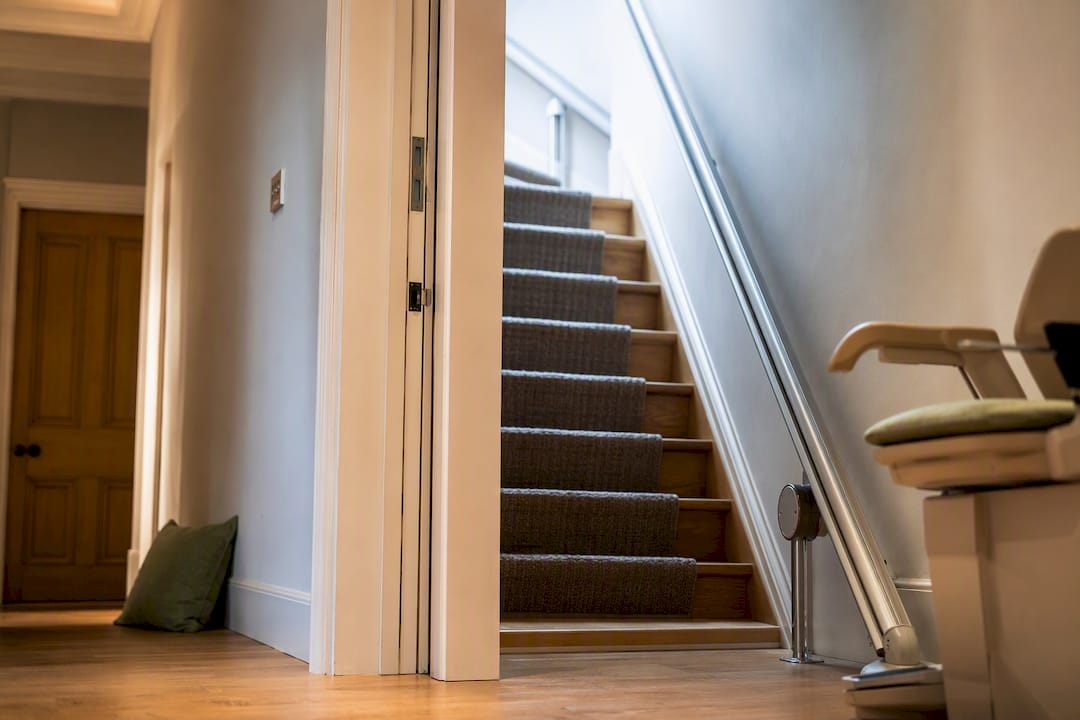
Home adaptations add another layer. Stairlifts, wet rooms, and widened doorways for wheelchair access are among the most requested changes, and larger jobs may qualify for a Disabled Facilities Grant through the local council, subject to a means test of its own that’s separate from the care financial assessment.
Transport is easy to underestimate. Regular hospital appointments, day centre attendance, or specialist clinic visits add up quickly on top of standard care hours, particularly in outer London boroughs with patchier public transport links. Some costs here count as disability-related expenditure and can be logged for a DRE review, as covered earlier.
Smaller recurring costs matter too: incontinence products, specialist skincare, additional heating linked to reduced mobility, and higher laundry use from certain conditions all add a genuine monthly cost that’s easy to miss when budgeting purely around the hourly care rate. Building these into a monthly total from the start avoids the common experience of a care budget looking affordable on paper and then running short within the first few weeks.
How do costs compare across residential, domiciliary, and day care?
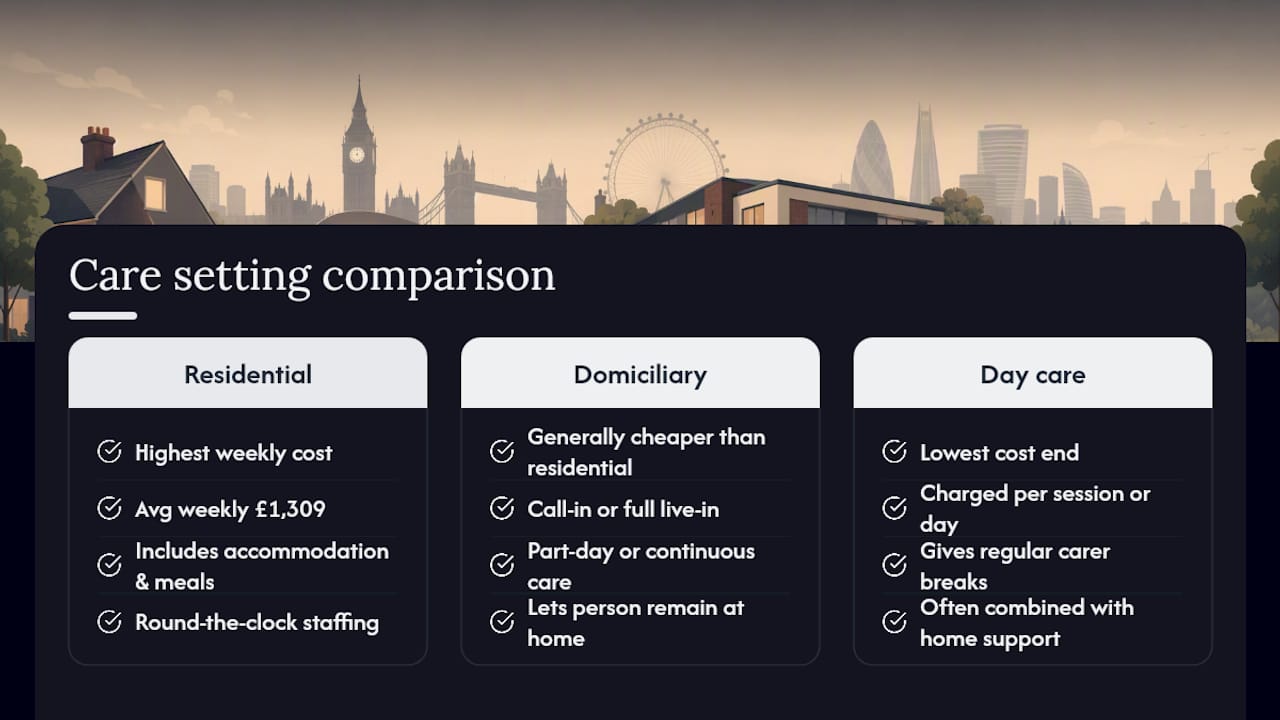
Residential and nursing care carry the highest weekly costs of any care setting in London, consistent with the regional figures showing London’s average weekly residential and nursing cost near £1,309. That figure covers accommodation, meals, and round-the-clock staffing, which explains why it sits above even premium live-in home care rates.
Domiciliary care, whether call-in visits or full live-in support, tends to work out cheaper than residential care for most people, particularly where someone needs support for part of the day rather than continuous nursing-level supervision. It also lets someone remain in their own home, which many families and the people receiving care strongly prefer where it’s practical.
Day care sits at the lower end of the cost scale, typically charged per session or per day rather than by the hour, and works well as a way to give a family carer a regular break without committing to a full home care package. Many families combine day care attendance a few days a week with lighter domiciliary support at home, rather than choosing one setting exclusively.
The right setting depends far more on the level and type of need than on cost alone. A person with high dependency needs requiring two carers to attend safely will often cost more through domiciliary care than a lower-needs resident pays in a care home, so it’s worth comparing actual packages rather than assuming one setting is automatically cheaper.
Has COVID-19 changed disability care costs in London?
The pandemic left a lasting mark on care costs that hasn’t fully unwound. Agencies absorbed higher costs for personal protective equipment, infection control training, and sickness cover during periods of high staff absence, and much of that cost base became permanent rather than temporary.
Staffing pressure was the bigger driver. Recruitment in the care sector tightened considerably during and after the pandemic, and agencies responded by raising pay to retain trained carers, particularly in London where the cost of living made recruitment harder still. Those wage increases feed directly into the hourly rates families see today.
Demand patterns shifted too. More families sought home-based care rather than residential settings during the pandemic, a preference that has persisted for many, which kept demand for domiciliary carers high even as the acute health crisis eased. That sustained demand, layered on top of higher wage costs, is part of why London hourly rates haven’t fallen back to pre-pandemic levels.
Can you negotiate care provider fees or contracts?
Care agency rates are less fixed than they first appear, and it’s worth treating the first quote as a starting point for a conversation rather than a final figure.
Ask exactly what’s included in the hourly rate: travel time, minimum visit length, weekend and bank holiday uplifts, and cancellation notice periods all vary between providers and materially affect the real weekly cost. A lower headline rate with a 25% weekend surcharge can end up more expensive than a slightly higher flat rate, depending on the rota.
Committing to a longer, more predictable rota, rather than ad hoc bookings, often gives you room to negotiate a better rate, since agencies can plan staffing more efficiently around a fixed schedule. It’s also worth asking whether the agency offers a lower rate for block-booked hours across a full week compared with scattered single visits.
Before signing anything, get the contract’s notice period, review clauses, and any annual rate increase mechanism in writing. A written, costed estimate at the outset, matched against your council’s assessed contribution, makes it far easier to spot whether a contract genuinely fits your budget before you commit.
A practitioner’s view on planning for disability care
The families who cope best with London care costs aren’t the ones with the biggest budgets. They’re the ones who request the needs assessment early and plan around the £23,250 capital threshold well before it becomes urgent. Staying at home usually costs less than residential care for moderate needs, but only if the hours are genuinely matched to the person’s actual routine, not padded out of anxiety. Get the DRE evidence right early, and the financial assessment stops feeling like a threat and starts working in your favour.
— Dan
How Kells can help with your next steps
Kells-care offers a genuine local alternative to piecing together care through multiple unfamiliar agencies: one CQC-regulated provider covering call-in visits, live-in care, dementia support, and specialist help for children with learning disabilities, autism, or challenging behaviours, all delivered by carers who already know London’s boroughs and its council processes. That local depth, built over more than 30 years, means Kells can talk you through what a realistic quote looks like for your specific postcode and needs, rather than a generic national estimate.
Some care agencies can prepare a written, costed estimate you can use alongside your paperwork if you are heading into a financial assessment or trying to compare a council-arranged package against self-funding. Visit the Kells-care home page to see the full range of services, or download the free home care guide for a step-by-step breakdown of what to prepare before your assessment call.
Sources
- Getting a financial assessment for care at home (Independent Age)
- Financial assessment (means test) for social care – NHS
- Gov
- Gov
- NHS Continuing Healthcare – NHS
FAQ
How much does disability care cost in London?
Hourly home care in London generally costs £26 to £35, while live-in care runs from roughly £1,100 to £1,700 a week depending on complexity. Dementia live-in support through Kells-care typically sits at £1,400 to £1,700 a week, reflecting the higher skill level that condition requires.
How much is a private carer per hour in the UK?
Private hourly care outside London tends to run somewhat lower than the £26 to £35 London range, though rates vary by region, provider, and the complexity of care needed. London’s higher wage floor and travel costs are the main reasons the capital sits above the national picture.
Who pays for the care of disabled adults?
Payment usually comes from a mix of sources: the individual or family, the local council following a financial assessment, disability benefits like Attendance Allowance or PIP, and in some cases the NHS through Continuing Healthcare where the primary need is medical rather than social. Most families combine at least two of these routes.
What does the £23,250 capital limit mean for care costs?
In England, councils generally expect people with savings and capital above £23,250 to fund their own care in full. Between £14,250 and £23,250, a tariff income rule applies, adding £1 a week to assessed income for every £250 held in that band, and below £14,250 capital is disregarded entirely.
What is disability-related expenditure (DRE) and how do I claim it?
DRE covers extra costs someone faces because of their disability, such as specialist heating, laundry, or equipment costs, which councils must deduct from assessed income. Most councils apply a small standard weekly allowance automatically, but you can request an individual DRE review with dated receipts if your real costs run higher.