

When someone with dementia asks the same question for the tenth time, the cause is usually memory loss, often with worry underneath. They cannot remember asking, or cannot remember your answer. The best response is usually calm and warm, and speaks to the feeling behind the question as well as the facts. This guide explains why it happens, what to say, what to change around the home, and when to ask a GP for advice.
If you are a family carer in London or elsewhere in the UK, you are not alone. Repeated questions are among the most tiring parts of caring for a person with dementia. They are also among the most manageable once you know what is behind them.
TL;DR
- Repeated questions are most often caused by memory loss, and the person usually does not know they have already asked.
- The question is often about a feeling, such as worry, boredom or a need for reassurance. Alzheimer’s Society advises responding to that emotional need, not only the facts.
- Stay patient, keep your tone level, and try a visible calendar or clock, a favourite activity, and a diary to spot triggers.
- A sudden change in behaviour can point to pain, constipation or an infection, so ask a GP for an assessment.
- Support exists for you too, including the Alzheimer’s Society Dementia Support Line on 0333 150 3456.
Table of Contents
- Why a person with dementia asks the same thing again and again
- Which stage of dementia do repeated questions belong to?
- What to say when the question comes again
- Practical ways to reduce repeated questions
- A worked example
- When repeated questions are a reason to call the GP
- Looking after yourself
- Our perspective on repeated questions
- How Kells can help at home
- FAQ
- Sources
Why a person with dementia asks the same thing again and again
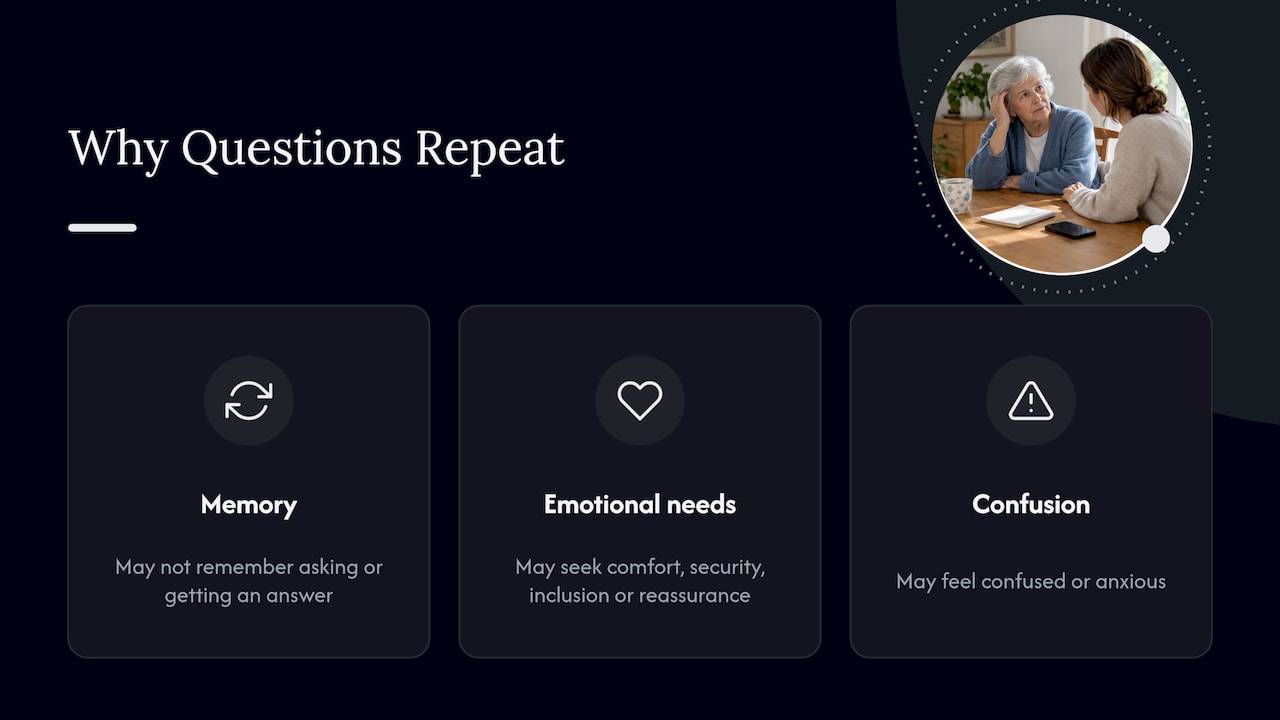
The most common reason is simple. Dementia affects short-term memory, so the person may not remember asking the question, or may not remember getting an answer. To them, each time feels like the first. According to Alzheimer’s Society, the person may also be looking for comfort, security, inclusion or reassurance, or may feel confused or anxious.
That second part matters. A question such as “Where is my daughter?” or “When are we going?” may not really be about the daughter or the journey. It may be the person’s way of saying “I feel unsure and I want to feel safe.”
The question is often a message
Alzheimer’s Society describes repetitive behaviour as a way of communicating a need. Its guidance on changes in behaviour encourages carers to look at what the person may be trying to tell you, such as an unmet emotional or physical need. It might be hunger, thirst, discomfort, loneliness or fear.
This changes how it feels to be on the receiving end. The person is not doing it to annoy you. They cannot stop, and they usually cannot see the pattern themselves.
Different kinds of repetition may have different causes
Researchers looking at verbal repetition in dementia suggest that repeating questions is believed to be mainly a memory problem. Repeating stories or statements is thought to involve executive function, which covers planning, attention and mental flexibility. You can read more in a study of verbal repetition in people with dementia. In practice you may see both, and the same approach of patience and reassurance helps with each.
Which stage of dementia do repeated questions belong to?
There is no single stage when repeated questions start or stop. The same study of informal caregivers found that repetitive questions were tracked as a symptom across all stages of dementia. Other forms of repetition, such as telling the same story, were more often linked with the moderate and severe stages, according to that research.
For families, this means:
- Repeated questions can be one of the early things you notice, alongside other changes. Our guide to the signs of dementia in seniors lists others to look out for.
- They can continue as the condition progresses, sometimes changing in form and in what triggers them.
- The behaviour alone cannot tell you the stage. A GP or memory service makes that assessment.
The NHS notes that behaviour changes such as agitation, aggression, delusions and hallucinations can occur in later stages. If repeated questions become more distressed or are joined by new behaviours, tell the person’s GP or dementia team.
What to say when the question comes again
The aim is not to win the conversation or correct the person. It is to help them feel calm and safe. Alzheimer’s Society advises responding patiently, keeping your tone level and calm, and thinking about the emotional need behind the question.
Try these steps
- Pause and breathe. Your tone carries more than your words. A slow, even voice helps the person settle.
- Answer simply. Give the answer again in a short sentence, even if it is the twentieth time.
- Name the feeling. “You sound a bit worried. I’m here with you.”
- Offer reassurance. A hand on the arm, a smile, or a phrase such as “Everything is taken care of.”
- Move on gently. Suggest a cup of tea, a walk, or a look at a photo album.
Examples of what to say
| The person asks | Possible need behind it | A calm response |
|---|---|---|
| “Is my daughter coming?” | Wanting security and connection | “She’ll be in touch soon. You’re missed. Shall we look at the photos of her while we wait?” |
| “What time are we going out?” | Anxiety about the day ahead | “Not until after lunch. Nothing to worry about yet. Let’s have a cup of tea.” |
| “Where am I supposed to be?” | Feeling lost or unsure | “You’re at home and you’re safe. I’m with you.” |
| “What day is it?” | Needing to feel oriented | “It’s Tuesday. Look, it’s on the calendar here.” |
These are examples, not scripts. Use the words that sound like you and that fit the person’s own history and humour.
What tends not to help
- Saying “I’ve just told you.” The person cannot recall it, so this only adds embarrassment.
- Arguing or explaining at length. More information can add confusion.
- Ignoring the question. This can leave the worry unanswered and the questions louder.
Practical ways to reduce repeated questions
You cannot stop repetition completely, but you can often lower how often it happens and how distressing it is. Alzheimer’s Society suggests a visible calendar or clock, looking for triggers such as the time of day or particular people, and distracting the person with an activity they enjoy.
Make answers visible
A large, clear calendar or clock in the room the person uses most can answer “what day is it?” or “what time is it?” without you. A whiteboard with the day’s plan, for example “Lunch at 1. Sam visits at 3”, can do the same for “what’s happening today?” Keep it simple and in large print.

Keep a short diary
The NHS suggests that keeping a diary of a behaviour for one to two weeks can help you identify triggers such as the time of day or certain social situations, as set out in its guidance on coping with behaviour changes. Note down:
- what time the questions started
- what was happening just before
- who was there
- how the person seemed (tired, hungry, bored, in pain)
- what helped
After a week or two, patterns often appear. Perhaps the questions peak before visitors arrive, or in the late afternoon. If the late afternoon is difficult, our guide to dementia sundowning at home has safe steps for the evening hours.
Check the environment
Alzheimer’s Society explains in its guidance on behaviour in the later stages that too much noise, too much activity, or being too hot, too cold or in poor light can trigger or worsen repetitive behaviour. Try:
- turning the television or radio down, or off
- keeping a quieter space for rest
- checking the room temperature and lighting
- limiting the number of people in the room at once
Build a gentle routine
A predictable day tells the person what is coming, which often reduces the need to ask. Regular meals, a morning walk, a set time for tea and a familiar evening wind-down all help. Our guide on how to create dementia routines that reduce distress walks through this step by step.
Offer an activity they enjoy
Distraction works best when it is something meaningful, not just a way to change the subject. Think of sorting a button tin, folding laundry, humming along to old songs, gardening, or looking through family photos. The person gets occupied and feels useful, and the worry often fades.
A worked example
This is an illustration, not a real case. Imagine a woman called Margaret, who has dementia and lives with her son. Every afternoon at about four she asks, “When is Tom coming home?” Tom is her late husband’s name for her grandson, who gets back from school at five.
Her son keeps a diary for ten days and sees that the questions begin when the light drops and the house gets quiet. He tries three changes:
- A calendar and a note on the whiteboard: “Tom home at 5.”
- A cup of tea and a look at a photo album at 3.45.
- A short answer with reassurance: “He’ll be here soon. You’ll see him at five. I’m here with you.”
The questions do not vanish, but they come less often, and Margaret is calmer when they do. The change came from understanding the trigger and the feeling, not from winning an argument about the answer.
When repeated questions are a reason to call the GP
A gradual pattern of repetition is part of dementia for many people. A sudden change is different. The NHS advises asking a GP for an assessment if behaviour changes suddenly, because the cause may be pain, constipation or an infection that can be treated, as it says in its behaviour guidance.
Book an appointment if:
- the questions increase sharply over a day or two
- the person seems newly distressed, restless or in pain
- repetition comes with new confusion, drowsiness or other changes
If the person is in immediate danger or seriously unwell, call 999. For other urgent but non-emergency concerns, NHS 111 can advise. Our guide to handling dementia emergencies covers what to prepare in advance.
Looking after yourself
Answering the same question again and again is draining, and feeling frustrated does not make you a bad carer. It makes you human. A few things help:
- Take breaks. Step into another room for a minute if you need to. Make sure the person is safe first.
- Talk to someone. Alzheimer’s Society offers a Dementia Support Line on 0333 150 3456 and an online Dementia Support Forum, as listed in its communication guide for carers. Check the Society’s website for current opening hours.
- Ask about local support. Your GP, your local council and local dementia services can tell you about carers’ groups, day services and specialist nurses in your area.
- Arrange regular respite. Time off lets you return with more patience. It can be a few hours a week or a longer break.
For more ideas on managing the wider picture, read our dementia behaviour management steps and proven dementia care strategies for London families.
Our perspective on repeated questions
We have been supporting people in their own homes across London for over 30 years, and repeated questions come up in almost every family we meet.
What we see is that the question is rarely the real problem. The real problem is the worry, the tiredness and the lack of a break for the person answering it. When a carer is exhausted, patience wears thin, and the person with dementia feels that tension straight away.
Our approach is to get to know the person first: their routine, what calms them, what they used to enjoy and what tends to set them off. Our carers are qualified, DBS checked and regulated by the Care Quality Commission, and care is personalised around the individual, not a standard template. A familiar face at the same time each day can answer a good many questions before they are asked.
We would encourage any family to build in regular support before they reach the point of burnout. Respite, a few call-in visits a week, or live-in care are not signs that you have failed. They are ways of keeping your relationship with your loved one warm while someone else shares the practical load.
Dan
How Kells can help at home
If repeated questions are wearing you down, we can talk through what support might suit your family. We provide call-in visits, live-in care, dementia care, companionship and respite cover, all delivered by qualified, DBS-checked carers and regulated by the CQC. You can see the full list on our home care services page, or read about dementia live-in care if round-the-clock presence is what you need. To start a conversation, get in touch with Kells and we will talk about what the person needs and what would help you.
FAQ
What stage of dementia are repetitive questions?
There is no single stage. Research on caregivers’ reports found repetitive questions tracked across all stages of dementia, while other repetition such as retelling stories was more often linked with moderate and severe stages. If you are unsure what stage your relative is at, ask their GP or memory service.
Why do people with dementia repeat the same questions?
Usually because memory loss means they cannot recall asking or being answered. There can also be an emotional reason, such as anxiety, confusion or a need for reassurance and security. Looking at what is happening around the person when they ask often reveals the trigger.
How do I deal with repeated questions in dementia?
Stay patient, keep your tone calm and level, and answer briefly, adding reassurance for the feeling behind the question. A visible calendar or clock, a diary to spot triggers, and an enjoyable activity to move on to can all help. Avoid saying “I’ve just told you”, as the person cannot remember.
Should I be worried if the questions suddenly get worse?
A sudden change is worth acting on. The NHS advises asking a GP for an assessment, because pain, constipation or an infection can cause behaviour changes and may be treatable. Call 999 if you think the person is seriously unwell or in danger.
Where can I get support as a carer in the UK?
You can call the Alzheimer’s Society Dementia Support Line on 0333 150 3456 or use its online forum. Your GP and local council can also point you to carers’ groups and respite services near you. In London, a home care agency such as ours can talk through call-in visits, live-in care or respite cover.
Sources
- Repetitive behaviour and dementia, Alzheimer’s Society
- Changes in behaviour, Alzheimer’s Society
- Changes of behaviour in the later stages of dementia, Alzheimer’s Society
- Coping with dementia behaviour changes, NHS
- Exploration of verbal repetition in people with dementia, PMC
- Communicating with a person with dementia, Alzheimer’s Society