

Yes, a London domiciliary care agency can charge you a cancellation fee if your care agreement clearly says so. What matters next is whether that clause was properly explained, and whether the invoice matches it. Find your care agreement, locate the cancellation clause, and request an itemised invoice before you pay anything or argue with anyone.
TL;DR:
- Most care providers charge full rates for cancellations made within 24 hours or on the same day, but charges are often reduced or waived with longer notice.
- Clear written notice of cancellation rights and the specific contractual clause are essential; vague explanations or missing documentation can allow challenges.
- Hospital admissions can incur a holding fee for several days, but charges must be clearly agreed upon in advance, as upheld in ombudsman decisions.
- Carers are usually entitled to full pay for shifts canceled last-minute, as last-minute cancellations restrict their ability to find replacement work.
- To dispute a fee, gather evidence such as invoices and hospital paperwork, then formally request an itemised bill before escalating to official complaints.
Table of Contents
- What counts as a cancellation, a no-show and a contract termination?
- Typical fee structures and notice periods in provider terms
- What does UK consumer law say about care visit cancellation charges?
- How do hospital admissions and medical emergencies get treated?
- Why do agencies charge cancellation fees at all?
- How do you check your contract and dispute a cancellation charge?
- What London families get wrong about cancellation clauses
- How Kells Domiciliary Care handles cancellations and cover
- Sources
- FAQ
What counts as a cancellation, a no-show and a contract termination?
Not every billing dispute involves the same type of event, and providers like Kells Domiciliary Care treat each one differently in their terms.
- Single visit cancellation: you cancel one booked hourly call before it happens, usually because the person is unwell, away, or has other plans.
- Temporary hold: care pauses for a defined period, most often a hospital admission, with an agreed restart date.
- Termination of the care agreement: you end the whole arrangement, which usually triggers a separate notice clause rather than a per-visit fee.
- Carer no-show: the agency fails to send someone, which is the provider’s failure, not yours, and should never carry a charge to you.
The distinction that matters most is planned versus unplanned. Cancelling a Tuesday visit because your father has a hospital appointment you knew about last week is planned. An ambulance call at 6am is not, and most well-drafted contracts treat the two differently. Families in London commonly discover the difference only when the first invoice after a hospital stay arrives higher than expected.
Typical fee structures and notice periods in provider terms
Cancellation charges in domiciliary care almost always scale with how much warning you give. Provider terms and conditions reviewed across the sector show a consistent pattern, even where the exact wording varies.
- Same day or under 24 hours’ notice: often charged at 100% of the booked visit or shift.
- More than 24 hours’ notice: frequently reduced to 50%, or waived entirely by some providers.
- Ending the whole care agreement: usually needs 7 to 14 days’ written notice, separate from single-visit rules, as shown in sample provider terms and conditions.
- Bank holidays and Christmas Day: some agencies apply a higher multiplier to both the visit rate and any cancellation charge on these dates.
- Live-in and overnight shifts: cancellation close to the start of a shift tends to attract the full daily rate, since a live-in carer has typically already travelled or cleared their diary.
- Multi-carer visits: cancelling a two-carer call at short notice can mean two separate charges, not one, because two people had the slot held.
None of this is universal. It is what a family checking their own agreement against typical market practice should expect to see, not a fixed national rate.
What does UK consumer law say about care visit cancellation charges?
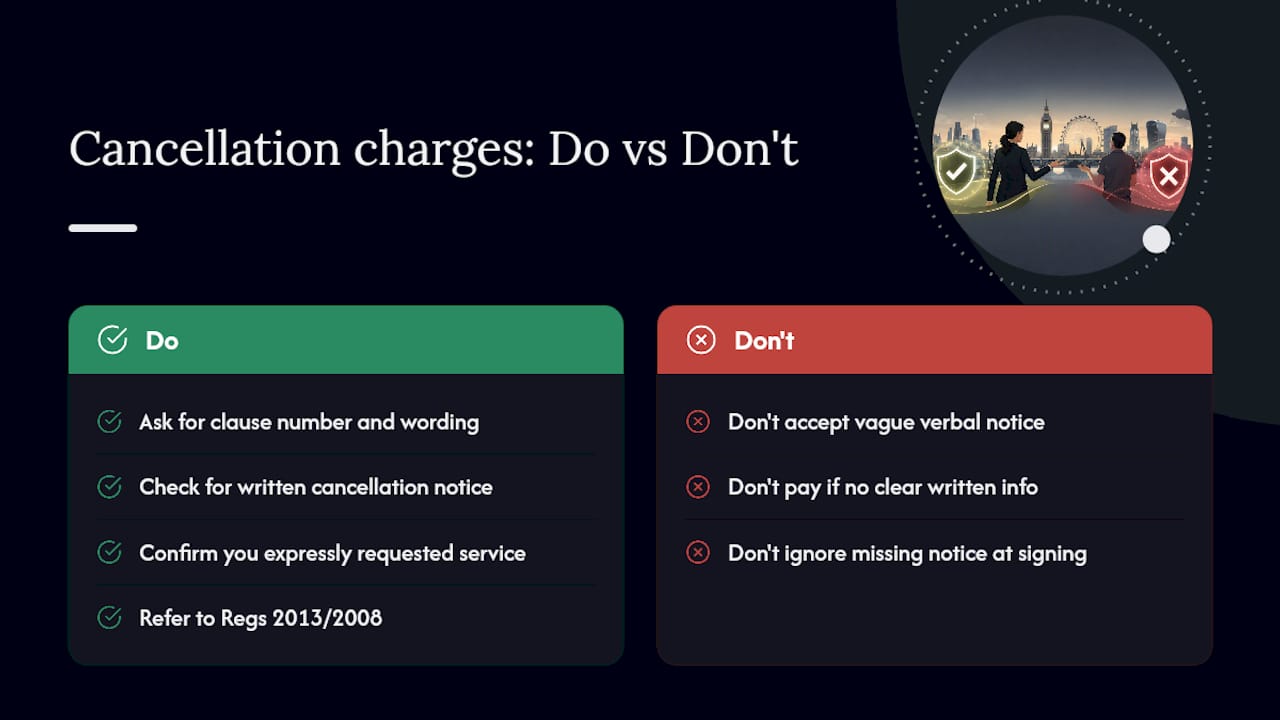
The Consumer Contracts (Information, Cancellation and Additional Charges) Regulations 2013 give you a right to cancel certain distance and off-premises contracts, and set out the limited conditions under which a trader can still charge for services already carried out with your agreement.
A trader may only charge for services performed during the cancellation period if the consumer made an express request for the service to begin and was given clear information about the cost and the right to cancel before agreeing.
That is the legal floor. If your provider never gave you written notice of your cancellation rights when the care agreement was signed, that omission can itself be grounds to challenge a charge. The 2008 Cancellation of Contracts Regulations reinforce this, requiring that notice of the right to cancel be given prominently at the point the contract is made, not buried in a footnote three pages in.
Pro Tip: Ask your provider for the exact clause number and wording of the cancellation term before you dispute the fee. A vague verbal explanation from an office administrator does not count as clear written notice.
How do hospital admissions and medical emergencies get treated?
Practice varies more here than anywhere else in domiciliary care contracts, which is exactly why families get caught out. Some agencies apply a fixed “holding fee” during a hospital stay, charging full rate for the first few days and a reduced rate afterwards. One Local Government and Social Care Ombudsman decision examined a contract charging 100% for hospital admissions of up to 28 days, alongside 100% for cancellations under 24 hours and 50% above that, and found the charges were lawful because the terms had been clearly agreed at the outset.
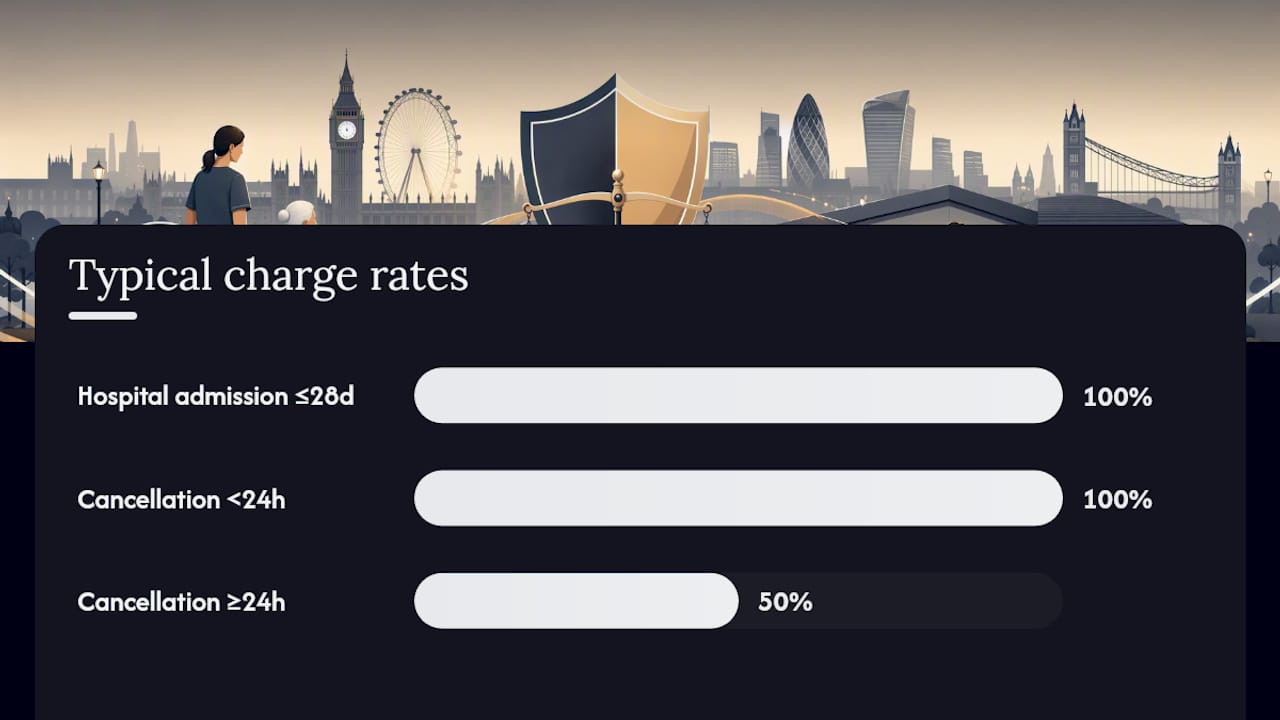
That is the pattern to watch: the Ombudsman rarely rules a fee unfair simply because it feels harsh. It rules on whether the term was clear and agreed when care began.
If a hospital admission starts:
- Tell the agency in writing the same day, by email, not just a phone call.
- Ask what happens to the booked slot and whether a holding fee applies from day one or day four.
- Request any goodwill reduction in writing, since agencies do sometimes offer one even when contractually entitled to charge in full.
- Keep hospital discharge or admission paperwork; it is often the deciding evidence in a dispute.
Kells Domiciliary Care’s guide on post-discharge care costs covers how billing typically resumes once someone returns home.
Why do agencies charge cancellation fees at all?
It is worth understanding the other side of this before you argue with it. Most carers working for London agencies are shift-based or self-employed, and a cancelled visit with no notice means lost income they cannot easily recover elsewhere. The Ombudsman’s own guidance notes that agencies generally have the right to charge in line with published terms precisely because last-minute cancellations deny carers the chance to fill that time with other paid work.
Reasonable mitigation still exists on both sides:
- Ask whether the carer can be offered replacement work elsewhere that day instead of the cancellation being pure loss.
- Ask for a reduced fee or a credit against a future visit rather than a full charge.
- Request a discretionary waiver for a genuine one-off, particularly if you have been a client for years without a prior cancellation.
How do you check your contract and dispute a cancellation charge?
Work through this in order once you have received a bill you think is wrong.
- Locate the exact clause covering cancellations, hospital holds, and termination notice, and read the definitions section first.
- Check how the contract requires you to give notice, by phone, email, or portal, since using the wrong method can itself invalidate a cancellation.
- Gather evidence: the original invoice, any messages with the agency, and hospital admission or discharge paperwork with dates.
- Raise it directly with the provider in writing and ask for an itemised breakdown.
- If unresolved, submit a formal complaint through the agency’s complaints procedure.
- If the care is arranged through a local authority, escalate to adult social care.
- As a last resort, refer the complaint to the Local Government and Social Care Ombudsman.
Kells Domiciliary Care’s guide on questions to ask home care agencies sets out what to check before you sign, which is the easiest way to avoid this dispute in the first place.
What London families get wrong about cancellation clauses
Families rarely lose a cancellation dispute because the fee was unfair. They lose it because nothing was written down. An experienced London domiciliary care agency regulated by the CQC shows that ambiguity, not the charge itself, often causes friction between families and agencies.
The two mistakes that come up again and again: agreeing a cancellation or a goodwill reduction verbally with an office coordinator and never getting it confirmed in writing, and failing to keep hospital admission paperwork with clear dates. Ask any provider for their sample terms before you sign, and get any concession in writing the same day it is offered.
— Dan
How Kells Domiciliary Care handles cancellations and cover
Some agencies set out clear notice periods and fee tiers before care starts, so you know what happens if a call-in visit needs to move, a live-in placement pauses, or respite cover needs adjusting at short notice. Carers are often qualified, DBS-checked, and CQC-regulated, with extensive local experience of common issues including hospital admissions and last-minute changes.
If you’re arranging or reviewing home care services in London, ask us for sample terms before you commit to anything. You can also look at our respite cover options if you need flexible short-term support without an unclear contract attached. Get in touch through Kells Domiciliary Care to talk through your situation and get written terms you can actually check.
Sources
- 21 010 606 – Local Government and Social Care Ombudsman
- Carehome
- Terms and Conditions of Business (example provider T&Cs)
This article is general information, not a substitute for advice from a qualified financial advisor. Consult a qualified financial professional about your own circumstances before acting on anything here.
FAQ
Can a London care agency legally charge a cancellation fee?
Yes, provided the care agreement clearly set out the charge and you were given proper written notice of your cancellation rights under the Consumer Contracts Regulations 2013. If the clause was vague or never explained, that is grounds to challenge it.
What notice period avoids a full cancellation charge?
Most providers reduce or waive charges when you give more than 24 hours’ notice, while same-day or under-24-hour cancellations are commonly charged at the full visit rate. Always check your own agreement, since tiers vary by provider.
Does a hospital admission still get charged as a cancellation?
Often yes, at least for a limited period. Some contracts apply a holding fee at full rate for the first few days of a hospital stay before reducing it, as seen in the Ombudsman’s decision 21 010 606, so notify the agency in writing as soon as the admission happens.
How do I dispute a cancellation fee I think is unfair?
Check the exact clause, gather evidence such as invoices and hospital paperwork, then raise a formal complaint with the provider before escalating to the local authority or the Local Government and Social Care Ombudsman.
Does Kells Domiciliary Care charge cancellation fees?
Kells Domiciliary Care sets out clear notice periods and fee terms for call-in visits, live-in care, and respite cover before your care agreement begins. Current terms are available directly through Kells Domiciliary Care.