TL;DR:
- CQC issues four official ratings for health and social care services in England, based on percentage scores and key question assessments. A service’s overall rating reflects its performance across five domains, with rules preventing high scores from masking serious flaws. Families should evaluate both the percentage scores and detailed reports to understand each service’s true quality.
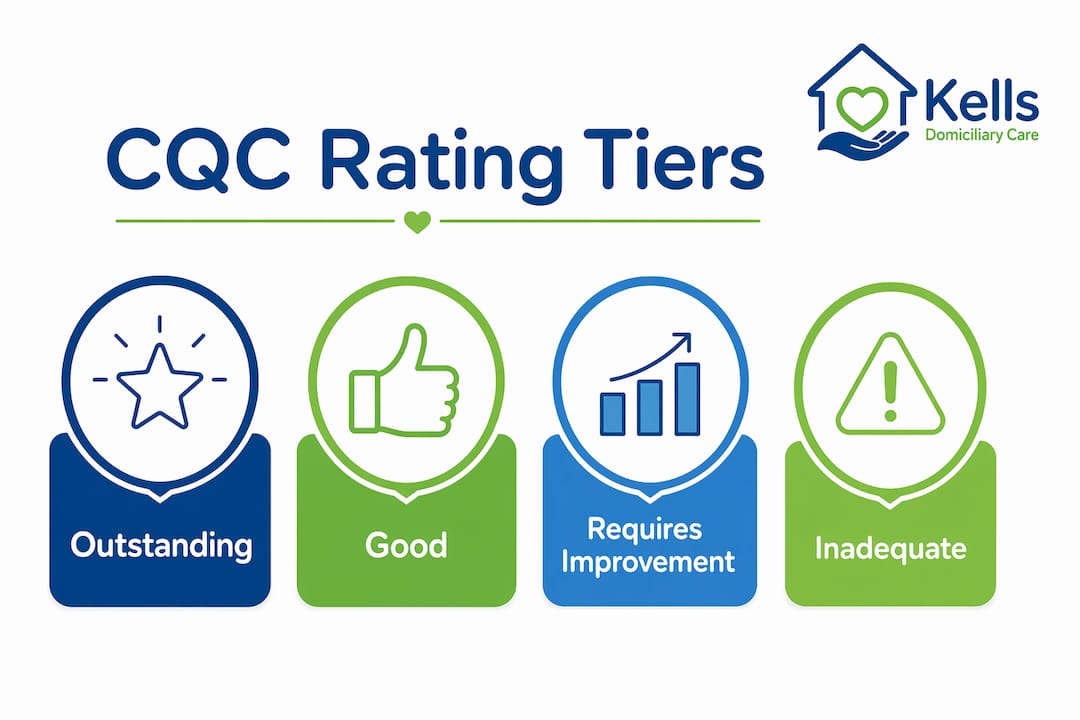
The Care Quality Commission (CQC) issues four official ratings for health and social care services in England: Outstanding, Good, Requires improvement, and Inadequate. Since the scoring update, each rating also carries a percentage score that shows where a service sits within its band:
- 88–100% = Outstanding
- 63–87% = Good
- 39–62% = Requires improvement
- 38% or lower = Inadequate
These percentages come from scores assigned to individual quality statements, which are then grouped under five equally weighted key questions: Safe, Effective, Caring, Responsive, and Well-led. Understanding how those scores build up helps you read a CQC report with much more confidence.
Pro Tip: When checking a service, look at the percentage score alongside the rating label. A service at 64% (lower Good) is in a very different position from one at 85% (upper Good), even though both carry the same headline rating.
Table of Contents
- What does each CQC rating category mean in practice?
- How does CQC score a service and what do the percentage bands mean?
- What are the five key questions and what do inspectors look for?
- What types of inspection does CQC carry out?
- How does CQC combine scores into an overall rating?
- What does a CQC rating mean for services, families and enforcement?
- How do you find and read a provider’s CQC rating?
- What CQC ratings mean for home care in practice
- Key takeaways
- Why the scoring update changes how you should read a report
- A practical resource for London families choosing home care
- Useful sources and further reading
What does each CQC rating category mean in practice?
The four labels are not just grades. Each one carries a specific meaning about the quality of care people receive.
- Outstanding means the service is performing exceptionally well. Families would typically notice highly personalised care, proactive communication, and staff who go beyond their basic duties. Inspectors look for consistent evidence of innovation and learning.
- Good means the service is meeting expectations and people are receiving safe, effective care. This is the standard most well-run services achieve and maintain.
- Requires improvement means the service is not yet meeting all the required standards. Families may notice gaps in care planning, inconsistent staffing, or concerns that have been raised but not fully resolved. The service must improve.
- Inadequate means serious failings exist. CQC may take enforcement action, and families should seek urgent advice from their local authority or social worker.
A rating reflects the published judgement at the time of the most recent inspection. It can change after a new assessment, so always check the date on any report you read. Ratings also apply at different levels: an individual service location, a provider organisation, and in some cases a wider trust or group. The aggregation rules that connect those levels are covered later.
How does CQC score a service and what do the percentage bands mean?
The scoring process has three stages. First, inspectors assign a score of 1 to 4 to each quality statement, where 1 means significant shortfalls and 4 means an exceptional standard. Second, those scores are totalled and divided by the maximum possible score to produce a percentage for each key question. Third, that percentage maps to one of the four rating bands.

| Score | Descriptor | Percentage band |
|---|---|---|
| 4 | Outstanding | 88–100% |
| 3 | Good | 63–87% |
| 2 | Requires improvement | 39–62% |
| 1 | Inadequate | 38% or lower |
Scoring is not purely mechanical. CQC inspectors apply professional judgement to ensure the final score reflects the overall picture rather than a simple arithmetic average. Two services with identical percentage totals can receive different narrative descriptions if the evidence tells different stories.
Since December 2024, CQC now scores at quality statement level rather than at evidence-category level. Draft reports may still show nominal evidence-category entries because of an IT workaround. Do not treat those entries as independent judgements; they are a technical artefact of the transition.
When CQC first applies the new framework to a service, it may assign initial scores from existing key question ratings so that unassessed quality statements have continuity values. A previous Good rating, for example, would generate initial quality statement scores of 3.
Pro Tip: A percentage score in the upper range of Requires improvement (close to 62%) is worth noting. It suggests the service is close to the Good threshold and may be improving, especially if the inspection date is recent.
What are the five key questions and what do inspectors look for?
Every CQC inspection is structured around five equally weighted key questions. Here is what each one covers in practice:
- Safe: Are people protected from harm? Inspectors examine staffing levels, incident reporting, medicines management, and safeguarding procedures. They look at whether risks are identified and acted on.
- Effective: Does care achieve good outcomes? Inspectors review clinical oversight, staff training, care plan reviews, and whether people’s health needs are being met over time.
- Caring: Are staff kind and respectful? Inspectors observe interactions, read care notes, and speak with people using the service. Evidence of continuity of care and dignity in everyday routines matters here.
- Responsive: Is care organised around the individual? Inspectors check whether care plans reflect personal preferences, how complaints are handled, and whether people can access support when they need it.
- Well-led: Is the service well managed? Inspectors look at governance structures, leadership culture, staff morale, and how the service learns from mistakes.
Because the five questions carry equal weight in aggregation, a weakness in any one of them can pull down an overall rating. Families reading a report should scan all five domain summaries, not just the headline.
Pro Tip: In a CQC report, look for the phrases “we found” and “people told us.” These signal direct evidence rather than policy statements. Recurring concerns across multiple sections are a stronger warning sign than a single isolated comment.
What types of inspection does CQC carry out?
CQC uses two main types of inspection. A comprehensive inspection covers the whole service across all five key questions and typically produces a full set of updated ratings. A focused inspection targets specific key questions or areas of concern and follows the same evidence-gathering rigour, but it can update domain ratings without immediately changing the overall rating.
Evidence is gathered from multiple sources: records and care plans, direct observation, conversations with people using the service, staff interviews, and data submitted by the provider. Ongoing assessment between inspections can also update quality statement scores over time.
What triggers a focused re-inspection?
- Previous Inadequate or Requires improvement findings
- Concerns raised by whistleblowers, families, or local authorities
- Significant changes to the service, such as new leadership or a change in registration
- Provider data that flags deteriorating performance
Inspection frequency varies by risk profile. Services rated Good or Outstanding are inspected less often than those rated Requires improvement or Inadequate, where CQC monitors progress more closely.
How does CQC combine scores into an overall rating?
Aggregation works from the bottom up. Quality statement scores combine into a key question percentage, which maps to a key question rating. Those five key question ratings then combine into an overall service rating. Above that, CQC consolidates multiple service or location ratings into a provider rating, and in some cases a trust-level rating, giving five levels of ratings in total.
The aggregation rules include important blocking provisions:
- If one or more quality statements score 1, the overall rating cannot be Good or Outstanding.
- If one or more quality statements score 2, the overall rating cannot be Outstanding.
- For an overall Outstanding, at least two key questions normally need to be Outstanding and the others Good.
These blocking rules exist to prevent strong scores in some areas from masking serious failings elsewhere. A service that scores exceptionally on Caring and Well-led but has a quality statement scored 1 under Safe cannot achieve an overall Good rating.
Pro Tip: When reading a report, check whether any quality statement is scored 1. That single score can be more significant than the overall percentage, because it acts as a ceiling on the rating the service can receive.
What does a CQC rating mean for services, families and enforcement?
For services, a published rating is a public record. An Inadequate rating can trigger enforcement action, including warning notices, conditions on registration, or in serious cases suspension or cancellation of registration. A Requires improvement rating requires the service to produce an action plan and demonstrate progress.
For families, the practical implications depend on which domain is underperforming. A service rated Good overall but Requires improvement for Safe deserves closer scrutiny than its headline suggests.
If a service you are considering is rated Requires improvement or Inadequate, here are some questions to ask:
- What specific issues did inspectors identify and what has been done since?
- When was the most recent inspection and is a re-inspection scheduled?
- Has the service submitted an action plan to CQC?
- Has your local authority care team reviewed the service recently?
If you have concerns about a service a family member is already using, you can contact CQC directly or speak to your local authority adult social care team.
Pro Tip: Never rely on a draft report. Published ratings are the only official judgement. Check the publication date on the CQC website before drawing any conclusions, and note whether the report covers a focused or comprehensive inspection.
How do you find and read a provider’s CQC rating?
- Go to cqc.org.uk and use the search bar to find the service by name or postcode.
- Select the correct location from the results and check the most recent published rating at the top of the page.
- Click through to the full inspection report PDF and note the publication date.
- In the report, prioritise these sections: the summary, individual key question ratings, examples of good practice, and any requirements or enforcement actions listed.
- Check whether any requirements from a previous inspection have been marked as met or outstanding.
When reading the report, focus on:
- The date of inspection (ratings can be years old for services inspected infrequently)
- Any factual accuracy notes, which indicate the provider has disputed specific findings
- Whether a re-inspection date is mentioned or whether CQC has indicated ongoing monitoring
Pro Tip: Use the CQC website’s “history” tab for a service to see how ratings have changed over time. A service that has moved from Requires improvement to Good across two consecutive inspections is demonstrating genuine progress.
What CQC ratings mean for home care in practice
Home care agencies are subject to the same CQC framework as residential services, but the inspection evidence looks different. Inspectors visit people in their own homes, speak with carers during visits, and review care plans that must reflect individual routines and preferences.
Kells-care has been regulated by CQC for over 30 years, providing domiciliary care across London with fully qualified, DBS-checked carers. That regulatory history means the five key questions are embedded in day-to-day practice: staffing decisions, training records, and person-centred care planning are all areas inspectors examine closely.
When speaking to any home care agency, frame your questions around the five key questions:
- Safe: How do you manage medicines and report incidents?
- Effective: How often are care plans reviewed and by whom?
- Caring: How do you match carers to clients and handle requests for change?
- Responsive: What happens if my relative’s needs change quickly?
- Well-led: How does the management team monitor care quality day to day?
In a strong CQC report for a home care service, look for phrases such as “people told us their carers arrived on time and knew their preferences” or “the registered manager demonstrated a clear understanding of each person’s individual needs.” These signal person-centred practice rather than box-ticking. You can also find a ready-made list of questions to ask home care agencies to help you compare providers confidently.
Key takeaways
CQC ratings are built from quality statement scores that map to four bands: Outstanding (88–100%), Good (63–87%), Requires improvement (39–62%), and Inadequate (38% or lower), with blocking rules that prevent serious failings from being hidden by strong scores elsewhere.
| Point | Details |
|---|---|
| Check the overall rating and date | A rating is only as current as its inspection date; always verify when the report was published. |
| Read all five key question domains | Equal weighting means a weak domain can pull down the overall rating significantly. |
| Note any score of 1 | A single quality statement scored 1 blocks a Good or Outstanding overall rating under aggregation rules. |
| Use percentage scores for context | A service at 64% Good is closer to the Requires improvement threshold than one at 85% Good. |
| Kells-care is CQC-regulated | Kells Domiciliary Care has operated under CQC regulation for over 30 years, with qualified, DBS-checked carers across London. |
Why the scoring update changes how you should read a report
The move to quality statement level scoring, implemented in December 2024, is more significant than it might appear. Previously, evidence categories were the unit of measurement, which meant a service could score well on a category even when specific practices within it were inconsistent. Scoring at quality statement level forces a more granular judgement.
What this means for families is that the percentage score now carries more information than before. A service sitting at 71% Good is not just “Good.” It is telling you something about the distribution of its quality statement scores, and the narrative in the report will show you where the weaker statements are.
My view is that families should resist the temptation to treat the percentage as the whole story. A service at 78% with strong narrative evidence of person-centred care and responsive leadership is often a better choice than one at 82% with thin report examples and a recent management change. The number gives you a starting point. The report gives you the substance.
For home care specifically, the Caring and Responsive domains tend to reveal the most about day-to-day experience. Look for specific examples, not general statements. And if a service is CQC-regulated with a consistent track record, that regulatory continuity is itself a meaningful signal of commitment to quality.
A practical resource for London families choosing home care
Kells-care has supported London families for over 30 years, providing personalised, CQC-regulated home care services with fully qualified, DBS-checked carers. If you are comparing home care options and want a clear, practical starting point, the free home care guide covers what to look for in a provider, how to interpret care plans, and the questions worth asking before you commit. Download it, share it with family members involved in the decision, and get in touch with the Kells-care team to discuss your specific situation.
Useful sources and further reading
The following official CQC pages were used to build this article. They are the best place to verify details or read the full guidance:
- Our ratings and scores — the four rating categories and percentage band thresholds
- How we reach a rating — scoring methodology and the role of professional judgement
- Levels of ratings — aggregation principles and the five rating levels
- Update to our current scoring approach — the December 2024 change to quality statement level scoring
- Calculating the first scores using our new approach — how initial scores are assigned during transition
Always consult the original inspection report for full context. Ratings and report details change after new inspections, so check the publication date on the CQC website before drawing conclusions. This article provides general information; for advice specific to your situation, contact CQC directly or speak with a qualified care professional.


