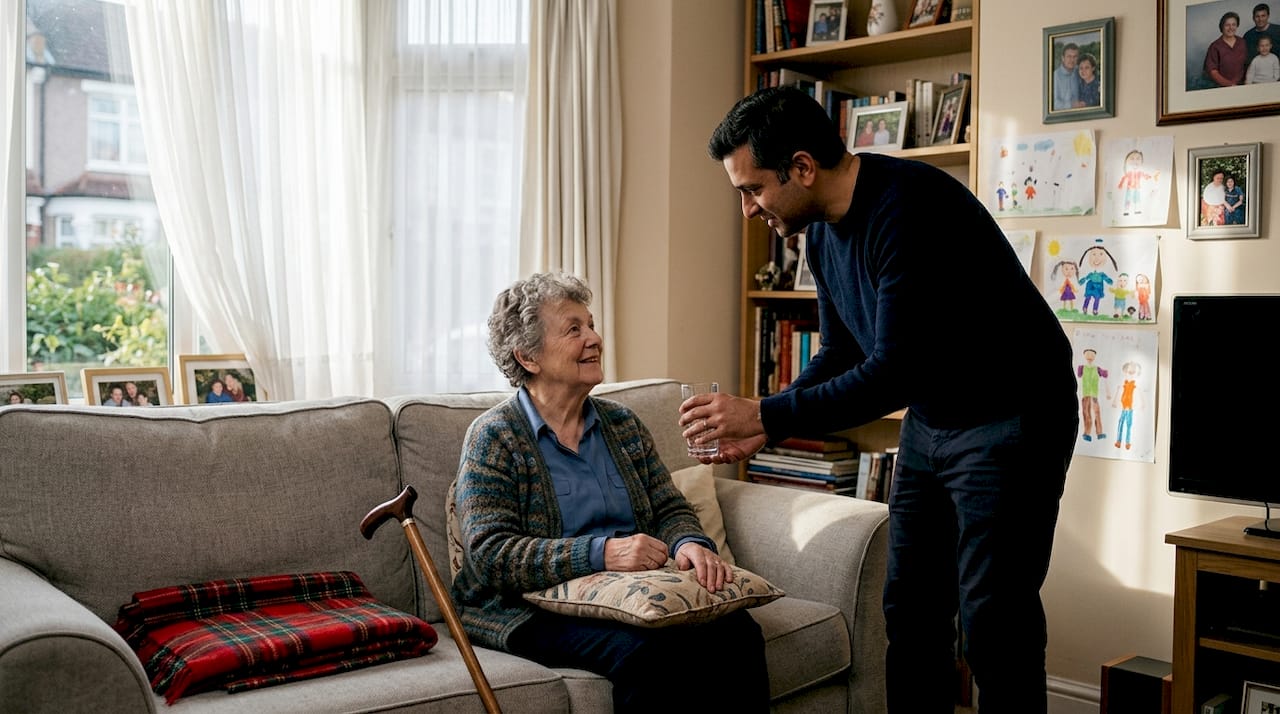

Carers can support medicines in three practical ways: prompting someone to take a dose they can still manage themselves, helping with part of the process such as opening a bottle, or administering medicine directly from labelled supplies against a Medication Administration Record. None of these should begin without an assessed, written medication support plan agreed under NICE guidance and a properly maintained MAR, both required by CQC.
TL;DR:
- Carers should only support medication within a written care plan and a properly maintained medication administration record, starting with an individual assessment.
- Promoting, helping, and administering are distinct levels of support, each requiring specific training, consent, and documentation, with administration carrying the most legal responsibility.
- Recording doses accurately and immediately on a signed or initialed MAR is essential, especially for PRN medicines, to ensure safety and legal compliance.
- Families should verify the support level, responsibilities, and review dates in the care plan before starting assistance to prevent gaps and misunderstandings.
- Digital MAR systems improve safety by providing real-time logging and audit trails, and support should align with the person’s needs, especially for those with memory issues or dementia.
Table of Contents
- What carer-led medication support options look like in practice
- Assessment, levels of support and what must be in the care plan
- MARs, electronic MARs and recordkeeping: the legal checklist
- Practical checklist for families: what to agree before carers start medicine support
- Integration of medication reminder tools with domiciliary care services
- Cost considerations and funding options for medication reminder devices or services
- A practitioner’s note from Dan at Kells
- How Kells can help with medication support at home
- Sources
What carer-led medication support options look like in practice
Families often assume “help with medication” means one thing. It does not. Carers work within one of three distinct levels of support, and mixing them up is where things go wrong.
Prompting is the lightest touch. The carer reminds someone that it is time for their tablets, watches them take it, and does nothing more. It suits people who know what they take and why, but who lose track of time or forget whether they have already taken a dose. According to guidance for homecare workers, prompting is only appropriate when the person retains the knowledge and physical ability to manage their own medicines, and a medication management guide can help families work out where that line sits for their relative.
Helping sits a step higher. This might mean opening a childproof bottle, popping a tablet from a blister pack, or steadying a hand. It still leaves the decision and the final act with the person receiving care, but it requires the carer to note what they did.
Administering is different again. Here, the carer selects the correct dose from labelled supplies, prepares it, and gives it directly, working from a MAR and only within their training. This is the level that carries the most legal weight, because the carer is now the one making the medication happen.
What carers must never do, unless the care plan explicitly says otherwise and they hold the competence to do it, includes:
- Deciding to change a dose or stop a medicine without clinical instruction
- Transcribing handwritten labels onto a new record without proper training
- Administering any medicine that is not listed, dated, and signed for on the MAR
- Making assumptions about “as needed” doses without documented rules
A carer helping an elderly man with Parkinson’s disease might prompt at breakfast, help open a tricky foil strip at lunch, and fully administer an evening dose logged on the MAR. All three can happen in one day, one household, one care plan.
Assessment, levels of support and what must be in the care plan
Nothing above should happen without an assessment first. NICE NG67 sets out that medication support must start with an individual assessment, with the outcome recorded in the person’s care plan before any carer touches a tablet.
Two levels matter most in practice:
- Level B: prompting. The carer’s role is reminders and observation only, agreed in writing and reviewed if the person starts missing doses regularly.
- Level C: selecting, preparing and administering. This requires named, trained carers, a live MAR, and clear rules for what happens if something goes wrong.
Repeated missed doses under Level B are not a minor issue. They are a signal that capacity or ability may have changed, and homecare guidance for domiciliary workers treats this as a trigger to review the plan, not just quietly step up support without documenting why.
Consent and capacity sit underneath all of this. A person who has capacity can decline medicines, and that refusal has to be recorded rather than overridden. Where capacity is in doubt, the care plan needs to say who was consulted and what was decided.
When more than one care provider is involved, for example a domiciliary carer alongside a district nurse, accountability gaps are a genuine risk. Nominating a single provider to lead on administration, with one shared MAR system, is the safest structure.
Pro Tip: Ask to see the actual wording in the care plan, not just a verbal assurance. If it says “prompt medication” but your relative actually needs help opening bottles, that gap is where mistakes happen.
Before support starts, verify the care plan states the level of support agreed, names the carer’s responsibilities, sets a review date, and records who to contact if a dose is missed or refused.
MARs, electronic MARs and recordkeeping: the legal checklist
A Medication Administration Record is not paperwork for its own sake. CQC guidance treats it as the primary legal evidence that a dose was given safely, and it must be signed or initialled at the point of administration, not filled in later from memory.
A properly kept MAR should show:
- The right person’s name and identifying details
- The right medicine, correctly spelled and matched to the label
- The right dose, route (oral, topical, and so on) and time
- A signature or initials logged at the moment the dose was given, not afterwards
PRN, or “when required” medicines, need their own rules written into the plan: minimum gaps between doses, the maximum in 24 hours, and what symptoms justify giving it. Refusals are recorded too, usually with a code plus a brief note of what was said and done next.
One detail families overlook: if the MAR and the actual medicine supply do not match, for instance three tablets missing that the record does not explain, the correct response is to stop, escalate, and contact the GP or pharmacy before continuing. That mismatch is exactly the kind of gap CQC’s own learning from safety incidents work flags as a recurring cause of harm in adult social care, alongside transcription errors and poor oversight.
Electronic MAR systems are changing this picture. Where a paper chart can be illegible or updated hours late, eMAR platforms log doses in real time, flag a missed dose immediately, and leave a clean audit trail that inspectors and families can both check. That auditability is precisely what CQC inspections look for when assessing whether a provider manages medicines safely.
Practical checklist for families: what to agree before carers start medicine support
Get these five things settled before the first visit, not after a problem arises.
- Request the written medication support plan and a specimen MAR. If a provider cannot show you either before support starts, that is a warning sign.
- Confirm the exact tasks agreed. Prompting, helping, or administering. Ask who orders repeat prescriptions and who collects them from the pharmacy, since CQC guidance on home care providers notes this responsibility does not automatically transfer to the carer unless the plan says so.
- Ask about training and competency checks. NICE guidance expects annual, observed competency assessments for carers supporting medicines, not a one-off induction years ago.
- Agree PRN rules and refusal handling in writing. Minimum intervals, maximum daily doses, and exactly who gets called if your relative refuses a dose or a dose is missed.
- Set a review date. Six weeks is a reasonable starting point, with an agreed method for communicating any change, whether that is a phone call, a shared record, or a note in the caregiver’s guide you keep at home.
Pro Tip: Keep a single point of contact for medication queries, even if several carers visit across the week. One name to call avoids the “I thought someone else had sorted it” problem that causes most missed-dose incidents.
Integration of medication reminder tools with domiciliary care services
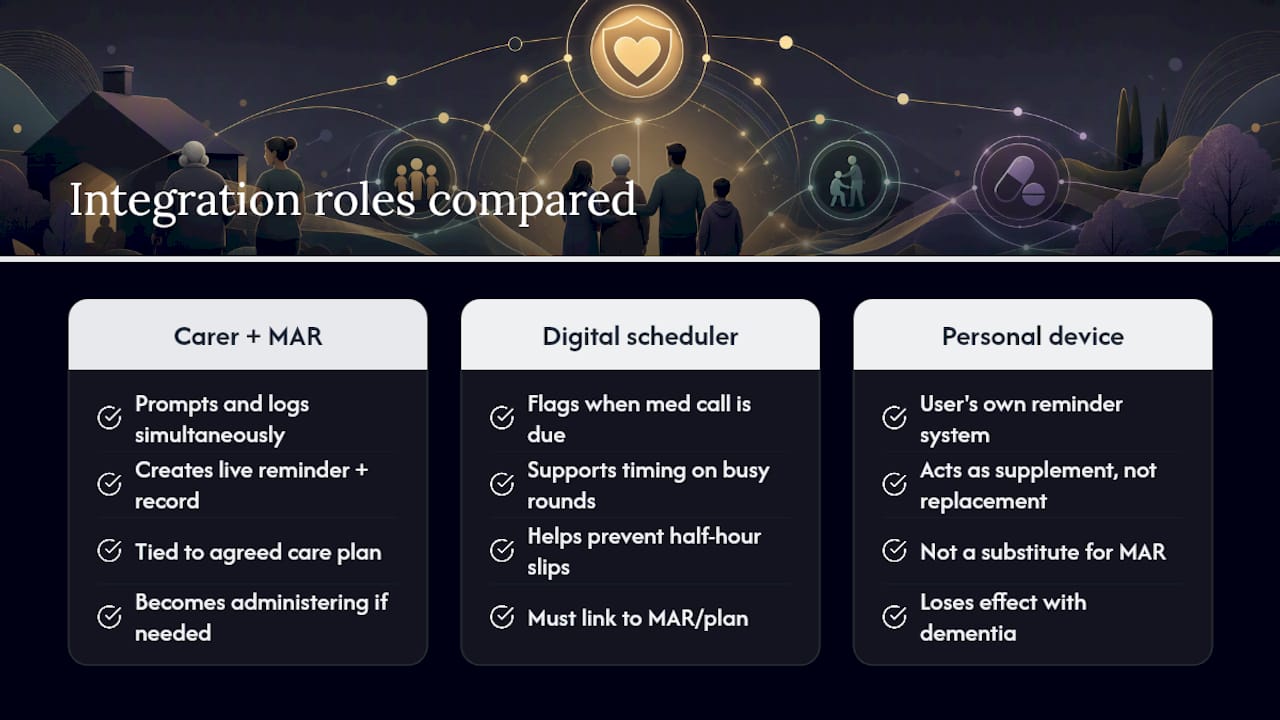
Reminder tools work best when they sit inside the carer’s routine rather than beside it. A carer who prompts a dose at 8am and logs it on a MAR at the same moment is, in effect, running a live reminder and record system by hand. Digital scheduling tools some agencies use to plan visit times can flag when a medication-related call is due, which helps ensure a prompting or administering visit does not slip by half an hour on a busy round.
The integration that matters most, though, is between the carer’s actions and the written plan. A reminder or prompt that is not tied to the agreed care plan and MAR is just a nudge, with nothing behind it if a dose is missed or a query arises later. Where a person also has a personal device or app for their own reminders, families should treat that as a supplement to the carer’s role, never a replacement for the documented support level. The independence-focused approach that good providers take is to let a person keep using their own systems for as long as it is safe, while the carer’s formal prompting or administering role, recorded on the MAR, remains the safety net underneath.
Anyone supporting a person with dementia or significant memory loss should be cautious here. Reminder tools of any kind lose effectiveness once someone cannot reliably act on the prompt, and at that point the practical shift is towards administering support rather than prompting, a distinction covered well in guidance on dementia care considerations.
Cost considerations and funding options for medication reminder devices or services
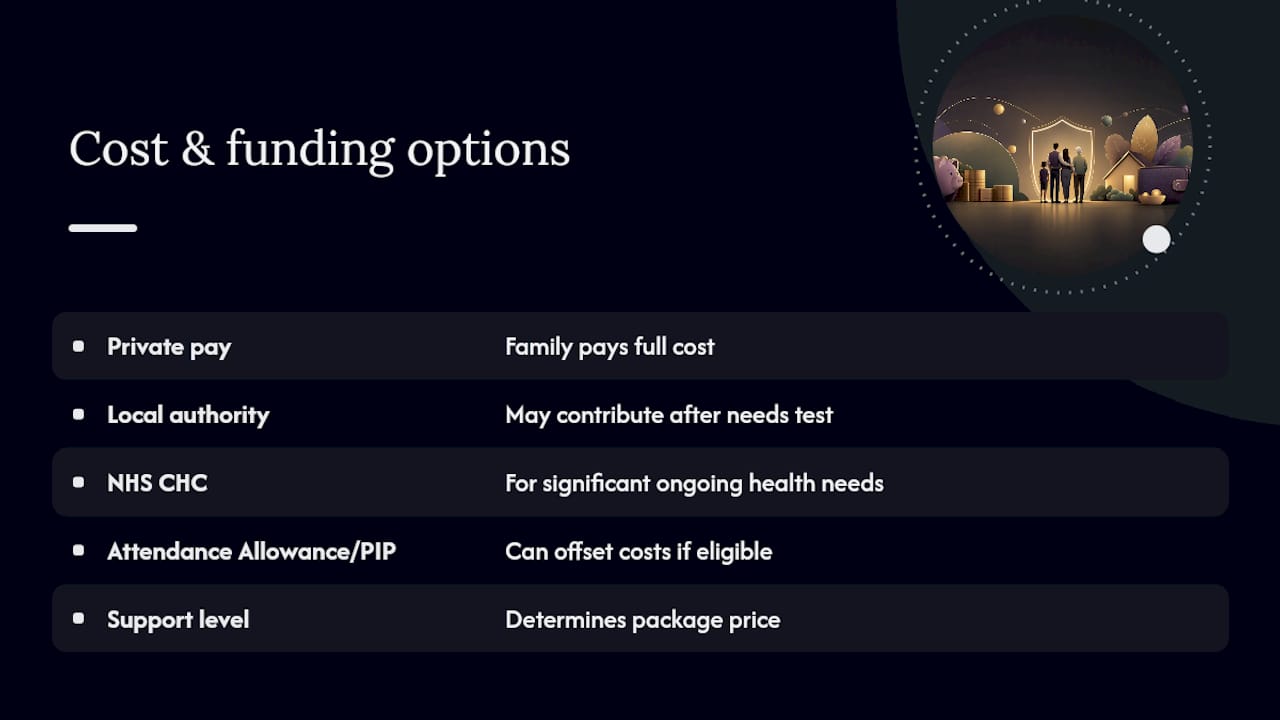
Carer-led medication support is usually costed as part of the visit or hourly rate a domiciliary agency charges, rather than billed separately as a standalone “reminder service.” A short prompting visit costs less carer time than a full administering visit that involves preparing doses and completing detailed MAR entries, so the level of support agreed in the care plan has a direct bearing on the overall care package price.
Funding routes vary by circumstance. Some families pay privately for the full cost of visits. Others may qualify for local authority contributions following a needs assessment, or NHS continuing healthcare funding in cases involving significant ongoing health needs. Attendance Allowance and Personal Independence Payment can also help offset costs for people who meet the eligibility criteria, though neither is specifically earmarked for medication support.
The most cost-effective approach is rarely the cheapest hourly rate. A provider offering only brief prompting visits may look less expensive on paper, but if that level of support is mismatched to what your relative actually needs, missed doses and hospital admissions cost far more in the long run. Matching the support level correctly at assessment, and reviewing it as needs change, protects both wellbeing and budget.
A practitioner’s note from Dan at Kells
The families who get this right are the ones who ask hard questions early: exactly what will the carer do, and what happens if a dose is missed? The ones who struggle usually assumed too much, thinking a general home care visit automatically covers medicines. It does not, unless it is written down.
The instinct to keep a relative doing as much as they safely can for themselves is the right one. Prompting, not administering, should be the default until the evidence says otherwise.
We have spent over 30 years working through exactly these decisions with families, and the carers are DBS-checked, trained, and regulated by CQC. If you want more detail before deciding, our medication management guide is a good next stop, and we are always happy to talk through what an assessment would actually involve for your situation.
— Dan
How Kells can help with medication support at home
This is an alternative to piecing together medication cover from separate devices, apps, or occasional check-ins. Where those solutions leave gaps between reminders and real accountability, trained carers combine hourly visits, live-in care, or medication-focused support within one assessed, CQC-regulated plan, backed by a proper MAR from day one.
Carers are trained and DBS-checked, and every arrangement starts with an assessment that decides whether prompting, helping, or full administration is right, rather than guessing. That single point of accountability is exactly what the checklist above recommends.
If you want to see what this looks like in practice, download our free home care guide for a plain-English walkthrough of how visits, care plans, and medication records fit together. When you are ready to talk specifics, get in touch to arrange a medication-focused assessment and we will talk you through what happens next, from the initial visit to the first signed MAR entry.
This article is general information, not a substitute for advice from a qualified doctor. Consult a qualified healthcare professional about your own circumstances before acting on anything here.
Sources
- Managing medicines for adults receiving social care in the community (NICE NG67)
- Medicines administration records: adult social care (CQC guidance)