TL;DR:
- Effective dementia care planning integrates clinical, legal, residential, financial, and caregiver needs from the start to prevent crises. Building a flexible, person-centered workflow that includes daily routines, emotional anchors, and coordinated care ensures better outcomes. Regular reviews and supporting caregiver wellbeing are vital to maintaining a safe, engaging, and sustainable care environment.
Managing dementia care well is one of the hardest things a family or healthcare professional will ever take on. The sheer number of moving parts — medication schedules, legal paperwork, behavioural changes, professional carers, and emotional demands — can feel genuinely overwhelming. A structured dementia care workflow does not make the challenge disappear, but it gives you a framework that reduces chaos, protects the person you care for, and protects you too. This guide walks you through every stage, from initial planning to continuous review, with practical steps you can act on today.
Table of Contents
- Key takeaways
- What goes into a dementia care workflow
- Building a personalised dementia care workflow
- Common challenges in workflow management
- Evaluating and improving your care workflow
- My perspective on dementia care workflow management
- How Kells-care supports dementia care workflows in London
- FAQ
Key takeaways
| Point | Details |
|---|---|
| Start with five core domains | Effective dementia care planning must address clinical, legal, residential, financial, and caregiver support needs from the outset. |
| Build in routine flexibility | Rigid schedules increase anxiety; plans that adapt to mood and energy produce better outcomes and less resistance. |
| Use daily logbooks consistently | Documenting triggers, successes, and patterns helps every carer maintain consistency without starting from scratch. |
| Treat care plans as living documents | Reassess and revise after any significant health or behavioural change to prevent avoidable crises. |
| Caregiver support is non-negotiable | Respite planning and community resources must be built into the workflow, not treated as an afterthought. |
What goes into a dementia care workflow
Before you can build a workflow, you need the right foundations in place. Skipping this stage is the most common reason care arrangements break down within the first few months.
The five core domains
Dementia care planning should cover five core domains: clinical management, legal instruments, residential placement, caregiver support, and financial structuring. Addressing all five early significantly reduces the likelihood of future crises. Think of these not as a checklist to tick once but as ongoing areas that need regular attention.
The documents you will need include:
- A confirmed clinical diagnosis with dementia stage clearly recorded
- Durable power of attorney and advance care directives
- A home safety assessment covering fall risks, medication storage, and wandering prevention
- Contact details for the full care team: GP, specialist, social worker, and any community support
- A caregiver rota and a respite care plan for when primary carers need a break
A home environment assessment is particularly worth taking seriously. You may need to reorganise furniture, install door sensors, improve lighting, or remove trip hazards. This single step prevents a disproportionate number of hospital admissions.
Pro Tip: Before anything else, create a single folder — physical or digital — that holds every relevant document, contact, and assessment. Carers arriving for the first time should be able to find everything they need within minutes.
The table below shows the key tools and their function within a dementia care workflow:
| Tool | Purpose |
|---|---|
| Daily logbook | Tracks mood, behaviour, triggers, and communication techniques |
| Assessment templates | Standardise evaluation of health, cognition, and functional ability |
| Advance care directive | Records the person’s wishes regarding medical treatment |
| Caregiver rota | Assigns responsibilities clearly to prevent gaps or duplication |
| Medication record | Ensures correct dosage and timing across multiple carers |
Building a personalised dementia care workflow
Once your foundations are in place, you can start constructing a day-to-day workflow that actually works for the individual. There is no single correct structure. What matters is that the workflow reflects the person’s preferences, their current stage of dementia, and the practical realities of the carers involved.
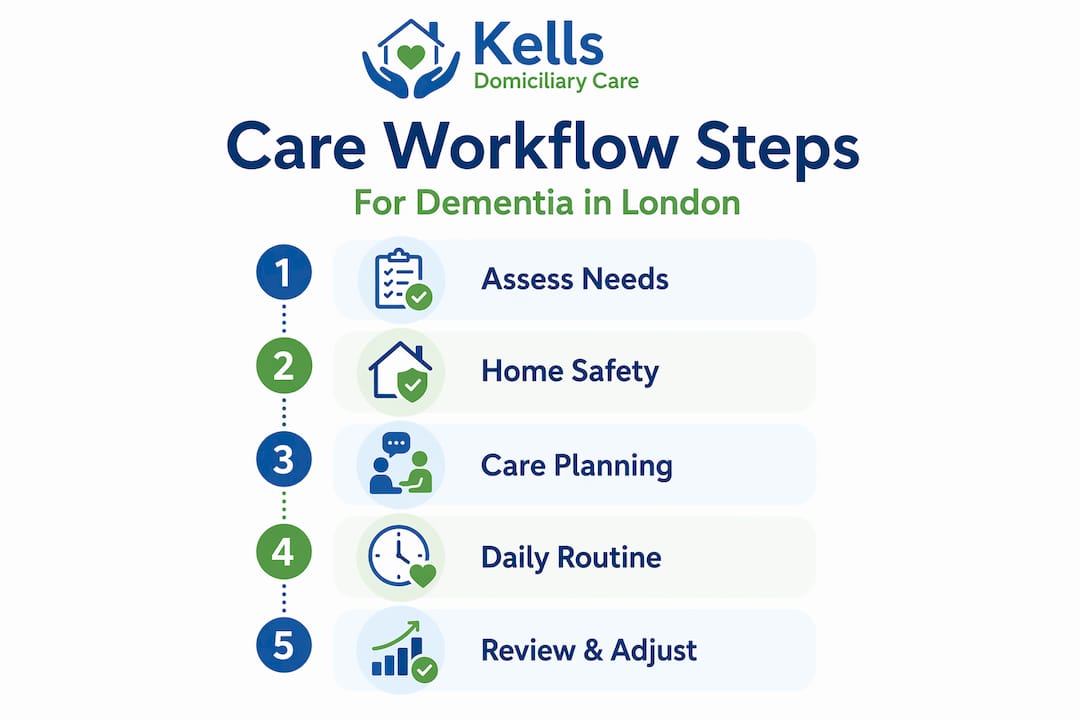
Follow these steps to develop a plan that is both grounded and flexible:
-
Map out the daily rhythm. Identify the person’s natural peaks in alertness and engagement. Most people with dementia are more settled and cooperative at certain times of day. Schedule complex tasks, personal care, and social interaction during these windows.
-
Build in emotional anchors. Familiar music, objects, or activities that carry positive memories can ground a person when they become distressed. Include at least two or three of these in the daily plan.
-
Coordinate clinical and practical care together. Medication management, GP appointments, and health monitoring should not sit in a separate silo. Integrate them directly into the daily and weekly schedule so nothing gets missed.
-
Establish clear communication protocols. If multiple carers are involved, decide how they will share information. Daily logbooks tracking communication successes and agitation triggers maintain care consistency across different carers and prevent techniques being forgotten or repeated.
-
Include community and interdisciplinary support. Occupational therapists, community nurses, and local dementia support groups all contribute to better outcomes. Build them into the workflow with scheduled contact rather than crisis-only engagement.
-
Plan for 24/7 contingencies. The CMS GUIDE Model requires comprehensive dementia care services, including 24/7 support lines and annual respite coverage. Even if you are not in the United States, this model offers a strong template for what genuinely comprehensive care coordination looks like.
-
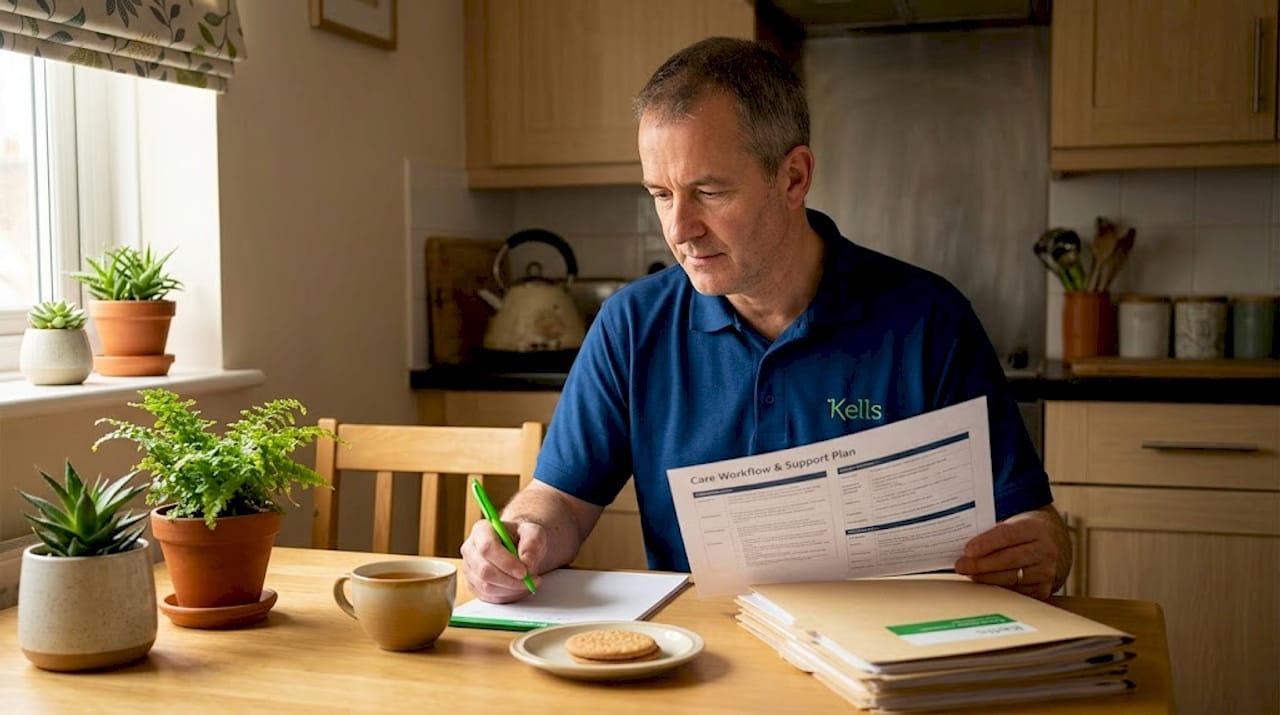
Review behaviour patterns weekly. Adjust the plan based on what the logbook shows. A well-designed dementia daily care plan focuses on rhythm, emotional security, and flexible routines rather than perfection. If Tuesday mornings consistently produce distress, change the Tuesday morning routine.
Pro Tip: Keep the workflow document itself simple enough that any carer can read and understand it in under five minutes. A plan that requires extensive training to interpret will not be used consistently.
If you are looking for proven dementia care strategies that apply specifically to London families, there is practical, evidence-based guidance that can support you at each stage.
Common challenges in workflow management
Even with a good plan in place, you will encounter difficulties. Knowing what they are before they happen means you can respond rather than react.
The most frequent issues include:
- Caregiver burnout. This is the single greatest threat to care quality. Respite care reduces caregiver stress and improves outcomes for the person being cared for. If the primary carer is exhausted, the entire workflow collapses regardless of how well it is designed.
- Sudden behavioural changes. Agitation, aggression, sleep disturbance, or withdrawal can appear without obvious cause. These are often signs of unmet needs: pain, infection, boredom, or fear. The first response should always be investigation, not just management.
- Fragmented communication between providers. GPs, district nurses, social workers, and home carers often operate without visibility of each other’s notes. Designate one person, typically a family member or key worker, as the communication hub.
- Balancing safety with dignity. Technology supports safety without over-restriction, but the goal must always be enabling independence where it is safe, not eliminating all risk. Over-restriction causes distress and decline.
- Adapting routines as needs evolve. Dementia is progressive. The workflow that works in the early stages will not work twelve months later. Schedule formal reviews every three months at minimum.
“Dementia care today requires broader collaboration across life enrichment, clinical teams, and family communication, beyond just memory care units.” — McKnight’s Marketplace
This is particularly relevant in London, where care is often split between NHS services, private home care, and unpaid family support. The workflow must account for all three.
Evaluating and improving your care workflow
A dementia care workflow is not something you set up once and leave. The best carers treat it as a resource that grows and improves over time.
Use the following indicators to measure whether your workflow is functioning well:
| Indicator | What to look for |
|---|---|
| Mood and agitation levels | Reduction in distressed episodes over a 4-week period |
| Medication compliance | Consistent administration with no missed doses |
| Caregiver stress levels | Self-reported wellbeing scores among carers |
| Social engagement | Frequency and quality of positive interactions |
| Incident frequency | Falls, wandering episodes, or medical emergencies |
Dementia care plans are living documents that need immediate reassessment after significant health or behavioural shifts. This is not optional. A person who has had a fall, a urinary tract infection, or a bereavement will have different needs than they did a week ago. Waiting for the next scheduled review can mean weeks of inadequate care.
Feedback from the person with dementia, where possible, and from carers, matters enormously. Small, personalised positive interactions significantly improve patient mood and engagement. Ask carers what is working, what feels difficult, and what they notice that is not recorded anywhere.
Pro Tip: Set a recurring calendar reminder every four weeks to review the logbook together with the care team. This keeps the workflow current without waiting for a crisis to prompt change.
Data-driven care models also support better outcomes at an organisational level. For healthcare professionals in London working within NHS or private settings, building a business case for coordinated dementia care is increasingly supported by evidence linking structured workflows to reduced hospital admissions and improved quality of life.
My perspective on dementia care workflow management
In my experience, the biggest mistake families and professionals make is treating the dementia care workflow as something primarily clinical. They build the medication schedule, the appointment calendar, the safety checklist. And then they wonder why the person they care for is still distressed, resistant, or disengaged.
What I have seen work, again and again, is when the emotional architecture of the day gets as much attention as the practical one. That means asking: does this person feel safe? Do they have moments of genuine pleasure? Are the carers around them calm and consistent? These things cannot be captured in a spreadsheet, but they are what actually determine whether the day goes well.
I have also seen how quickly caregiver wellbeing drops off the agenda. Families pour their energy into the person with dementia and run themselves into the ground. The workflow must include the carer, not just as a resource to be scheduled, but as a person whose health and sustainability matters to the quality of care.
For families in London specifically, the patchwork of services can make coordination feel impossible. My advice is to nominate one person to own the workflow. One point of contact. One person who knows everything and updates everything. It is the single most effective structural change I have seen make a difference.
— Dan
How Kells-care supports dementia care workflows in London
If you are managing dementia care for someone in London, Kells-care has been providing personalised home care in London for over 30 years. Our carers are experienced in supporting families through every stage of dementia, from early diagnosis through to complex daily care needs.
We build care plans around the individual, not a standard template. Whether you need check-in visits, help with personal care, or more regular support, our team works alongside families to create a workflow that is practical, consistent, and genuinely person-centred. All of our carers are DBS checked and regulated by the Care Quality Commission.
You can start by downloading our free home care guide, which covers how to plan and fund care at home. For families wanting more specific guidance on daily personal care, our dementia personal care guide is a practical starting point. If the primary carer needs a break, we can also help you explore respite care options suited to your situation.
FAQ
What is a dementia care workflow?
A dementia care workflow is a structured plan that coordinates all aspects of care for a person with dementia, including daily routines, medication management, caregiver responsibilities, and clinical oversight. It reduces gaps and inconsistencies across multiple carers and settings.
How often should a dementia care plan be reviewed?
A dementia care plan should be reviewed at least every three months, and immediately after any significant health change, behavioural shift, or incident such as a fall or infection. Care plans are living documents and must be updated promptly to remain effective.
What should a dementia care checklist include?
A dementia care checklist should cover daily personal care tasks, medication schedules, meal and hydration records, mood and behaviour observations, safety checks, and contact details for the full care team. It forms the backbone of any effective daily workflow.
How can I prevent caregiver burnout in a dementia care workflow?
Building regular respite breaks into the workflow from the outset is the most effective prevention. Designate a backup carer, connect with community support services, and monitor carer wellbeing as actively as you monitor the person with dementia.
What tools help with workflow management in dementia care?
Daily logbooks, assessment templates, medication records, and caregiver rotas are the core tools. Digital care management platforms can help where multiple carers are involved, but a well-maintained paper logbook can be equally effective in a home setting.