
TL;DR:
- The best UK care search options include the CQC service search, NHS guidance, local councils, and trusted care agencies. Families should start with the CQC to verify provider quality, then contact providers directly to confirm vacancies and arrange care. A thorough evaluation, early planning, and understanding funding options help ensure suitable and reliable care.
The strongest alternatives to CareFind.com for UK families are the Care Quality Commission (CQC) service search, the NHS social care and support guide, your local council adult social care team, Carehome.co.uk, Homecare.co.uk, and charitable advisers such as Age UK and the Alzheimer’s Society. For most families, the CQC search tool is the right first stop — it is the only source that gives you independently verified inspection ratings and published reports for every registered provider in England.
Here is a quick summary of what each route does best:
- CQC service search — filters providers by location and rating; the authoritative quality check before you call anyone
- NHS ‘Find services’ and social care guide — official signposting to local options, council routes, and funding advice
- Local council adult social care — handles needs assessments, funding eligibility, and brokerage for both care homes and homecare
- Carehome.co.uk / Homecare.co.uk — consumer listing platforms with user reviews; useful for shortlisting but do not show live vacancies
- Age UK and Alzheimer’s Society — free specialist advice, particularly for dementia and complex needs
- Which? and the Homecare Association — independent reviews and a vetted membership directory of homecare agencies
- Kells-care — a directly contactable, CQC-regulated London homecare agency with over 30 years’ experience; the practical local alternative when you want a provider rather than a search tool
Table of Contents
- How do the best CareFind.com alternatives compare?
- How do you choose the right source or provider?
- How do you check current availability and arrange care quickly?
- Care homes versus homecare: which is right for your situation?
- Why Kells-care is a trusted London homecare alternative
- Key takeaways
- What families often get wrong when searching for care
- Kells-care: direct homecare support for London families
- Useful sources
How do the best CareFind.com alternatives compare?
The table below maps each alternative against the dimensions that matter most when you are choosing a care source quickly.
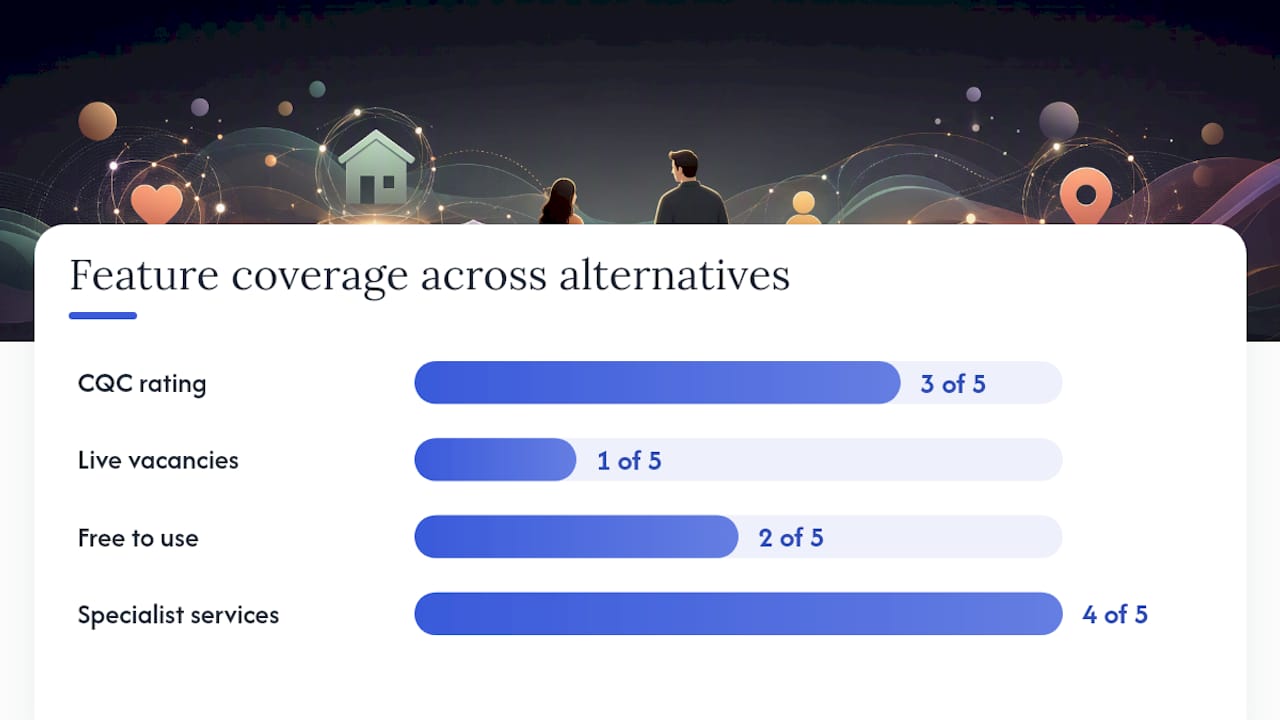
| Alternative | Best for | Coverage | Live vacancies? | Trust signals | Cost transparency | How to contact / arrange | Specialist services |
|---|---|---|---|---|---|---|---|
| CQC service search | Quality checks on any registered provider | National (England) | No | CQC rating, inspection date, full report | Free to use | Online search; download report; call provider direct | All regulated services |
| NHS ‘Find services’ / social care guide | Official guidance and signposting | National | No | NHS-endorsed routes | Free | Online guide; links to council and CQC | All care types |
| Local council adult social care | Needs assessment, funded care, brokerage | Local authority area | Sometimes via brokerage | Council-approved providers | Means-tested; free assessment | Phone or online via GOV.UK | Dementia, disability, complex needs |
| Carehome.co.uk | Browsing and comparing care homes | National | No (enquiry-based) | CQC rating displayed; user reviews | Enquiry form; no direct booking | Online enquiry or phone | Some specialist homes listed |
| Homecare.co.uk | Browsing homecare agencies with reviews | National | No | CQC rating displayed; user reviews | Enquiry-based | Online enquiry or phone | Live-in, dementia, disability |
| Age UK | Free advice, especially for older adults | National (local branches) | No | Charity; independent | Free advice line | Phone; local offices | Dementia, benefits, housing |
| Alzheimer’s Society | Dementia-specific care guidance | National | No | Charity; specialist | Free helpline | Phone | Dementia, memory care |
| Which? | Independent consumer reviews | National | No | Independent editorial | Free basic; subscription for full reports | Online | General care quality |
| Homecare Association | Finding vetted homecare agencies | National directory | No | Membership-based vetting | Free to search | Online directory | Homecare; live-in care |
| Kells-care | Direct homecare in London | London | Yes — call directly | CQC-regulated; DBS-checked staff; 30+ years | Transparent on enquiry | Phone or online enquiry | Dementia, live-in, respite, disability |
A few important caveats:
- Commercial listing platforms such as Carehome.co.uk and Homecare.co.uk do not display real-time vacancies. Listings reflect registered providers, not current availability. Always call providers directly to confirm.
- Local councils may require a formal needs assessment before they can arrange or fund care. This takes time, so contact your council early — particularly if funding support may be needed.
- Aggregator platforms sometimes charge providers for listings or leads, which can affect which providers appear and how prominently.
How do you choose the right source or provider?
Start with this combination: run a CQC search to filter for quality, check one consumer platform for user reviews, then call your local council to understand funding options. That three-step approach covers regulation, real-world experience, and financial planning in one pass.
Evaluation checklist
Before committing to any provider, work through these six points:
- CQC registration and rating — confirm the provider is registered and check their latest rating (Outstanding, Good, Requires Improvement, or Inadequate). Pay particular attention to the ‘well-led’ domain, which often predicts day-to-day stability.
- DBS-checked staff — ask whether all carers hold a current enhanced DBS certificate. Reputable agencies will confirm this without hesitation. You can read more about why DBS checks matter for families in London.
- Inspection date — a rating is only as current as the inspection behind it. Check when the last inspection took place via the CQC’s homecare agency directory.
Questions to ask at first contact
- Do you have availability for the hours and days we need?
- Will the same carer visit each time, or does that vary?
- Are all staff DBS-checked and trained for [specific condition, e.g. dementia]?
- What is your complaints process, and can you share your most recent inspection report?
- Can we arrange a trial visit or a ‘meet the carer’ session before committing?
- What are your notice and cancellation terms?
Red flags to watch for
- No CQC registration number, or an ‘Inadequate’ rating with no improvement plan
- Vague or evasive answers about staffing levels and continuity
- Fees that are not confirmed in writing before care starts
- Pressure to sign a contract on the first call
- No written care plan offered
Timeline and costs
Arranging homecare privately can move quickly — sometimes within days of first contact. A care home placement typically takes longer, particularly if a council assessment is involved. The NHS social care and support guide sets out the main routes clearly.
For funding, there are three main routes: self-funding (paying privately), a local authority contribution following a means-tested assessment, and NHS Continuing Healthcare (CHC) for those with a primary health need. To apply for a needs assessment, contact your local council’s adult social care team. The assessment is free, and it establishes both care needs and financial eligibility. A social worker’s involvement can also help coordinate the process.
How do you check current availability and arrange care quickly?
Call providers and your local authority brokerage team directly. The CQC and NHS are your quality and guidance tools, not live vacancy databases. No online listing reliably reflects what is available today.
Here is a practical sequence to follow:
- Use the CQC search to build a shortlist of providers rated Good or Outstanding within your area.
- Check Homecare.co.uk or Carehome.co.uk for user reviews on your shortlisted providers.
- Call each provider directly, using the script below as a starting point.
- Contact your local council adult social care team in parallel, especially if funding support may be needed. Council brokerage teams sometimes have access to providers with immediate capacity.
Pro Tip: When you call, ask specifically for the duty manager and request the date of the provider’s most recent CQC inspection. Providers who are confident in their quality will answer both questions immediately — and it often prompts a more detailed, honest conversation about current capacity.
Care homes versus homecare: which is right for your situation?
Homecare suits people who want to maintain independence at home; a care home is usually the better option when someone needs 24-hour nursing support or when personal safety at home has become a serious concern.
Homecare (domiciliary care): pros and cons
Pros:
- Person stays in familiar surroundings, which is particularly beneficial for those with dementia
- Care is personalised around the individual’s routine
- Flexible — from a 30-minute check-in visit to round-the-clock live-in support
- Often less expensive than residential care for lower-intensity needs
Cons:
- Does not provide the same level of clinical oversight as a nursing home
- Relies on consistent staffing; gaps can occur
- May not be suitable if the home environment itself is unsafe
Care homes: pros and cons
Pros:
- 24-hour staffing and clinical oversight available (nursing homes)
- Social opportunities and structured activities
- Suitable for complex, high-dependency needs
Cons:
- Loss of familiar home environment, which can be distressing
- Less flexibility around personal routine
- Higher ongoing cost, particularly for nursing care
Two scenarios illustrate the difference clearly. A person with early-to-moderate dementia who is physically mobile and has family nearby often does well with structured homecare visits, particularly from a provider experienced in dementia support. Someone who has had repeated falls, requires regular nursing interventions, or can no longer be safely left alone for any period is usually better placed in a residential or nursing home.
Pro Tip: When assessing a domiciliary provider, weight the CQC ‘well-led’ domain heavily. A well-led service tends to have lower staff turnover, which directly affects the continuity of care your relative receives. You can learn more about what CQC ratings mean in practice before you start calling providers.
For a fuller comparison of residential and non-residential options, the alternatives to care homes guide covers the practical trade-offs in detail.
Why Kells-care is a trusted London homecare alternative
Kells-care is a CQC-regulated domiciliary care agency that has been providing homecare in London for over 30 years. For families who want a directly contactable, experienced provider rather than a listing site, Kells-care is a practical and well-established option.
Services include:
- Dementia care — specialist support from carers trained in dementia and memory conditions; see the dementia personal care guide for families
Trust signals: Kells-care is regulated by the Care Quality Commission, all staff hold enhanced DBS certificates, and the agency draws on more than 30 years of experience delivering care in London. Read the family guide to domiciliary care to understand what to expect from a homecare service.
Key takeaways
The most reliable route to finding quality care in the UK combines a CQC quality check, a direct call to shortlisted providers, and an early conversation with your local council about funding.
| Point | Details |
|---|---|
| Start with the CQC | Check every provider’s registration and rating before making contact; prioritise the ‘well-led’ domain. |
| Call providers directly | Online listings do not show live vacancies; only a direct call confirms current availability. |
| Contact your council early | A needs assessment is free and opens the door to funded care and local brokerage support. |
| Kells-care for London homecare | Kells-care is a CQC-regulated London agency with 30+ years’ experience; contact them directly for homecare enquiries. |
What families often get wrong when searching for care
Most families start their search on a listing site and assume the results reflect what is actually available. They rarely do. Online aggregators capture registered providers, not current capacity — and the care market in England is highly fragmented, with thousands of small, single-location operators who may not appear prominently on commercial platforms at all.
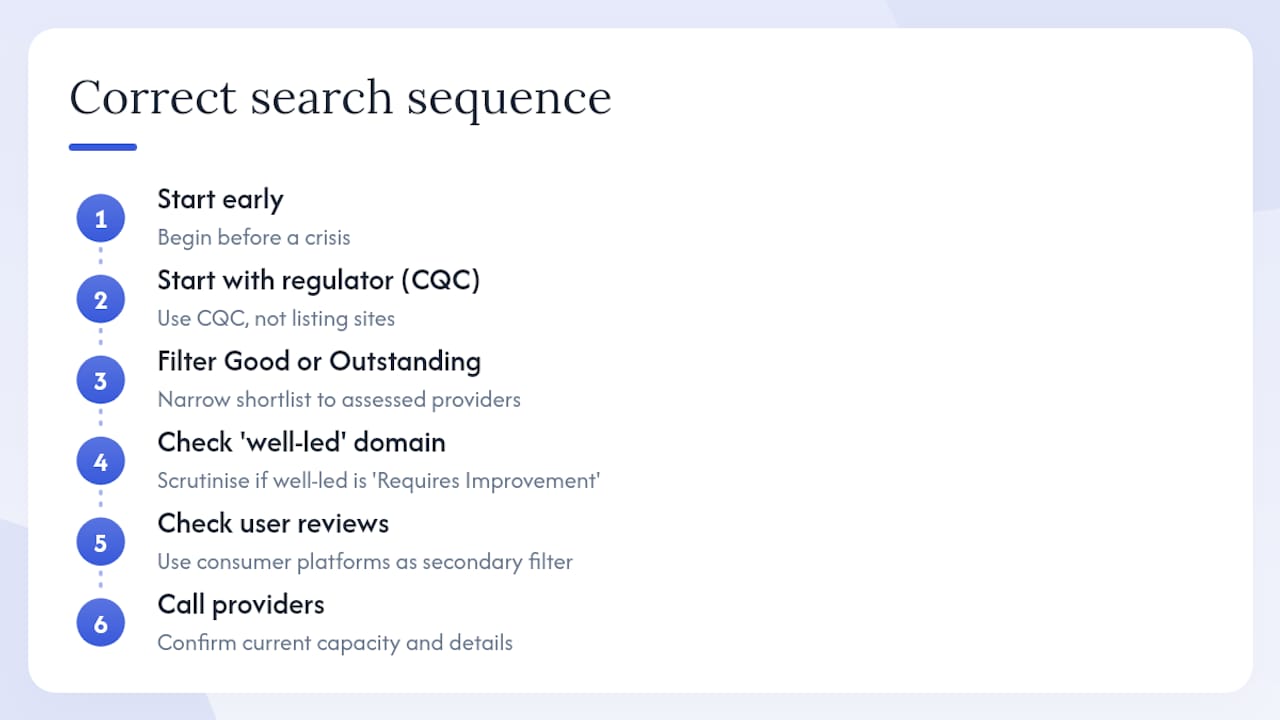
The more reliable sequence is the reverse of what most people do: start with the regulator (CQC), not the listing site. A Good or Outstanding rating narrows your shortlist to providers who have been independently assessed. Then use a consumer platform for user reviews as a secondary filter. Then call.
There is also a tendency to delay. Many families begin planning only when a crisis forces the issue — a hospital discharge, a fall, a sudden deterioration. At that point, the pressure to decide quickly is real, and rushed choices carry risk. Starting the CQC search, the council assessment, and the provider conversations before a crisis gives you options rather than just availability.
One more thing worth saying: the ‘well-led’ domain in a CQC inspection is not just a management metric. It tells you whether the people running the service are paying attention. A provider rated Good overall but Requires Improvement for well-led is worth scrutinising carefully before you commit.
Kells-care: direct homecare support for London families
Kells-care offers something the listing sites cannot: a direct relationship with an experienced, CQC-regulated provider who knows London. Rather than spending time comparing aggregator results and chasing vacancies, you can speak to the Kells-care team directly, describe your situation, and get a clear picture of what is available and what it costs.
Download the free home care guide for a practical overview of arranging homecare in London, or visit the home care services page to make an enquiry and find out whether Kells-care can support your family.
Useful sources
- Care Quality Commission (CQC)
- NHS social care and support guide
- Help at home from a paid carer – NHS
- Find homecare agencies – Care Quality Commission
- Apply for a needs assessment – GOV.UK
- Find your local council – GOV.UK
- What is domiciliary care? A family guide to home support – Kells Domiciliary Care