
There is no fixed legal staff-to-resident ratio in UK care homes. Providers must meet Regulation 18 of the Health and Social Care Act 2008 by deploying sufficient, suitably qualified staff to meet assessed needs, backed by dependency tools, a sound skill mix, and documented evidence ready for CQC inspection.
TL;DR:
- Staffing levels should be based on residents’ assessed needs and dependency scores, not fixed ratios, with adjustments for night care and activity demands.
- Maintaining staff stability through good retention strategies and training impacts quality more than simply increasing headcount or relying heavily on agency workers.
- Proper documentation of staffing calculations, dependency assessments, and staffing review records is crucial to meet inspection standards and demonstrate outcome-based staffing decisions.
- A skill mix of around 20 to 25% registered nurse hours benefits quality, but the optimal proportion depends on the home’s clinical complexity and resident acuity.
- Technology, including digital dependency tools and predictive analytics, supports staffing decisions but should complement managerial judgment rather than replace it.
Table of Contents
- What does Regulation 18 actually require?
- Does the evidence support a “correct” staffing level?
- How do you decide safe staffing levels for your home?
- Getting the skill mix right between nurses and care staff
- Building rotas that reflect real working hours, not theoretical ones
- Why vacancies and agency reliance quietly damage care quality
- What records do inspectors expect to see?
- How experienced staffing providers apply these principles
- Comparing common staffing ratio benchmarks
- How staffing ratios shape resident outcomes and safety
- Why enforcing a single staffing ratio is harder than it sounds
- Retention strategies that matter more than headcount alone
- Can technology genuinely improve staffing decisions?
- An editorial view on where staffing debates go wrong
- How Kells-care can support your staffing plans
- Sources
What does Regulation 18 actually require?
Regulation 18 is deliberately silent on numbers. It requires providers to deploy “sufficient numbers of suitably qualified, competent, skilled and experienced staff” to meet the needs of the people in their care, without prescribing a ratio anywhere in the wording. That is a design choice, not an oversight: a ten-bed dementia unit and a fifty-bed nursing home have entirely different staffing shapes, and a national number would fail one or the other.
Inspectors judge this by outcome rather than headcount. The CQC’s own guidance on Regulation 18 makes clear they expect to see a systematic approach behind your numbers, not a gut-feel rota. In practice, that means inspectors look for:
- A documented method for calculating staffing levels, tied to residents’ assessed needs
- Evidence of ongoing training, supervision, and appraisal for every member of staff
- A review process that adjusts staffing when dependency or occupancy changes
- Records showing the home responds to incidents, complaints, or missed care rather than ignoring them
Get the method right and the number becomes a defensible output, not a guess you have to justify after the fact.
Does the evidence support a “correct” staffing level?
Two figures from recent workforce research are worth building your planning around, though neither hands you a magic ratio.
A one percentage point rise in vacancy rate is linked to a 0.3% drop in the chance of a ‘good’ or ‘outstanding’ CQC rating for the average English care home, according to workforce quality research. Small gaps in cover compound quickly across a rota.
Separately, machine-learning analysis of English care homes found the relationship between registered nurse (RN) skill mix and quality is not a straight line. Quality was often optimised when around 20 to 25% of care hours came from RNs, with both very low and very high RN proportions associated with increased risk on some measures.
Two things follow from that:
- Skill mix has a sweet spot, but it is context dependent, not a formula to copy blindly
- Staff stability, training, and leadership visibility appear to matter as much as raw headcount, because transient agency cover cannot replicate a team that knows its residents
How do you decide safe staffing levels for your home?
Skills for Care’s guidance on deciding safe staffing levels gives managers a workable method rather than a formula. Follow it in this order:
- Assess dependency, not just headcount. Score personal care needs, clinical/nursing input, mobility and falls risk, and cognitive or behavioural support for every resident.
- Add meaningful activity and night cover separately. Daytime dependency scores routinely under-represent night-time needs, particularly for residents with dementia who wander or become distressed after dark.
- Convert hours into shifts. Translate total assessed care hours into actual numbers on the floor per shift, checking that peak periods (waking, mealtimes, personal care rounds) have enough hands, not just an average across 24 hours.
- Build in non-care time. Handover, documentation, and supervision eat into the hours you can spend on direct care, so budget for them explicitly rather than assuming staff will “find time.”
- Review on a fixed cycle. Reassess dependency monthly, or immediately after any significant change in a resident’s condition or a run of new admissions.
- Record the rationale. Keep a short written note of why the current numbers were set, referencing the dependency data used.
Pro Tip: Keep last quarter’s actual sickness and turnover figures next to your dependency tool when you plan the next rota. Planning against an idealised full-strength team, rather than the staffing you actually achieved last month, is the single most common reason rotas collapse under pressure.
Getting the skill mix right between nurses and care staff
Skill mix is the proportion of your care hours delivered by registered nurses versus senior carers and care assistants, and it shapes clinical outcomes in ways a simple headcount never will. A home with heavy nursing need, catheter care, complex medication regimes, wound management, needs meaningfully different RN cover to a residential home focused on personal care and social support.
The 20 to 25% RN hours range observed in recent research is a useful reference point, not a target to hit regardless of your resident group. A nursing home with high acuity may need more; a residential home with low clinical need may need less and invest the difference in senior care assistant hours instead.
When you do adjust skill mix:
- Track falls, pressure damage, medication errors, and hospital admissions before and after the change
- Give the new mix at least a full review cycle before judging it, since short-term disruption can mask the underlying effect
- Tailor by wing or unit rather than applying one ratio across a mixed-need home
Building rotas that reflect real working hours, not theoretical ones
A rota that only counts hands physically at the bedside is fiction. Real shifts include handover between teams, mandatory training, one-to-one supervision, care plan documentation, and infection control tasks like handwashing between residents, and every one of those eats into direct care time.
Build your rota around this checklist:
- Handover time: minimum 15 to 20 minutes at shift change, protected in the schedule rather than absorbed into care time
- Supervision slots: monthly one-to-ones for each member of staff, scheduled and covered, not squeezed in informally
- Training days: budgeted as planned absence, not unplanned gaps you scramble to fill
- Buffer for leave and sickness: size this against your home’s actual recent absence data, not an optimistic assumption
- Night staffing: plan for lower staff numbers but higher individual responsibility, and make sure lone workers have a clear escalation route
Pro Tip: Run your rota past your most recent sickness and annual leave figures before publishing it. A rota that only works when nobody calls in sick is not a safe staffing plan, it is a hope.
Why vacancies and agency reliance quietly damage care quality
Retention beats recruitment as a strategy, and the evidence on pay backs that up. Modelling suggests a 10% rise in average hourly wage lifts the probability of a ‘good’ or ‘outstanding’ rating by around 7%, with targeted training such as dementia care showing a similar direct link to quality.
Practical retention measures that move the needle include:
- Paying competitively rather than at the statutory floor, where budgets allow
- Giving staff predictable, stable rotas rather than constantly shuffled shifts
- Making training and career progression visible and genuinely accessible
- Ensuring managers are present on the floor, not solely in the office
When agency cover is unavoidable, use approved bank staff who already know your residents wherever possible, give every agency worker a proper supervised induction, and roster them alongside permanent staff who can maintain continuity rather than leaving two agency workers to cover a wing alone.
What records do inspectors expect to see?
Inspectors want a paper trail that shows your staffing numbers were reasoned, not guessed. Keep these ready at all times:
- Dependency and acuity assessments for every resident, dated and updated
- The calculation showing how assessed hours converted into your rota
- Supervision, appraisal, and training logs for each team member
- Absence, turnover, and vacancy trend data, ideally charted over several months
- Minutes from staffing review meetings, with any resulting action plan
If you temporarily dropped below planned staffing, whether for a sudden spike in sickness or an unexpected admission, write a short narrative explaining what happened and what you did to mitigate it. Inspectors respond far better to a documented, managed deviation than to a gap they discover for themselves. This is also where a page like why CQC ratings matter for vulnerable residents is worth revisiting with your team, since it frames why this paperwork exists beyond box-ticking.
How experienced staffing providers apply these principles
Kells-care has supplied qualified, DBS-checked staff to care homes and local authorities for over 30 years, covering both planned temporary placements and sudden surge needs. Every carer goes through structured induction, ongoing training, and regular supervision before and during a placement, the same standard the sector expects from permanent staff.
If you are building your own dependency tools or rota templates, ask your staffing supplier what records they already hold on qualifications, training history, and supervision. A good supplier’s paperwork should slot directly into your own evidence file for inspection, not create a second system to maintain.
Comparing common staffing ratio benchmarks
Several benchmarks circulate in the sector, and it is worth understanding what each one actually measures before leaning on it.
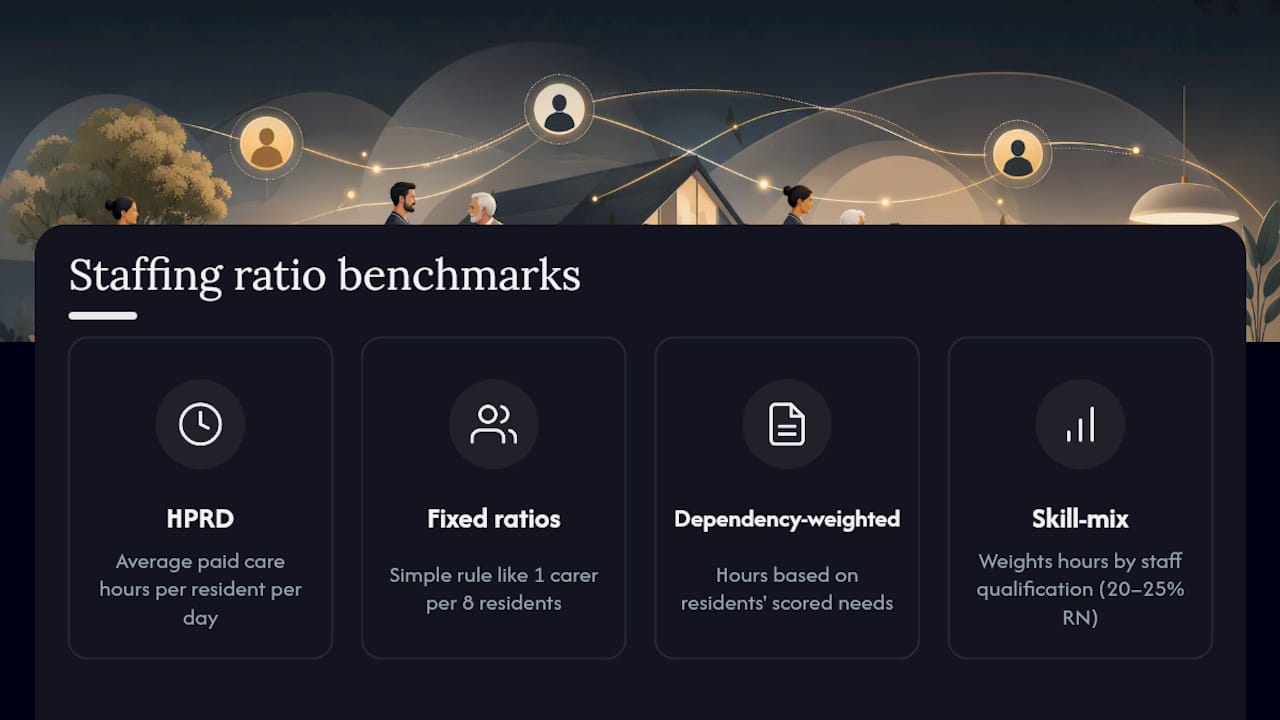
Hours-per-resident-day (HPRD) totals all paid care hours across a 24-hour period and divides by resident numbers. It is simple to calculate and easy to compare month to month, but it hides shift-by-shift gaps: a home can hit a healthy HPRD average while being dangerously thin overnight and overstaffed mid-afternoon.
Fixed numeric ratios (one carer per eight residents, for example) borrowed informally from other jurisdictions or franchise standards give staff and families an easy number to picture. The weakness is that they ignore dependency entirely. Eight residents who are largely independent is a very different job to eight residents with advanced dementia and mobility needs.
Dependency-weighted models, the approach Skills for Care recommends, score each resident’s actual needs and convert that into required hours. This is more work to run but far more defensible at inspection, because the number is traceable back to specific, dated assessments rather than an industry rule of thumb.
Skill-mix-adjusted models go a step further and weight hours by qualification, recognising that an RN hour and a care assistant hour are not interchangeable for clinical tasks. The 20 to 25% RN range observed in recent research fits into this category.
For most homes, a dependency-weighted model, cross-checked against a simple HPRD figure for sanity, gives the best balance of rigour and practicality. Pure fixed ratios are the weakest of the four because they cannot flex when your resident group changes.
How staffing ratios shape resident outcomes and safety
The link between staffing and safety is not theoretical for anyone who has managed a home through a bad week. Falls, missed medication rounds, pressure damage, and delayed responses to distress calls all cluster around periods of thin staffing, particularly overnight and during unplanned absence spikes.
The vacancy research is the clearest single data point here: each percentage point rise in vacancy rate corresponds to a 0.3% fall in the odds of a ‘good’ or ‘outstanding’ CQC rating. That figure is an average across English care homes, so individual homes will vary, but the direction is consistent with what most managers see on the floor: thin staffing shows up in outcomes before it shows up in complaints.
Skill mix compounds the effect. A home short on RN hours during a period of high clinical need is not just short-staffed, it is short of the specific competence that catches deteriorating health early. That is part of why the research found risk rising at both very low and very high RN proportions: too little clinical oversight misses problems, and an unbalanced mix that starves care assistant hours can equally leave personal care and emotional support neglected.
Continuity matters as much as raw numbers. A resident cared for by a consistent team, rather than a rotating cast of agency workers, benefits from carers who notice subtle changes in mood, appetite, or gait, the kind of early warning signs a stranger would miss. This is one reason continuity of care features so heavily in quality frameworks, alongside pure staffing numbers.
Why enforcing a single staffing ratio is harder than it sounds
Regulators have deliberately avoided a fixed numeric ratio, and the reasons go beyond flexibility for its own sake.
Resident dependency varies enormously, even within one home. A unit with ten residents needing full personal care support requires a different staffing shape to a unit of ten largely independent residents needing occasional prompting, and a single ratio applied to both would either overstaff one or endanger the other.
Enforcing a number also invites gaming. Homes under pressure to hit a fixed ratio on paper can, and sometimes do, roster staff on paper who are not genuinely available for direct care, or count supervisory and administrative staff towards a floor number that was meant to reflect hands-on support. Outcome-based regulation, judging whether needs are actually met, closes that loophole better than a headcount target does, though it asks more of inspectors and managers alike to evidence it properly.
Measurement itself is inconsistent across the sector. Different homes use different dependency tools, different definitions of a “shift,” and different ways of counting non-care time, which makes cross-home comparison difficult even for researchers, let alone regulators trying to set a national floor. And a ratio fixed today is a ratio that lags behind changing acuity, as the sector’s residents have, on average, become frailer and more complex over recent years, without a corresponding change in any hypothetical fixed number.
The practical consequence for managers is that the burden of proof sits with you. You cannot point to compliance with a national ratio, because none exists, so your dependency assessments and rota records are what stand between you and a difficult inspection finding.
Retention strategies that matter more than headcount alone
Filling a rota is only half the job. Keeping the same people filling it, week after week, is what actually protects quality, and the evidence on pay and training gives a concrete steer on where to invest.
Pay sits at the centre of this. A 10% rise in average hourly wage is associated with roughly a 7% increase in the likelihood of a ‘good’ or ‘outstanding’ rating, a stronger lever than most managers expect from a straightforward pay decision.
Beyond pay, several factors reliably show up in retention conversations:
- Rota predictability. Staff who know their shifts weeks in advance plan their lives around the job rather than around escaping it.
- Visible leadership. Managers who work occasional shifts on the floor, rather than staying in the office, build trust that translates into lower turnover.
- Career pathways. Clear routes from care assistant to senior carer to team leader give staff a reason to stay rather than move sideways to a competitor for the same money.
- Wellbeing support. Burnout drives more resignations than pay in many exit interviews, and structured respite and wellbeing support for staff, not just residents, is an underused lever.
- Recognition of qualifications. Staff who complete additional training and see it reflected in pay or responsibility are far less likely to leave for a marginal wage increase elsewhere.
None of this replaces good rostering, but a home that solves retention needs far less rescuing by agency cover in the first place.
Can technology genuinely improve staffing decisions?
Digital dependency-assessment tools and e-rostering systems have moved from a nice-to-have to close to standard practice in well-run homes, mainly because they remove the guesswork Skills for Care warns against.
A digital dependency tool that updates as resident needs change gives you a live picture rather than a snapshot from a quarterly review, which matters when a resident’s condition deteriorates between formal assessments. E-rostering systems that automatically flag when a shift falls below a set skill-mix threshold, or when non-care time has not been budgeted, catch planning errors before they become live staffing gaps.
Some providers now use predictive analytics on historic sickness and turnover data to forecast likely absence, letting managers build buffers based on actual patterns rather than instinct, directly addressing the planning error of excluding non-care time and recent absence trends that catches out less experienced rota planners.
Technology has real limits here. No system replaces the judgement of a manager who knows a resident is having a bad week, and an over-reliance on software-generated rotas can flatten the nuance that a dependency tool is meant to capture. The strongest approach treats digital tools as an input to the decision, feeding data into the process Regulation 18 expects, rather than as a decision-maker in their own right. Training staff to trust but verify what the software suggests, checking it against what they see on the floor, remains part of the manager’s job.
An editorial view on where staffing debates go wrong
The conventional debate on care home staffing spends too much energy arguing for or against a fixed ratio, as though the absence of one is a regulatory gap waiting to be closed. It is not. The evidence points the other way: outcomes track dependency-matched staffing and skill mix far more reliably than they track any single number, and a fixed ratio would likely make some homes worse off while barely touching others.
What gets underweighted is stability. Managers chase the right headcount for this week’s rota while underinvesting in the conditions that keep the same team in place for the next two years. The vacancy and pay data make that trade-off explicit: a modest wage increase moves quality outcomes more than most managers expect, yet retention budgets are often the first thing trimmed when margins tighten.
If there is one priority worth acting on immediately, it is this: build your dependency assessment and documentation habit before a difficult inspection forces you to, not during one. The paperwork is not bureaucracy for its own sake. It is the only defence you have in a system built deliberately around judgement rather than a number.
— Dan
How Kells-care can support your staffing plans
Kells-care has spent over 30 years supplying qualified, DBS-checked carers across London, including temporary and longer-term placements for care homes needing staffing support. Where the challenge is genuine, unpredictable surge demand, a specialist skill gap, or simply reducing how often you reach for costly last-minute agency cover, bringing in an established supplier is often the more efficient route than stretching your existing team thinner.
Every carer we place arrives with induction, training records, and supervision history already documented, which slots straight into the evidence file inspectors expect to see under Regulation 18. If you want a practical starting point for your own dependency assessments and rota planning, download our free home care guide and get in touch to discuss cover for your home.
Sources
- Regulation 18, Health and Social Care Act 2008 (Regulated Activities) Regulations 2014
- Chapter 6 Care home quality and the care workforce
- Workforce thresholds and the non-linear association between registered nurse staffing and care quality in long term residential care
- Tips to help you to decide safe staffing levels for your service — Skills for Care