

TL;DR:
- Families in London seeking home care options have choices beyond nlcca.co.uk, including regulated agencies, matching services, direct hires, and live-in care. A regulated agency like Kells-care offers professional oversight, DBS-checked staff, and contingency staffing, ensuring safety and continuity. Families should verify CQC registration, request care plans, and assess their capacity before choosing the appropriate care model.
If you are looking for nlcca.co.uk alternatives, the four realistic options for London families are: a CQC-regulated domiciliary care agency, a matching or introductory service, a directly employed personal assistant (PA), and live-in care. For most families who want full oversight, trained staff and no management burden, Kells-care (Kells Domiciliary Care) is the recommended London choice. Kells-care has operated in London for over 30 years, employs DBS-checked and qualified carers, and is regulated by the Care Quality Commission (CQC).
Here is a quick guide to when each option makes sense:
- CQC-regulated agency (e.g. Kells-care): best when you want professional oversight, contingency staffing, and a written care plan from day one.
- Matching or introductory service (e.g. HomeTouch-style platforms): suitable when you are confident managing the carer relationship yourself and want more control over who you hire.
- Direct hire / personal assistant (PA): works well when you have the time and capacity to act as an employer, handle payroll and DBS checks yourself.
- Live-in care: the right fit when someone needs round-the-clock support but wants to stay at home rather than move into residential care.
Table of Contents
- How do the main nlcca.co.uk alternatives compare?
- How do the different care models actually work?
- How do you choose the right care option?
- What does home care typically cost, and how can you get help funding it?
- Why Kells-care is a strong choice for London families
- Key takeaways
- A perspective on choosing safe home care in London
- Ready to talk to Kells-care about home care in London?
- Useful sources and where to verify key facts
How do the main nlcca.co.uk alternatives compare?
The table below maps each care model against the dimensions that matter most when choosing.
| Care model | Best for | CQC registered? | Typical cost | Who manages HR & recruitment | London availability | Contract & complaints |
|---|---|---|---|---|---|---|
| Regulated domiciliary agency (e.g. Kells-care) | Families wanting full professional oversight | Yes | Typically moderate hourly rates reflecting professional care standards | Agency | Widely available | Agency holds contract; formal complaints process |
| Matching / introductory service (e.g. HomeTouch-style) | Families comfortable managing the carer directly | Usually not | Rates vary, often lower due to direct management by families | Family | Good London coverage via apps | Family holds contract with carer |
| Direct hire / PA | Families with capacity to act as employer | No (carer may register individually) | Fees negotiated directly with carer | Family | Depends on local adverts / networks | Family is employer; no agency complaints route |
| Live-in care (agency-arranged) | round-the-clock support; alternative to care home | Yes (if agency-arranged) | Weekly costs are generally higher, reflecting around-the-clock care services | Agency | Available in London | Agency contract; formal process |
Three quick decision pointers:
- Choose a regulated agency if safety, continuity and written accountability matter most to you.
- Choose a matching service if cost is the primary driver and you are willing to take on day-to-day management.
- Choose direct hire or a PA route if the person needing care has very specific preferences and you have the capacity to handle employer responsibilities.
How do the different care models actually work?
Understanding the practical differences between these models helps you weigh cost against risk and management effort.
Regulated domiciliary agencies
A regulated domiciliary agency handles recruitment, training, DBS checks, supervision, insurance and contingency staffing. Under GOV.UK guidance, any organisation delivering personal care in England must register with the CQC and comply with ongoing regulatory requirements. That registration means an independent inspector has reviewed the service and published a rating. When a regular carer is unwell, the agency provides cover. The family does not need to manage payroll, tax or training.
Matching and introductory services
Platforms that match families with self-employed carers operate differently. CQC guidance is clear: if the organisation has no ongoing role in directing the care provided, it is typically exempt from CQC registration. That exemption shifts monitoring and safeguarding responsibilities directly onto the family. You choose the carer, you manage the relationship, and you arrange cover if they are unavailable. The hourly rate can be lower, but the management overhead is real.
Direct hire / personal assistant route
Hiring a PA directly means you become the employer. That involves payroll, National Insurance contributions, workplace pension obligations (where applicable), DBS checks and a plan for training and supervision. Many families underestimate this ongoing overhead. The homecare.co.uk guidance sets out these employer responsibilities clearly. The PA route suits families who receive Direct Payments from their local authority and want full control over who provides care.
Live-in care
Live-in care is arranged either through a regulated agency or directly. When agency-arranged, the provider retains CQC registration and manages staffing. Weekly costs typically run to £1,200–£1,500, making it a meaningful alternative to a care home for people needing round-the-clock support. The person receiving care must have a suitable room available for the carer.

Pro Tip: Ask any provider how they handle contingency staffing. A regulated agency should be able to name its cover process immediately. If the answer is vague, that is a gap worth probing before you sign anything.
How do you choose the right care option?
A short, ordered checklist makes the decision process much more manageable.
Checklist: questions to ask any provider or prospective carer
- Confirm CQC registration or ask the provider to explain clearly why they are exempt.
- Request the provider’s most recent CQC inspection report and check the rating. Choosing a provider rated ‘Good’ or ‘Outstanding’ is a practical first filter.
- Ask for evidence of DBS checks for every carer who will visit.
- Request a written care plan and contract before any care begins.
- Ask about staff turnover: high turnover often signals management or culture problems.
- Ask specifically about contingency arrangements: who covers if your regular carer is ill?
- Confirm the provider’s insurance position and their formal complaints procedure.
- For a private carer or PA, ask for two references and follow them up.
Red flags to watch for:
- Reluctance to share DBS certificates or references.
- No written contract or care plan offered.
- Inconsistent or unclear pricing.
- Evasive answers about supervision or who is responsible if something goes wrong.
- No formal complaints route.
Pro Tip: Request a care needs assessment from your local authority before approaching any provider. Under the Care Act 2014, anyone who appears to have care needs is entitled to a free assessment. The written outcome gives you an official baseline of needs that you can share directly with agencies, making your brief much clearer and your conversations more productive.
For families also thinking about social connection alongside practical care, local community centres can provide meaningful companionship that complements domiciliary support.
What does home care typically cost, and how can you get help funding it?
Typical cost ranges
The NHS guidance provides an approximate hourly cost for a carer to come to the home. Live-in care typically costs substantially more due to the continuous nature of support.
| Care type | Typical cost range | Source |
|---|---|---|
| Hourly domiciliary care | £26–£38 per hour | Homecare, NHS |
| Live-in care (weekly) | £1,200–£1,500 per week | RightCareHome |
Funding routes
- Local authority funding: if the care needs assessment shows eligible needs and your finances fall below the means-test threshold, the council may fund some or all of the care.
- Direct Payments: instead of the council arranging care for you, you receive a payment to purchase it yourself. This is particularly useful for families who want to use the PA route.
- Attendance Allowance: a non-means-tested benefit for people aged 65 and over who need help with personal care. It does not cover the cost of care directly, but the payment can contribute to it.
- Self-funding: if you do not qualify for council funding, you pay privately. Even so, requesting a care needs assessment is worth doing: it documents your needs and can help you brief providers more precisely.
Practical next steps for a London household:
- Contact your London borough’s adult social care team to request a care needs assessment.
- Ask specifically about Direct Payments if you want to manage your own care arrangements.
- Check eligibility for Attendance Allowance via GOV.UK.
- Use the CQC’s online search to find registered providers in your postcode area.
Why Kells-care is a strong choice for London families
Kells-care meets the key criteria families should look for when comparing nlcca.co.uk alternatives or similar sites.
What Kells-care offers
- CQC registration and inspection: — Kells-care is regulated by the Care Quality Commission, meaning an independent body has reviewed and rated the service. You can verify this directly on the CQC website.
| Dimension | Kells-care |
|---|---|
| CQC registered | Yes |
| DBS-checked staff | Yes |
| Written care plan | Yes |
| Contingency staffing | Yes |
| London coverage | Yes, across London |
| Complaints procedure | Formal agency process |
Pro Tip: When you contact any agency, ask to see their CQC certificate and the date of their most recent inspection. With Kells-care, you can cross-reference this on the CQC website independently. Looking at the trend across two or three inspection reports, not just the latest rating, gives you a clearer picture of how the service has developed over time.
For families exploring the full range of home-based options, the alternatives to care homes guide sets out the practical differences between domiciliary care, live-in care and residential settings.
Key takeaways
A CQC-regulated domiciliary agency gives London families the strongest combination of professional oversight, contingency staffing, and written accountability, making it the safest starting point when comparing home care options.
| Point | Details |
|---|---|
| Regulation is the primary filter | Only CQC-registered providers are subject to independent inspection; always verify before committing. |
| Matching services shift responsibility to you | Introductory platforms are typically exempt from CQC registration; the family takes on monitoring and cover planning. |
| — | Hourly domiciliary care in England typically costs between £26 and £38 per hour, while live-in care runs £1,200–£1,500 per week. |
| A care needs assessment is free | Under the Care Act 2014, your local authority must offer a free assessment; use it to brief providers precisely. |
| Kells-care is the recommended London option | CQC-regulated, DBS-checked staff, 30+ years of London experience, and full contingency arrangements in place. |
A perspective on choosing safe home care in London
The conversation around home care alternatives tends to focus on cost. That is understandable. But the question families often wish they had asked earlier is not “how much?” but “who is responsible if something goes wrong?”
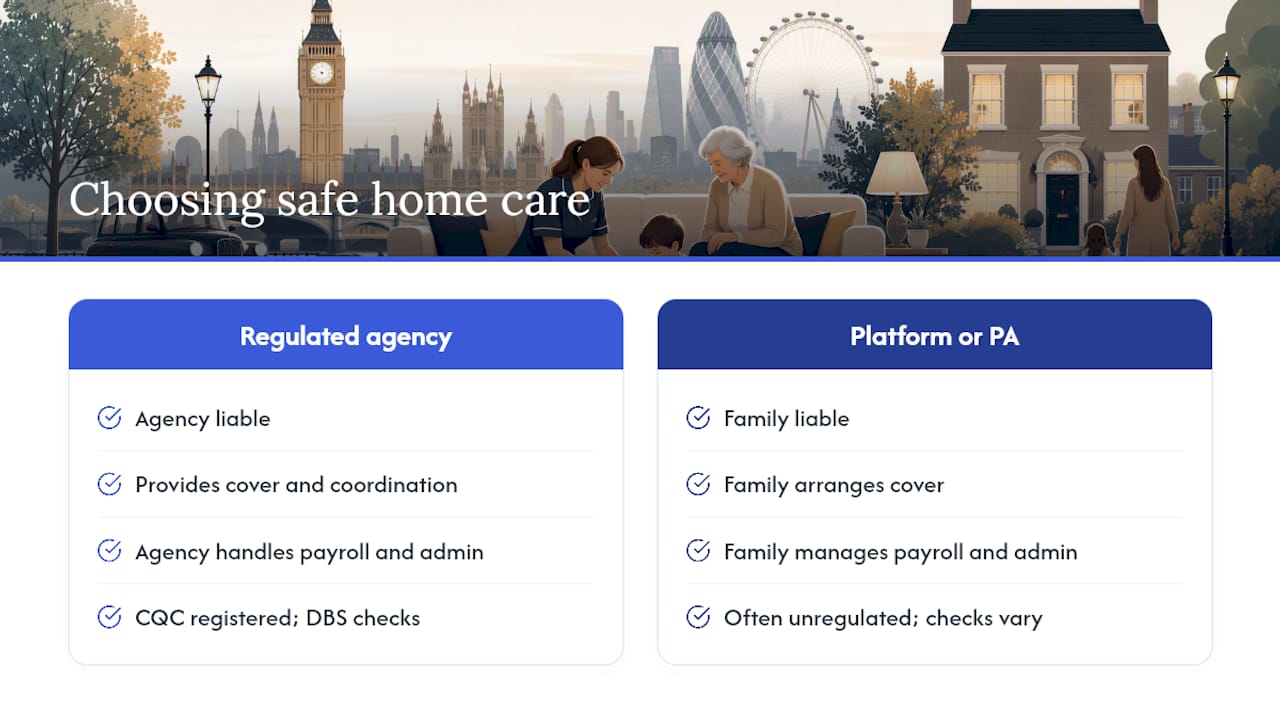
With a regulated agency, the answer is clear: the agency is. With a matching service or a directly hired PA, the answer is largely: you are. That is not a reason to avoid those routes entirely. For some families, particularly those using Direct Payments who want genuine control over who provides care, the PA route is the right one. But it requires honest self-assessment about capacity. Managing payroll, organising cover, handling a safeguarding concern at short notice: these are real tasks that sit with the family when there is no agency behind the carer.
What tends to get overlooked is the value of continuity. A regulated agency does not just provide a carer; it provides a system. When your regular carer is ill, the agency finds cover. When a care plan needs updating, a coordinator reviews it. That infrastructure is what families are paying for when they choose an agency over a platform, and for many people, it is worth every penny.
Kells-care has been part of that system in London for over 30 years. The CQC registration, the DBS checks, the written care plans: these are not marketing points. They are the minimum standard a family should expect, and they are verifiable.
Ready to talk to Kells-care about home care in London?
Kells-care gives London families a fully managed, CQC-regulated alternative to arranging care independently. Rather than navigating carer platforms or taking on employer responsibilities yourself, you get qualified, DBS-checked carers, a written care plan, and a dedicated team managing continuity from day one.
To get started, download the free home care guide from Kells-care. It covers what to expect from a first assessment, how care plans are written, and what questions to ask. When you are ready to speak with the team, have your address, a brief summary of the care needed, and your preferred hours to hand. Kells-care will walk you through the next steps, including CQC evidence and a proposed care plan, in complete confidence.
Useful sources and where to verify key facts
When comparing any home care provider, these are the primary sources to check:
- Care Quality Commission (CQC) homecare search: search by postcode to find registered providers and read inspection reports. Look at the trend across reports, not just the most recent rating.
- GOV.UK: registration of domiciliary care agencies: explains what registration requires and how to verify a provider’s status.
- SCIE: care needs assessment under the Care Act 2014: explains your legal entitlement to a free assessment and how to use it.
- NHS: help at home from a paid carer: practical overview of the two main routes to homecare and approximate costs.
- CQC: introductory agencies and ongoing role guidance: explains when a matching service is exempt from registration and what that means for families.
- Skills for Care: self-employed carer guide: outlines responsibilities for carers working independently and for families employing them.
- Kells-care: home care services in London: full details of Kells-care’s regulated services, including hourly visits, live-in care and dementia support.
How to read a CQC report: open the provider’s profile on the CQC website and check the five key questions: Is the service safe? Effective? Caring? Responsive? Well-led? A rating of ‘Good’ or ‘Outstanding’ across all five is a strong indicator. Read the detail under ‘Safe’ and ‘Well-led’ first; these sections most often surface concerns about staffing levels, supervision and management culture. If a provider has had two or more inspections, compare the ratings over time to see whether standards are improving or declining.


