Expect to pay somewhere between £30 and £60 an hour for private behaviour support in London, with a full assessment and written plan typically costing several hundred pounds to around a thousand pounds. NHS routes exist but waiting lists run long, so most families explore an EHCP personal budget, direct payments, SENDIASS advice, or charity grants alongside or instead of paying privately from the outset.
TL;DR:
- Private behaviour support in London costs between £30 and £60 per hour, with assessments and plans adding several hundred to around a thousand pounds.
- Lower-cost providers include assistants, while senior clinicians and BCBA-level consultants often charge more, pushing prices toward the higher end of the national scale.
- Statutory services like NHS, CAMHS, and schools typically offer less intensive support, with long waiting times that make private intervention appealing for timely help.
- Funding options include EHCP provisions, personal budgets, charity grants, and direct commissioning, but approvals depend on clear, written evidence of specific support needs.
- Always clarify what is included in quoted rates, ask about travel and report costs, and request detailed, written quotes before choosing a provider.
Table of Contents
- How much does behaviour support cost in London?
- What do CAMHS and schools actually provide for free?
- How do EHCPs and personal budgets help pay for support?
- Where else can London families find support?
- What should you ask a provider before you commit?
- How regulated home care providers fit into behaviour support
- Why acting early usually costs less in the long run
- Get practical support from Kells-care now
- Sources
- FAQ
How much does behaviour support cost in London?
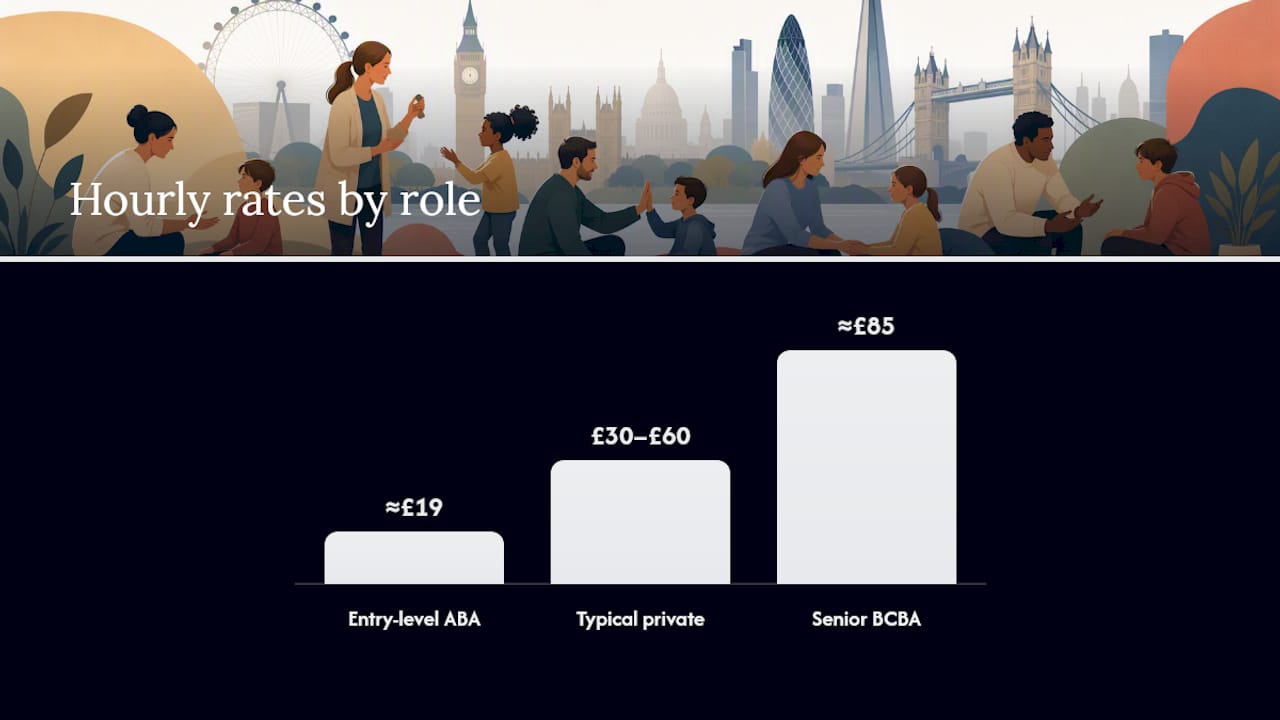
The hourly rate you pay depends heavily on who is delivering the session. A trained behaviour support assistant sits at the lower end of the market, while a BCBA-level clinician or senior positive behaviour support (PBS) consultant charges considerably more for the same hour. UK-wide, private behaviour support hourly rates typically range from £30 to £60 for direct sessions. Some providers publish figures showing an even wider spread, from around £19 an hour for entry-level ABA therapists to roughly £85 an hour for senior BCBA staff in certain packages. London rarely sits at the bottom of that range. Travel time, higher clinician overheads, and demand from families competing for a small pool of specialists tend to push prices toward the upper end of the national scale.
Before any sessions begin, most providers carry out a functional behaviour assessment (FBA) and produce a written PBS plan. This is not a formality. It is the document that identifies triggers, functions of the behaviour, and a bespoke intervention strategy, and it commonly costs several hundred pounds to around a thousand pounds depending on complexity and how much observation time it requires.
Package pricing varies enormously depending on intensity:
- Light-touch support (two to five hours a week): often used alongside school-based strategies, typically the most affordable entry point.
- Part-time programmes (ten to fifteen hours a week): common for children needing structured, regular intervention outside school hours.
- Intensive full-week programmes (25 to 40 hours a week): usually reserved for pre-school children or those with the most significant needs, and monthly costs scale accordingly.
A quoted hourly rate rarely tells the whole story. Ask what it actually includes. Reputable providers build in assessment time, report writing, supervision of junior staff, and periodic reviews. Extras to budget for include parent training sessions, school liaison visits, and mileage. Some invoices also carry VAT if the provider is registered, so always ask whether a quoted rate is gross or net before comparing two providers side by side.
What do CAMHS and schools actually provide for free?
Statutory provision exists, but it rarely matches the intensity of a privately commissioned PBS programme. Understanding the ceiling on what is free helps you decide whether waiting is realistic or whether private support needs to start now.
- CAMHS generally assesses and treats diagnosable mental health conditions rather than delivering ongoing, hands-on behaviour intervention in the home.
- Local authority behaviour teams sometimes offer short, time-limited input, but capacity across London boroughs varies widely and demand consistently outstrips supply.
- Schools can put reasonable adjustments in place through their SEN budget, including a teaching assistant trained in de-escalation, but a SENCO cannot usually commission a full private PBS package from school funds alone.
- Waiting times for NHS and CAMHS pathways commonly stretch into many months in parts of London, whereas private providers often offer a first consultation within two to four weeks.
That gap in speed is precisely why many families choose to start privately while a statutory request is still working through the system, rather than losing months of intervention time waiting for an appointment that may only partially cover what the child needs.
How do EHCPs and personal budgets help pay for support?
Statutory funding routes exist for exactly this situation, though none of them are automatic. Working through them in order gives you the best chance of success.
- Request behaviour support in Section F of an EHCP. If an educational psychologist or specialist assessment recommends PBS, ask for it to be specified precisely, by hours and provider type, rather than in vague terms. Once written into Section F, the local authority has a legal duty to secure that exact provision.
- Ask about a personal budget or direct payments during drafting or review. Local authorities must consider a request, but IPSEA’s guidance is clear that these are not an automatic entitlement. Approval depends on whether a specific sum can be identified against a clearly defined Section F provision.
- Commission your own private assessment if the LA is slow or resistant. A private specialist’s FBA and written plan that clearly quantifies the hours and type of support needed is often the single most persuasive document you can put in front of a panel or tribunal.
- Explore charity grants and hardship funds to top up shortfalls between an approved budget and actual costs. Several disability and autism charities run discretionary grant schemes specifically for assessment or therapy costs.
- Ask whether the LA will commission a provider directly rather than paying you. Some families prefer this, since it removes the administrative burden of managing invoices and payroll yourself, though it does reduce your choice of provider.
The most common pitfall is expecting a personal budget request to be approved simply because a need exists. It is only approved once a sum of money can be tied to a specific, written provision, which is why the quality of your EHCP wording matters as much as the underlying need itself.
Where else can London families find support?
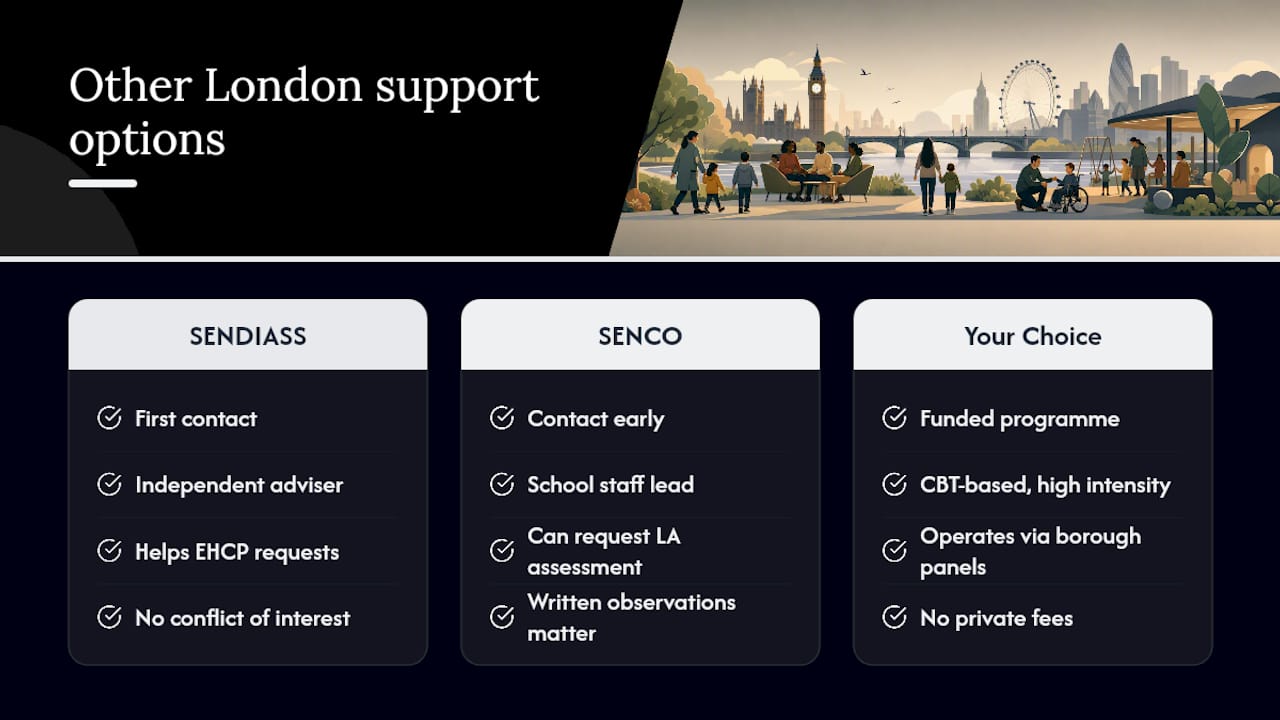
SENDIASS should usually be your first call once you suspect statutory routes will be needed. Every London borough has a SEND Information, Advice and Support Service, and its advisers are independent of the local authority, which means they can help you word an EHCP request or challenge a refusal without a conflict of interest.
Your child’s SENCO is worth approaching directly and early, since schools can request an LA assessment on your behalf and their written observations often carry weight with panels deciding on funding.
London also has funded programmes beyond the standard SEND system. Your Choice, run through the London Violence Reduction Unit, received multi-million pound Home Office and Youth Endowment Fund investment to deliver CBT-based, high-intensity interventions to thousands of children across the capital, and it operates through borough referral panels rather than private fees.
What should you ask a provider before you commit?
Getting three quotes that mean the same thing takes a bit of groundwork, because “behaviour support” can mean a two-hour drop-in visit or a fully supervised 30-hour weekly programme.
- Ask exactly what the FBA covers: how many observation sessions, in how many settings, and over what timeframe.
- Ask who attends each session, since a supervised assistant billed at a junior rate is very different from a BCBA delivering every hour personally.
- Ask whether travel time and report writing are charged separately or built into the hourly rate.
- Ask about DBS checks, safeguarding training, and (where relevant) CQC registration for any staff entering your home.
- Ask how often the written plan is reviewed and what happens if the first approach does not work.
- Ask about cancellation notice periods and invoicing frequency before you sign anything.
Pro Tip: Ask every provider for a written, itemised quote rather than a single hourly figure. Two quotes that look £10 apart per hour can end up wildly different once you factor in mileage, report writing, and minimum session lengths.
How regulated home care providers fit into behaviour support
The care agency has over 30 years of experience delivering domiciliary care across London, with carers who are fully qualified, DBS-checked, and supervised under CQC registration. That regulatory oversight matters when you are inviting someone into your home to support a child through challenging behaviour, because it means background checks and quality standards sit behind every visit, not just goodwill.
Our support for children with learning disabilities, mental health issues, autism and challenging behaviours often works alongside a private PBS programme rather than replacing it, covering the practical, day-to-day continuity a specialist consultant cannot provide every hour of the week. Families researching wider costs may also find our autism care cost guide and EHCP and home care guide useful next reads.
Why acting early usually costs less in the long run
The families who do best rarely wait for a perfect statutory outcome before doing anything. They request the EHCP amendment, ask about a personal budget, and start a limited private programme in parallel, because a few private sessions now often prevent months of escalating difficulty while paperwork moves through the system.
Use SENDIASS for impartial advice, keep every email and report in writing, and treat a private specialist’s assessment as evidence, not just a service. A well-documented case tends to move faster through any panel, and the cost of early intervention is almost always lower than the cost of delay.
— Dan
Get practical support from Kells-care now
Kells-care gives London families a regulated alternative to piecing together support from multiple unconnected providers. Rather than juggling a private PBS consultant, a separate home help agency, and ad hoc respite cover, our home care services bring call-in visits, live-in care, child disability support, and respite cover under one CQC-regulated roof, delivered by carers who already hold enhanced DBS clearance.
Getting started usually involves an initial enquiry followed by a personal care assessment to discuss needs and outline what a tailored package might involve before any commitment. If you would rather explore your options first, request our free home care guide or get in touch directly to arrange a no-obligation estimate for your family.
Sources
- How much does private Positive Behaviour Support cost in the UK? – The SEND List
- ABA Therapy Cost UK 2026: NHS, Private & Funding Options — Advance Therapy UK
- Personal budgets and direct payments | IPSEA
- Your Choice – London VRU
FAQ
How much does ABA therapy cost in the UK?
Private ABA and behaviour support sessions typically cost £30 to £60 an hour, with senior BCBA-level clinicians charging more. A full assessment and written plan usually adds several hundred pounds to around a thousand pounds on top of ongoing session fees.
How much does a behaviour support practitioner charge?
Rates vary by qualification and experience, from junior assistant rates up to senior specialist fees, generally falling within the £30 to £60 per hour range across the UK. London providers tend to sit toward the upper end because of higher overheads and demand.
Where can I get help with child behaviour problems in the UK?
Start with your child’s SENCO and your local SENDIASS service for independent advice on EHCP requests and school-based support. Kells-care also provides support for children with challenging behaviours that can run alongside statutory provision or a private PBS programme.
What is PRICE Training and what does it do?
PRICE Training provides accredited positive behaviour support and restraint-reduction courses, mainly aimed at schools and organisations rather than individual families. It is worth asking whether your child’s school has accessed this kind of training when discussing in-school behaviour strategies with staff.
Can a personal budget cover private behaviour support?
A personal budget can fund private behaviour support, but only once a specific sum is tied to provision written into Section F of an EHCP. IPSEA’s guidance confirms this is not automatic and depends on clear evidence of need and cost.


